Section-level gap matrix
What the current page answers, what relevant competitors cover and which buyer questions remain unresolved.
One existing page.
A better answer. A reviewable update.
An AI on-page SEO workflow for marketers and site owners. From research and content gaps to a page prototype in your design. Inspect the result
The SEO Audit page on this site is a real example of the deliverable. These are retained captures from its October 2026 update, not mock software screens or evidence of a ranking increase.
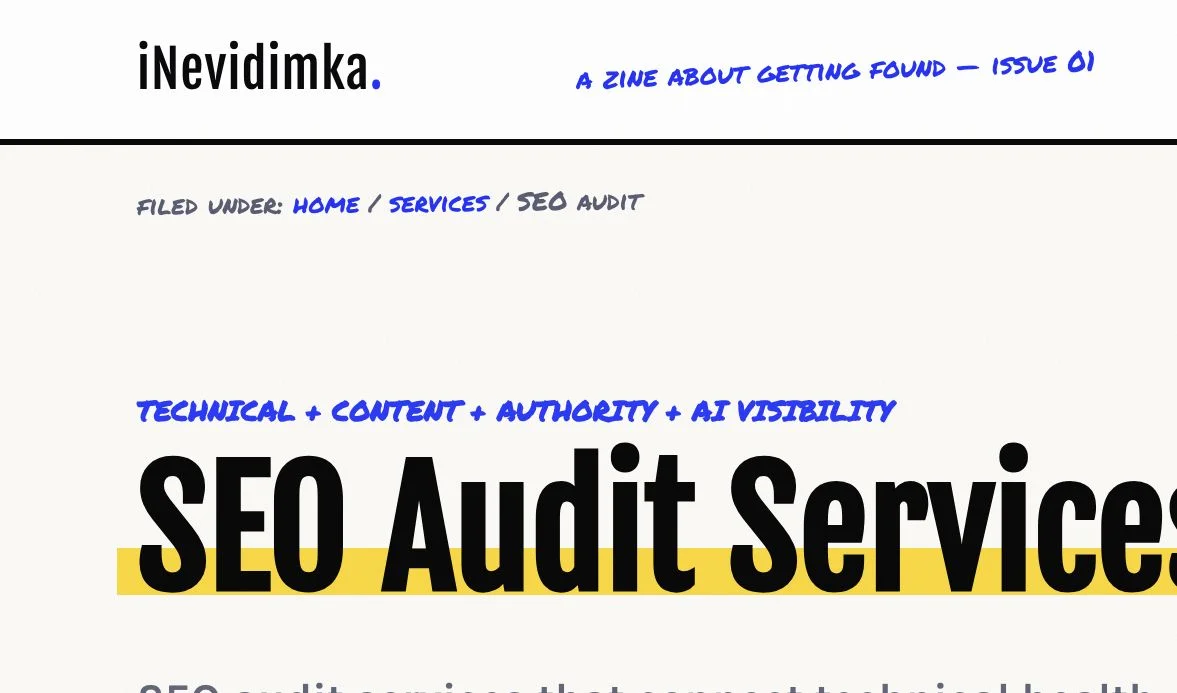
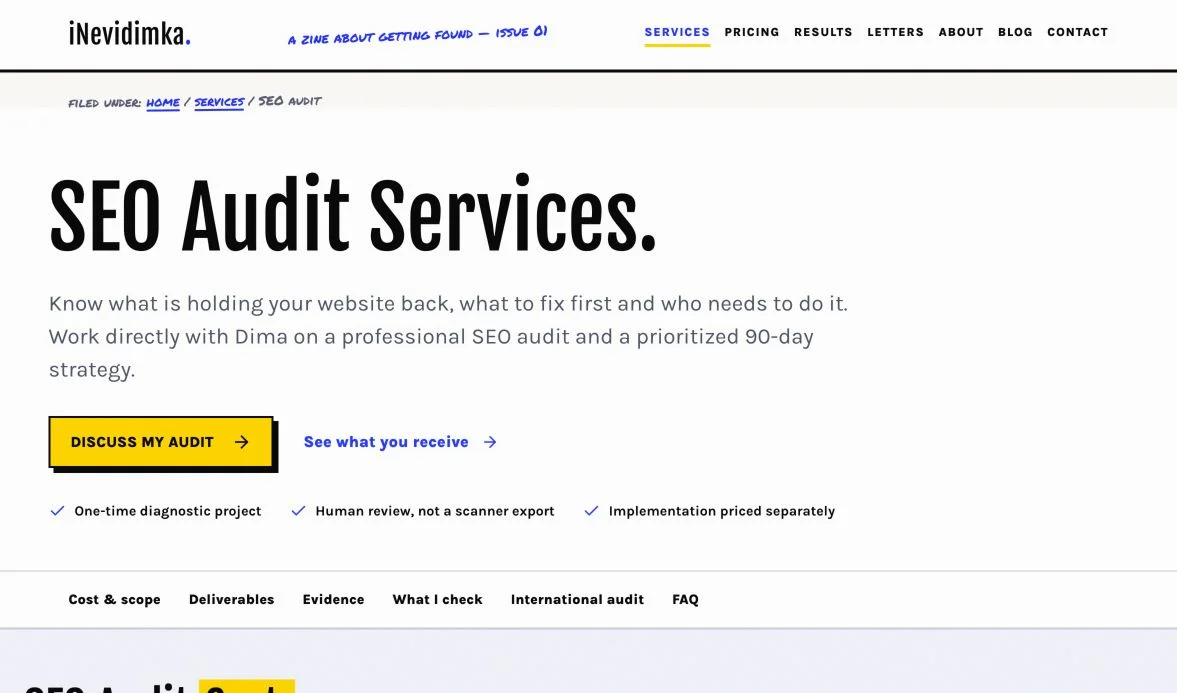
A clearer offer, visible deliverables and explicit scope. The existing brand stayed recognizable while the information became easier to evaluate.
AI on-page SEO uses artificial intelligence to help analyze and improve a page’s content, headings, metadata, internal links and structure. The SEO goal is the same: help a visitor resolve the task behind a search. AI supports the work; it does not replace the source evidence or the decision to publish.
These Skills turn that idea into a repeatable workflow. Use AI to compare competing sections, organize an audit and draft supported revisions. Use SEO data to check the target query and page context. Then review the actual content for accuracy and the rendered page for usability. AI-generated content still needs original value and human judgment.
A useful page update connects evidence to decisions. The output explains what to change, why it matters and what the next person needs to implement it.
What the current page answers, what relevant competitors cover and which buyer questions remain unresolved.
A purpose for each section, supported facts and relevant concepts mapped to the revised copy.
The proposed content in your visual system, with links, responsive behavior and a clear next action.
What changed, what was preserved, what passed testing and what still needs approval.
The handoff format depends on the project: a reviewable HTML version, source changes or a CMS draft where an authorized editing environment is available. None is automatically a public release.
A retrospective summary of the SEO Audit update, not its original issue log. The table connects each action to evidence and status; reconstructed buyer rationale is labelled. It is not a universal checklist of additions.
| Area | Observation / rationale | Action taken | Evidence | Status |
|---|---|---|---|---|
| Hero and offer | Oversized headline dominated the retained first-viewport capture. | Reorganized the hero around a readable headline, specific outcome and discussion action. | Retained before/after captures shown above. | Published Oct 26, 2026; release approval recorded. |
| Deliverables | A buyer needs to understand the handover. | Presented the findings register, page/intent map, action plan and walkthrough separately. | Deliverables section on the linked live SEO Audit page. | Published; rationale reconstructed here for explanation. |
| Buyer decisions | A buyer needs clear scope and implementation boundaries. | Made cost/scope, focused versus full audit options and implementation exclusions visible. | Cost/scope and audit-option sections on the live example. | Published; rationale reconstructed here for explanation. |
| Evidence and QA | A rewritten draft alone would not establish a completed page. | Captured the published page and recorded protected-form checks and release status. | Retained October 26 release record and public-page screenshots. | QA/release recorded; no ranking impact claimed. |
Preserve what works. Keep verified offer details, approved images, useful sections and working functions. The diagnosis may call for a focused addition rather than a complete rewrite.
Artificial intelligence helps with organization, analysis and drafting. Source evidence and human review decide whether a proposed change belongs on the page.
On-page SEO is the work you can do within a page’s content and source. The aim is a useful, accurate destination that answers the query and supports its next action.
Draft accurate alternatives that express the page’s purpose. Avoid clickbait, keyword stuffing and character-count rules presented as ranking laws. Google can generate a different title link or snippet; a rewrite is a proposal, not control over the search result.
Organize the answer around a coherent reader journey. Keep useful sections, remove repetition and add specific missing information. A keyword in every heading is not a substitute for helpful content. The structure should make the next decision easier for a visitor.
Explain the concepts that matter to the offer: services, products, conditions, methods and evidence. Check names, numbers and dates against primary sources. Natural language processing recommendations can reveal gaps, but an unrelated entity does not become relevant because an AI tool suggested it.
Suggest relevant internal links from an approved URL inventory, with descriptive anchors. Preserve working links and meaningful original images. Alt text should describe the image’s role, not repeat a keyword formula. Broader link building is outside this page-level task.
Match structured data to visible content and the actual page type. Review canonical and indexability settings, anchor targets and essential HTML content. A content update does not replace a comprehensive technical audit, and adding schema is not a promise of a rich result.
Keep the page readable and the action findable. Check text fit, contrast, keyboard controls, image loading and responsive behavior. A business owner should understand the offer before meeting a wall of SEO copy. A local SEO service page and a long-form guide can need different layouts.
An entity map connects a concept to a useful explanation, not a mention quota. This illustrative mapping uses the visible SEO Audit example; it is not a claim that the following rows are a verbatim export from its research.
AI content optimization is useful when it exposes an unanswered question. The strongest addition might be a specific condition, an original example or a missing fact, rather than another paragraph containing the word SEO.
AI tools supply different parts of the process. A reusable workflow connects them without treating any one score, model or software subscription as the verdict.
Supply the current URL, a primary query and the market you want to serve. Add the business facts that a search result cannot establish: real scope, exclusions, approved evidence and the action you want a visitor to take.
For marketing teams and SEO agencies, a preserve list helps prevent accidental edits to product details or an approved offer. For an entrepreneur reviewing one landing page, it makes the work easier to approve.
Use SEO Page Update Skills for [existing URL] targeting [primary query] in [market], in [language]. Preserve [working sections, assets and functions]. Use [approved research sources] and [verified business facts]. Return a competitor section matrix, prioritized change register, entity-to-section map, revised copy and a local page prototype in the current design. Validate facts, links, schema and desktop/mobile behavior. Check and save final content in NeuronWriter. State unresolved issues. Do not publish without separate approval.
Replace the bracketed inputs before use.
This is a workflow for a defined page, not a promise to fix every part of your digital marketing strategy in one pass.
Improve a service landing page, product explanation or article when its intent and evidence support an update. New content creation starts with a different brief. Sitewide architecture, a complete technical SEO audit and off-page outreach need their own scope. A fresh page is not always the right response to a content gap.
Save the pre-update baseline, actual release date and change record. Revisit organic search performance and meaningful user actions after publication, allowing for seasonality, other changes and reporting delays. AI search visibility needs its own defined observations; traffic and a citation are not interchangeable measures.
They describe different jobs. AI for SEO means using AI to assist search engine optimization: research, content review and implementation. SEO for AI concerns discovery and representation in AI-powered search. A large language model (LLM) can help with the first job without proving success at the second. Keep each measurement tied to the question it answers.
For a content marketing team, efficiency comes from an actionable brief: a confirmed issue, credible evidence and an owner for the fix. AI can generate SEO content or help with keyword research, but subject expertise supplies the insight and original examples. Ask an expert to review consequential claims. One useful condition may enhance the page more than a new feature list.
Request SEO Page Update Skills and share the URL, target market and what you want to improve. We can agree the inputs, access and output format before work begins.
Design, access and the difference between an improved draft and a published page.
The starting point is your existing visual system and page purpose. The workflow can reorganize sections or propose a clearer component when the evidence supports it, but it should preserve approved brand assets, working functions and verified offer details. A wider redesign is a separate decision.
Yes. The research must compare pages answering the same buying or information need. A service page may need scope, evidence, limitations and an enquiry path; a product page needs accurate specifications and purchase information. A blog outline should not be imposed on either format.
A public URL, target query, market and verified business facts can support an initial page review. Performance exports add context, and source files or an editable CMS environment are needed for implementation. Without them, the handoff can remain a gap analysis, revised copy and a standalone prototype rather than an installed update.
No. A content score describes coverage against a tool’s selected recommendations. It does not establish factual accuracy, usability, indexing, authority or a ranking outcome. Compare the score alongside the actual page task and retain the competitor set, date and limitations. Judge results using later observations, not the score alone.
No. Research, a reviewable prototype and a public release are separate stages. Publication requires explicit approval, a backup and the site’s deployment or CMS process. Verify the public URL after release. A local preview or saved draft is not proof that visitors can see the update.
Google’s guidance on generative AI content emphasizes accuracy, quality and relevance. Its helpful-content guidance supports original value rather than copied coverage, and its title-link guidance explains why concise, descriptive titles are preferable to rigid character formulas. These principles guide review; they are not a ranking guarantee.
Cookies, briefly. Essential ones run the site; analytics cookies (Google) only switch on if you say yes. Details in the Privacy Policy.