The right pages do not appear.
Competitors own valuable search engine results while your service, category or product pages remain outside the buying journey.
GOOGLE + MAPS + AI SEARCH
Expert-led search engine optimization for companies that need technical fixes, commercial pages, authority and AI visibility to become qualified demand.
DIRECT ANSWER
SEO services improve how a website is crawled, understood, ranked and selected across organic search. The work combines keyword research, technical SEO, on-page SEO, useful content, internal links, structured data, authority and measurement. For local and ecommerce companies, it also includes Maps, location or catalog systems. For AI search, it adds answer-ready facts, entity consistency, external citations and visibility tracking.
The objective is not more SEO activity. It is to connect real customer demand with the correct landing page, remove the constraints that stop that page from competing and measure whether visibility becomes qualified traffic, leads or revenue.
Search engine optimization works across systems rather than one ranking factor. Search engines need clean access, stable canonical pages, clear relationships and useful evidence. Buyers need a page that answers the decision and makes the next action obvious. Strong SEO strategies improve both sides instead of writing for search engines at the expense of customers.
01 / WHEN IT FITS
The right SEO service starts with a commercial problem. A generic monthly package starts with the activities easiest for the provider to repeat.
Competitors own valuable search engine results while your service, category or product pages remain outside the buying journey.
Organic traffic grows around broad articles, but decision-stage pages receive little non-brand visibility or qualified action.
Rendering, templates, duplicates, migrations, Core Web Vitals or indexation problems keep content and authority from compounding.
More locations, products, languages or teams create overlapping pages and inconsistent releases without architecture and ownership.
02 / SERVICE SCOPE
A workstream belongs in the plan only when it can remove a constraint or improve a measurable opportunity. Every item ends in a decision, page, ticket, asset, release or verified outcome.
Keyword research, search intent, competitors, customer language and commercial priorities become a page-level demand map and measurable SEO plan.
Crawling, indexation, canonicals, sitemaps, rendering, Core Web Vitals, structured data and template risks become implementation tickets with acceptance criteria.
Titles, headings, content, internal links, entity coverage and conversion context are improved on the pages that own valuable search demand.
Pillar pages, service pages, category pages, briefs and editorial rules create useful coverage without publishing generic articles for a monthly quota.
Link profile analysis, digital PR, expert contributions, reclamation and relevant outreach support pages that are ready to compete.
Google Business Profile, location architecture, reviews, citations and market-level reporting connect Maps visibility to calls, visits and qualified leads.
Collections, products, facets, variants, inventory states and product data are controlled at template level and tied to organic revenue.
Crawlable facts, answer-ready sections, brand/entity signals, third-party citations and AI visibility measurement extend the same source of truth beyond blue links.
Google Search Console, analytics, rank tracking, release checks and lead or revenue data show what shipped, what changed and what deserves the next cycle.
03 / PAGE OWNERSHIP
The general SEO service is a hub, not a reason to duplicate specialist pages. Each page below owns a distinct buying decision and links back into one search system.
Senior diagnosis, roadmap, team support and decision ownership.
DIAGNOSISTechnical, content, architecture, authority and conversion findings.
MARKETSMaps, Google Business Profile, locations, reviews and calls.
CATALOGSCategories, products, facets, templates and organic revenue.
AUTHORITYRelevant outreach, digital PR, citations and link-profile control.
AI DISCOVERYGoogle AI Overviews, ChatGPT, Perplexity and source visibility.
SOFTWAREProduct-led and sales-led organic acquisition tied to trials, demos and pipeline.
04 / BUSINESS MODEL
There is no single best search engine optimization checklist for every company. The target audience, buying cycle, page system, competition and conversion model determine which type of SEO service deserves priority.
Local SEO connects Google Business Profile, reviews, location pages, local links and consistent business facts. Search engines need to understand which company serves which market, while buyers need accurate hours, services, proof and a direct conversion path.
National SEO and local SEO are not interchangeable. A multi-location company needs central authority plus market-level pages and reporting instead of copying one location template across every city.
Online stores create categories, products, variants, filters and inventory states that search engines must interpret consistently. Ecommerce SEO strategies map commercial demand to stable collections and products, control duplicate paths and connect organic landing pages to revenue.
A website SEO plan for a catalog also coordinates merchandising, structured product data, internal links and content marketing. Publishing more blogs cannot compensate for valuable categories that are duplicated, thin or excluded from the index.
SaaS and B2B search engine optimization services connect category demand, use cases, integrations, comparisons, technical education and proof. Search engines can surface several pages during the journey, but each page still needs a specific decision job and a path toward demo, trial or qualified conversation.
SEO and content marketing share the same demand map. Product, sales and customer data improve the evidence, while organic search shows which questions and alternatives buyers investigate before speaking to the company.
Enterprise SEO coordinates templates, releases, markets, languages and teams. Search engines encounter the combined output of product, engineering, content and regional operations, so inconsistent canonicals, internal links or ownership can affect thousands of pages.
International and advanced SEO strategies require market-specific demand, language architecture, hreflang where appropriate and clear release QA. The best practice is documented ownership: who approves the page, who changes the platform and who validates the result.
05 / OPERATING MODEL
The right SEO company, agency or independent specialist is the model that closes the capability and ownership gap. The label matters less than who makes decisions and who gets approved work into production.
Senior strategy, complex diagnosis, team enablement, vendor review or a focused project.
Will the named expert stay involved after the proposal?Ongoing production across content, development, local markets, digital PR or several business units.
Who does each workstream, and is any delivery resold?Companies with continuous releases, internal data, product teams and enough recurring search work.
Does the role have implementation access and executive support?An internal owner plus external specialist support for audits, migrations, content systems or authority.
Are decisions, tickets, QA and reporting assigned to named owners?I am the strategist and working SEO specialist, not an account layer. Unlike many SEO agencies, I do not sell a generic marketing services bundle or hand the account to a hidden team of SEO specialists. For larger execution scopes, I coordinate with the client's developers, writers, PR team or approved specialists and keep priorities, evidence and QA in one backlog.
06 / FIRST 90 DAYS
The sequence changes by site, but the operating rule stays stable: establish evidence, ship the highest-impact work, validate it and let measured constraints choose the next cycle.
Demand research, architecture, technical diagnosis, competitor evidence, analytics baseline, commercial factors and AI-crawler access define what matters first.
Priority pages, technical tickets, content briefs, internal links, structured data and authority assets move from recommendations into production.
Indexation, non-brand visibility, conversions, revenue, AI referrals and released work decide which constraint or opportunity receives the next investment.
See the full working system on the SEO methodology page →
07 / DELIVERABLES
A ranking report does not tell a developer what to release, a writer what evidence is missing or a decision maker where the budget should move. Deliverables make ownership visible.
Every priority cluster has one approved destination and business role.
The responsible team can release and validate the recommendation.
The page satisfies intent and strengthens the surrounding cluster.
Each link or mention has a relevant audience and target-page reason.
Decisions follow verified change, not a dashboard snapshot alone.
08 / SEARCH SYSTEM
A successful SEO campaign creates a consistent path from discovery to decision. Search engines crawl and interpret the website, but people decide whether the result deserves attention, trust and action.
Technical SEO gives search engines stable access to the intended pages. Keyword research and on-page SEO connect those pages to customer language. Content adds the facts, comparisons and first-hand evidence needed to make a decision. Off-page SEO adds independent backlinks and brand mentions that support credibility.
The same foundation now serves traditional SEO and AI search. Google, Bing and large language model retrieval systems need accessible source pages, consistent entities and evidence they can associate with the brand. AI SEO services add prompt and citation monitoring, but they do not remove the need for professional search engine optimization.
Search engine rankings can reveal whether a page is becoming competitive, but the position alone does not explain the business impact. A useful approach to SEO follows the query to the landing page, checks whether the page solves the task and measures the next action. Search visibility without a relevant offer can produce web traffic without revenue.
SEO and PPC can exchange query and conversion evidence without becoming the same channel. A digital marketing agency may also manage advertising, email or social media, but organic search needs its own technical, content and authority backlog. SEO marketing services should explain how those channels cooperate and which result belongs to each one.
Algorithms and interfaces evolve across search engines, yet effective SEO still asks whether the correct page is accessible, specific, trustworthy and useful for the target audience. SEO techniques may change, but shortcuts built only for search engines rarely create a durable advantage.
09 / FIRST-HAND EVIDENCE
These results combine technical, content, architecture and authority work. They demonstrate the operating system; they do not claim that one isolated task caused every click.
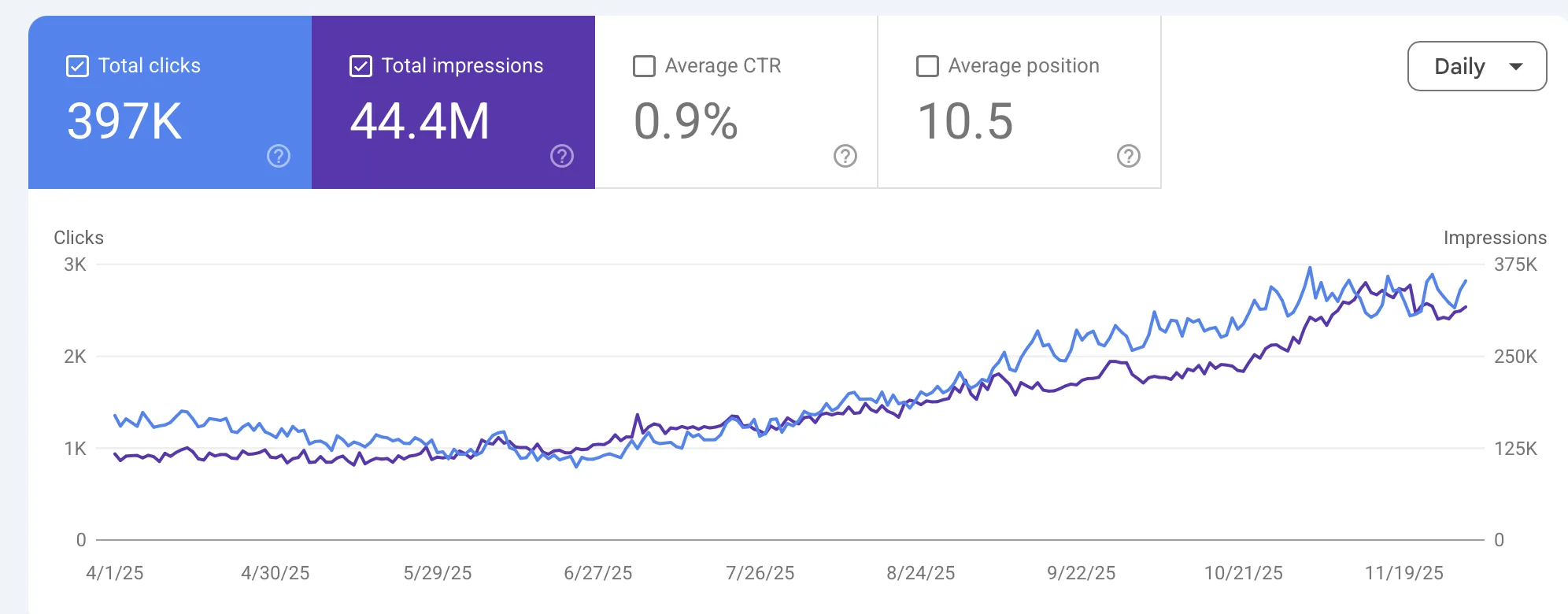
Commercial architecture, technical fixes, page improvement and authority work supported six months of compounding growth. Search Console recorded 397K clicks and 44.4M impressions.
Open verified case →
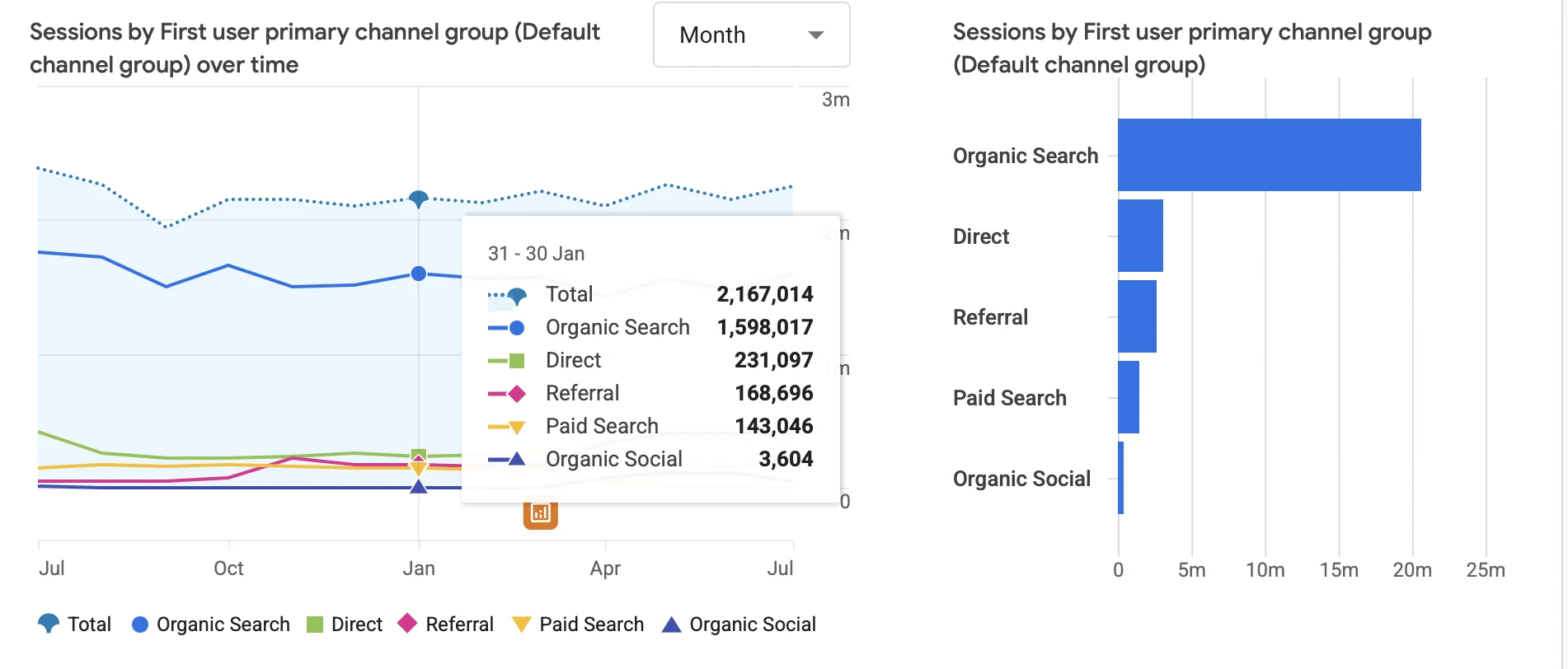
A large semantic architecture, technical execution and scalable page systems produced national and city-level discovery. GA4 recorded about 1.598M Organic Search sessions in the measured month.
Open verified case →
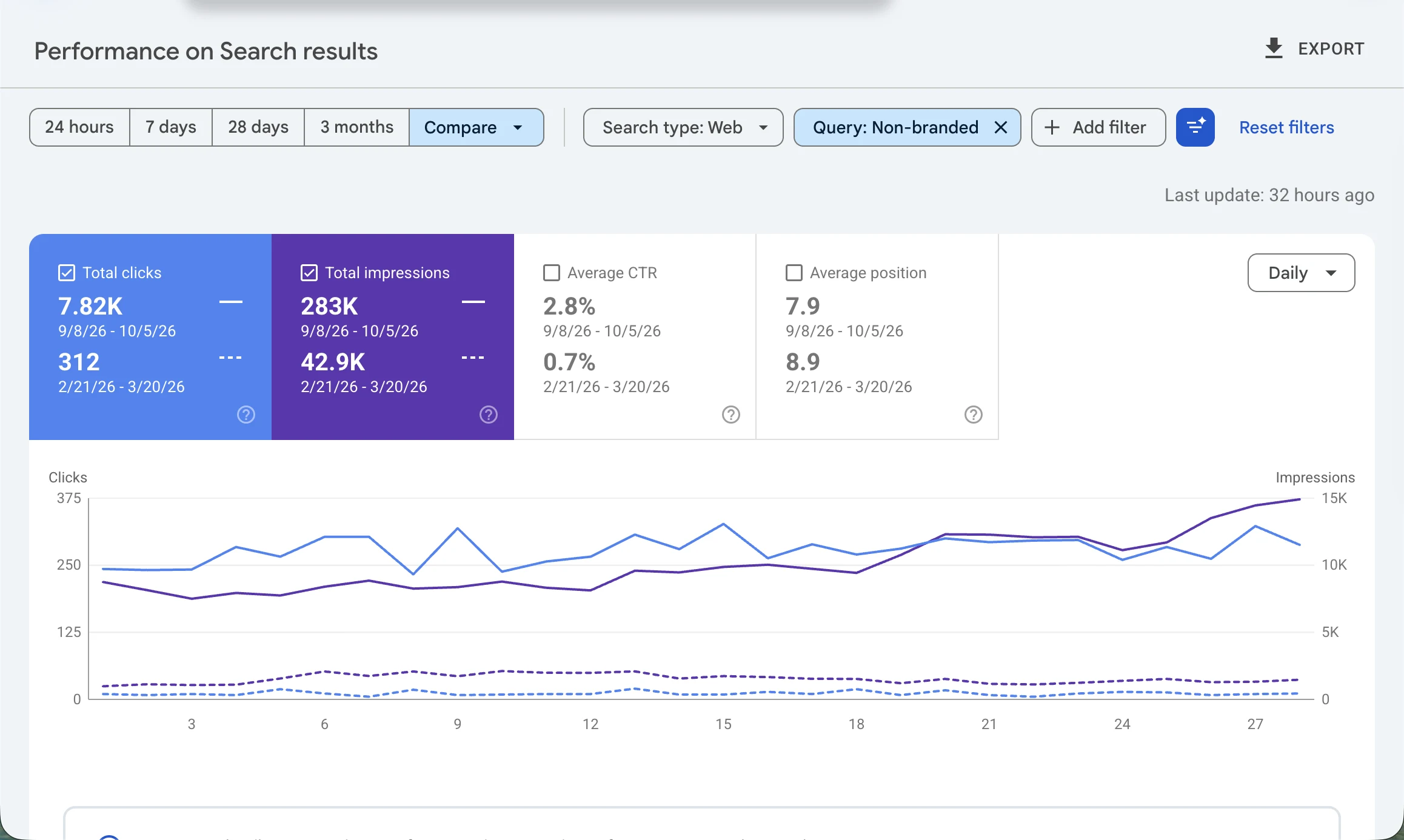
Consulting, technical priorities, content gaps, authority and GEO strategy were handed off for implementation. Daily non-brand clicks rose from about 3 to 27 and impressions from about 225 to 980.
Open verified case →
10 / SCOPE + COST
Website size alone does not define effort. Markets, templates, competition, content, authority, analytics and implementation ownership can change the scope more than URL count.
See SEO pricing factors →11 / MEASUREMENT
Search visibility is connected to the landing page and the action that page is expected to create. Reporting separates brand from non-brand demand and records implementation dates so the team can interpret change.
12 / HIRING AN SEO
Many SEO companies and SEO agencies present the same list of services. Selecting an SEO service provider requires more than comparing claims such as leading SEO, award-winning SEO or results-driven SEO services. The useful differences are evidence, senior involvement, implementation mechanics and the provider's willingness to explain limits.
The answer should name research, access, deliverables and decisions specific to your site, not promise an immediate ranking jump.
Meet the SEO specialist responsible for strategy and understand which developers, writers or outreach partners are involved.
Recommendations need an owner, ticket, acceptance criteria and QA. An audit without implementation mechanics is an unfinished project.
The provider should connect target pages to visibility and qualified actions while keeping forecasts separate from guarantees.
The best SEO agencies show how their SEO methodology adapts to the website rather than forcing every client into one package. A professional SEO agency should also disclose the working team, content review, link qualification and release process. An independent SEO firm or consultant should be equally clear about capacity and which work remains with the client.
A right SEO agency or right SEO company can help when the business needs production capacity across several workstreams. An experienced SEO consultant can help when the main need is diagnosis, prioritization or team guidance. There is no universal best SEO provider; there is a provider whose skills and operating model match the current constraint.
Do not trust an SEO marketing company because it repeats that its SEO services are designed to improve rankings. Ask for a relevant case, a sample deliverable and the first-month decision process. Strong SEO practices become visible in the work itself.
Google advises businesses to understand the work, ask for realistic estimates and avoid anyone guaranteeing first place. Read Google's guide to hiring an SEO →
13 / FAQ
Direct answers about scope, types, timing, pricing, guarantees, AI search, measurement and provider selection.
SEO services are professional activities that improve how a website is discovered, understood and selected in organic search. A complete service can include research, technical SEO, page optimization, content, internal linking, structured data, local visibility, link building and measurement. The scope should follow the business model and current constraint. A useful provider delivers implemented changes or clear tickets, not only ranking reports and recurring meetings.
Professional SEO services typically include a baseline audit, keyword and competitor research, page mapping, technical fixes, on-page SEO, content planning, internal links, authority work and reporting. Local or ecommerce businesses need additional work for Google Business Profile, locations, collections, products and revenue tracking. AI search now adds crawlability, fact consistency, brand citations and visibility monitoring. The proposal should name exact deliverables, owners, timing and success measures.
The main types are technical SEO, on-page SEO, content SEO, off-page SEO and local SEO. Ecommerce, international, enterprise and AI SEO are operating models that combine those foundations around a specific platform or market. They are not isolated shortcuts. Most businesses need several types at once, but the sequence matters: fix access and page ownership before scaling content or authority to pages that cannot rank or convert.
SEO service cost depends on market competition, website size, platform complexity, content demand, link gap and implementation ownership. A focused audit or consulting project costs less than ongoing execution for a multi-market catalog. I do not publish one package for every site because the same fee can hide very different work. After a short review, the proposal defines scope, deliverables, responsibility, timing and a fixed project or monthly fee.
Meaningful SEO movement usually takes several months, although crawling, indexation and page-quality improvements can appear sooner. Timing depends on site history, competition, release speed, content approval and authority. The first 90 days should create a baseline, remove the highest-impact constraints and ship priority work. Rankings and traffic are lagging outcomes, so progress is also measured through implemented fixes, index quality, impressions and qualified conversion behavior.
No responsible SEO service can guarantee a first-page position. Search engines control ranking systems, competitors keep changing and results depend on the website, market, content, authority and user response. Google explicitly warns against guaranteed rankings. A provider can guarantee agreed research, deliverables, implementation support, reporting and quality checks. Forecasts should be presented as scenarios with assumptions rather than promises that a specific keyword will reach a fixed position.
Hire a consultant when you need senior diagnosis, strategy, team guidance or a direct decision maker. Hire an SEO agency when the scope requires a larger production team for content, development, digital PR or many markets. Some projects need both: a consultant sets priorities and reviews evidence while internal or agency specialists execute. The key is to know who performs the work, who owns implementation and whether the senior expert remains involved after the sale.
A small business can handle basic SEO when the site is simple and the owner has time to learn Search Console, page optimization, local profiles and content. Professional support becomes useful when traffic drops, several templates compete, development is involved, a migration is planned or the market is expensive. Even when implementation stays in-house, an external audit or consulting project can reduce wasted work by identifying the real constraint and sequencing changes correctly.
SEO remains valuable when customers use Google, Bing, Maps, shopping results or AI assistants to research a problem and choose a provider. The channel has changed: an organic strategy now needs classic search visibility, strong source pages, consistent entities and measurement across AI referrals and mentions. It is not worth paying for when the service sells activity without implementation, ignores conversion quality or publishes generic content that adds no useful evidence.
AI SEO does not replace traditional SEO. AI systems still need accessible pages, understandable entities, reliable facts, third-party authority and sources they can retrieve or cite. Technical SEO, useful content, internal links and brand credibility remain the foundation. The additional layer measures prompts and citations, structures answer-ready blocks, improves source consistency and earns mentions on relevant external websites. Google and AI visibility should share one evidence base rather than run as separate campaigns.
SEO performance is measured against the business model. Core diagnostics include non-brand clicks, impressions, rankings, indexation, crawl quality and landing-page movement. Commercial measures include qualified leads, calls, purchases, revenue and assisted conversions. AI visibility can add mentions, citations, referral sessions and bot activity. Reporting also shows what was released, because a strategy cannot be judged fairly when recommendations remain in a document and never reach production.
Choose a provider that explains your likely constraint, shows first-hand evidence, names the people doing the work and defines deliverables before asking for a long contract. Ask how recommendations reach production, how content quality is reviewed, how links are qualified and which business outcomes will be measured. Avoid guaranteed rankings, hidden reseller teams, fixed backlink inventories, vague monthly reports and packages whose main output is a predetermined number of articles.
START WITH THE CONSTRAINT
Send the website, target market and the business outcome you need from organic discovery. I will identify the first likely constraint and whether an audit, consulting project or managed SEO scope fits.
Cookies, briefly. Essential ones run the site; analytics cookies (Google) only switch on if you say yes. Details in the Privacy Policy.