Demand and competitor map
A prioritized view of HVAC search behavior by service, urgency, season and real market, with one owner URL for each useful intent.
SEARCH, MAPS AND AI DISCOVERY FOR HVAC
A search growth system for heating and cooling companies that need more qualified service calls, estimate requests and market visibility without fake locations or ranking promises.
WHAT YOU GET
The first output is an ordered operating plan. It connects real HVAC demand to service pages, local visibility, implementation work and lead measurement.
A prioritized view of HVAC search behavior by service, urgency, season and real market, with one owner URL for each useful intent.
A controlled page system for repair, replacement, maintenance, equipment and valid service areas without doorway-page duplication.
Google Business Profile facts, categories, services, reviews, citations and website signals aligned to real operating coverage.
Reporting that separates rankings and traffic from qualified service calls, forms, estimates and booked jobs when CRM data is available.
AUDIT DECISION BOARD
Before specialized SEO begins, the audit turns an HVAC industry wishlist into release decisions. For a home service business, it should explain where an HVAC contractor can compete, which work the team can ship and what local leads count as useful.
Confirm HVAC repair and installation, HVAC maintenance, emergency availability, commercial work and real capacity. Each HVAC contractor needs priorities that fit the jobs, systems and local customers the business can actually serve.
Map each useful query to an existing page, profile, market or missing decision asset. This exposes local rankings and local signals without treating a keyword list as the strategy.
Turn local SEO services into named website, content and profile actions. The audit shows who approves and releases the SEO work, and where specialist SEO help is genuinely needed.
Define how calls and forms qualify by service and market, then connect estimates and jobs where the systems allow. This keeps optimization for HVAC tied to commercial reality instead of a traffic total.
FROM SEARCH TO QUALIFIED CONTACT
HVAC SEO becomes useful when a real search reaches the correct answer, establishes fit and produces a contact the business can serve.
Connect repair, installation, maintenance and emergency HVAC searches to the correct destination.
Show the service, equipment, market, availability and evidence a buyer needs before making contact.
Keep the next step obvious on mobile, whether it is a call, service request or estimate form.
Track in-area opportunities and downstream jobs where the call-tracking and CRM setup permits it.
DIRECT ANSWER
HVAC SEO is search engine optimization for heating, ventilation and air conditioning companies that need people in real service areas to find the correct repair, replacement, installation or maintenance path.
It combines search research, Google Business Profile governance, service-area architecture, technical SEO, local content, reviews, citations, link building and measurement. It should support business decisions, not merely increase a ranking count.
HVAC SEARCH BEHAVIOR
Urgency, system, season and buyer change the information and action a page must provide. One generic service page cannot answer every HVAC demand mode well.
LOCAL VISIBILITY STACK
Google Search, Google Maps and AI-assisted answers can reinforce the same local entity, but they do not show identical results or use one universal ranking formula.
Organic SEO connects each HVAC service and buyer question to a distinct, useful destination. The architecture should reflect the real offer instead of generating every keyword combination.
Local SEO depends on eligibility, proximity, accurate categories and services, reviews, citations and a website that confirms the same business facts. One profile cannot rank equally across an unlimited service area.
AI search can retrieve explicit services, markets, expertise and evidence from accessible pages. Clear entities and source-backed answers improve retrieval readiness, but citations and visibility cannot be guaranteed.
SERVICE AND MARKET ARCHITECTURE
An HVAC website should map services, systems and valid markets without creating a page for every possible phrase. Each URL needs its own buyer question, evidence and place in the internal-link path.
Before publishing, confirm that the company offers the service, can serve the market and can provide distinct information. This protects local relevance and prevents weak city-page duplication.
AC repair, furnace repair, installation, replacement, maintenance
One useful destination for each service and buying decision the company can fulfill.Heat pumps, central AC, mini-splits, boilers, rooftop units, IAQ
Create only where the offer and technical explanation are genuinely distinct.Staffed locations or service areas with operational coverage
Require demand, local proof and differentiated information. Never clone city names.Costs, rebates, tax credits, diagnostics, comparisons, maintenance
Support revenue pages without competing for the same transactional intent.GOOGLE MAPS CONTROL
Local search visibility is built from eligibility, proximity, accurate business information, useful owned pages, customer experience and real authority. A service-area setting does not create an office or a ranking guarantee.
The HVAC company retains primary control of the website, Google Business Profile, analytics and Search Console.
Addresses, service areas and locations reflect real operations. A virtual office or invented branch is not a local SEO asset.
Use the fewest accurate categories and align every listed service with the actual offer and its website destination.
Request honest feedback without incentives or review gating, respond consistently and protect customer privacy.
Coverage settings describe where the company works; useful pages still need distinct market evidence and buyer value.
Earn relevant citations, supplier or trade references, local mentions and links through real relationships and useful assets.
No fake offices, keyword-stuffed business names, duplicate profiles, incentivized reviews or cloned city pages. Local presence must match the HVAC company's real operations.
CHANNEL BOUNDARIES
Each channel has a different cost, speed, ownership model and eligibility layer. A useful HVAC marketing plan compares them honestly instead of calling every visibility tactic SEO.
Compounds through useful pages, links and entity evidence; requires implementation and time.
Captures local intent but remains constrained by proximity, eligibility and market competition.
HVAC can be eligible in supported US markets, subject to screening, licensing and availability. LSA is not organic SEO.
Can buy immediate auction visibility while budget and campaign quality hold. Paid-media management is not implied here.
TECHNICAL + ON-PAGE SEO
Technical SEO controls whether the correct page can be crawled, rendered, indexed and measured. On-page optimization makes its answer, entities, proof and action coherent.
Review the technical audit scopeCONTENT + LOCAL AUTHORITY
Useful local content explains the problem, service fit and next action with facts the business can support. Authority work should amplify those assets through real audiences and relationships.
See the link-building qualification processExplain symptoms, qualification limits, the service process, equipment fit, technician or license context and the next action. Use real operating facts rather than generic HVAC copy.
Connect genuine coverage to climate, housing or property context, equipment patterns and approved local proof. A replaced city name is not local content.
Prepare cooling and heating pages before demand peaks. Publish emergency, rebate and tax-credit information only when availability and eligibility are verified.
Qualify trade organizations, suppliers, local resources, original data and editorial placements by audience and topical relevance instead of link quotas.
HVAC LEAD MEASUREMENT
Reporting should preserve the path from non-brand search and landing page to qualified contact. Booked jobs and revenue require reliable call tracking, CRM discipline and attribution, so those outcomes are configured rather than assumed.
Queries and landing pages segmented by HVAC service, urgency and market.
Representative map coverage and profile actions with proximity limits disclosed.
Calls and forms that match a service, operating area and realistic job type.
Down-funnel outcomes and revenue only when call tracking, CRM data and attribution are reliable.
FIRST 90 DAYS
The sequence adapts to the company's services, markets, team and implementation capacity. It is an operating plan, not a promise that every query moves in one quarter.
Confirm services, systems, markets, seasonality, licenses, capacity and priorities. Audit the site, profiles, competitors, tracking and existing page ownership.
Fix priority templates and core service pages, clean up local facts, improve internal links and prepare justified market or decision-support content.
Review non-brand visibility, local presence, qualified calls and estimates. Expand only where demand, operations and the first releases support it.
ADJACENT LOCAL-SERVICE EVIDENCE
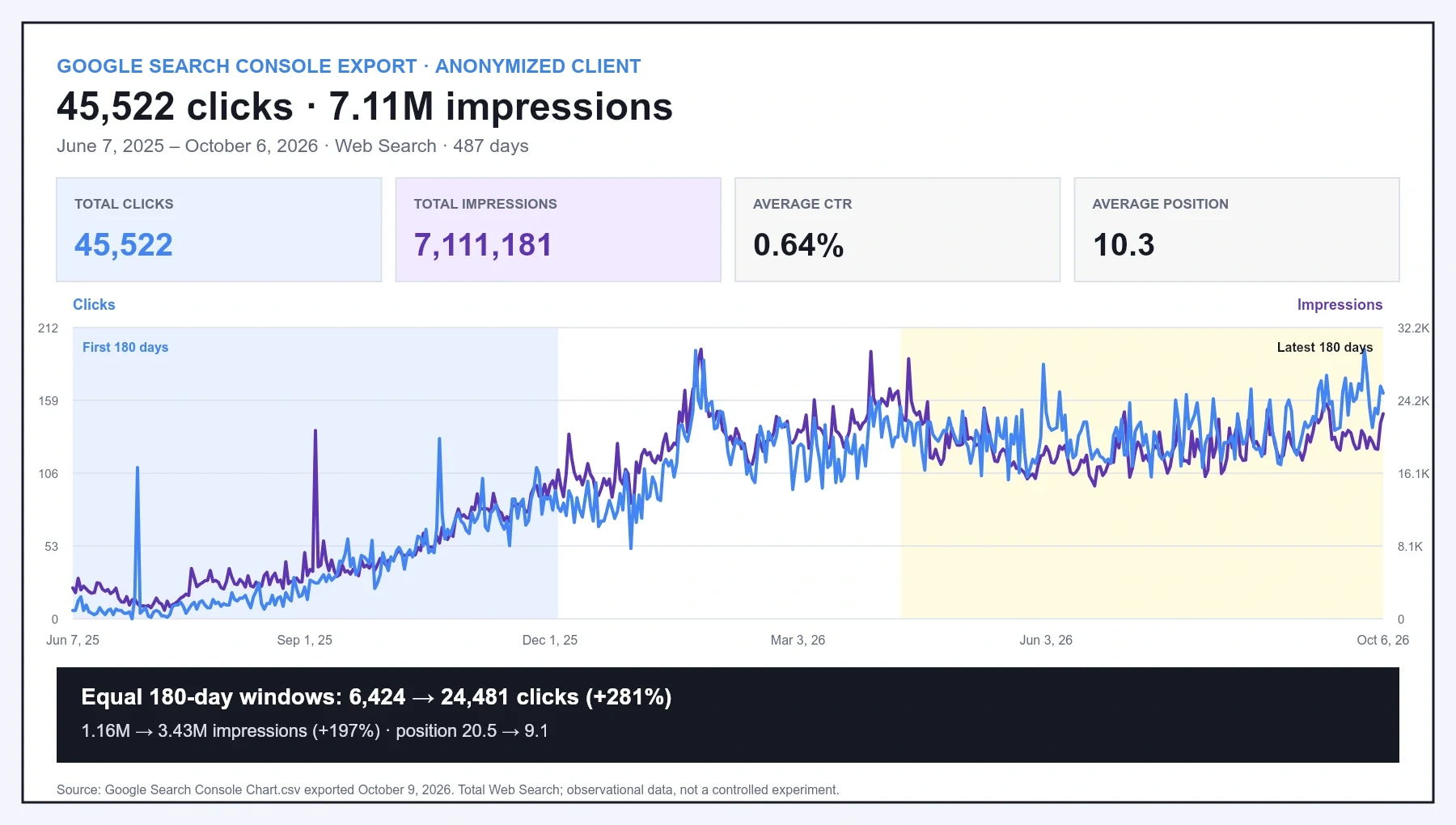
For a single-location auto repair workshop, I led technical priorities, commercial service architecture, multilingual publishing, internal linking and local entity work. Across equal 180-day Google Search Console windows, organic clicks increased 281% and impressions increased 197%.
Evidence boundary: this demonstrates local-service search execution. It is not presented as an HVAC client result, a lead guarantee or proof that one workstream caused the growth.
CHOOSING A PROVIDER
The best HVAC SEO company for one contractor may be the wrong operating model for another. Evaluate control, implementation, local page rules, channel clarity, measurement and evidence before comparing promises.
COST + ENGAGEMENT
Scope depends on services, systems, markets, profiles, technical debt, content production, local authority, tracking and who will implement the work. The quote should describe outputs and ownership rather than hide production inside a generic retainer.
Compare SEO pricing models and cost driversPRIMARY POLICY SOURCES
These Google sources support the profile, doorway-page and Local Services Ads guardrails above. They do not provide a universal ranking formula.
HVAC SEO FAQ
Direct answers about scope, cost, timing, service areas, seasonal demand, measurement and Local Services Ads.
HVAC SEO services normally include demand research, keyword-to-page mapping, Google Business Profile work, technical and on-page SEO, service and market architecture, local content, internal linking, review guidance, citations, link building and lead measurement. The exact scope should follow the current constraint. A contractor with incorrect profile ownership needs governance before more content; a multi-location HVAC company may need architecture and reporting by market; a technically sound site with weak local authority may need outreach and evidence development.
The local foundations are similar, but HVAC demand changes by service, system, urgency, climate and season. AC repair, furnace replacement, heat pump installation, maintenance plans and commercial HVAC are different buying journeys. A useful strategy also accounts for dispatch capacity, real service areas, emergency availability and the relationship between organic results, Google Maps, Local Services Ads and paid search. The specialization is in the operating model and page system, not in a secret ranking formula.
Cost depends on the number of services, systems, markets and eligible profiles; the current website condition; content and development requirements; authority work; measurement integrations; and who owns implementation. A single-market contractor needs a different program from a multi-location heating and cooling company. I inspect the gap before quoting, then define a fixed audit, a 90-day sprint or an ongoing program with named deliverables, responsibilities and exclusions. The SEO pricing page explains those engagement models.
Meaningful organic movement often takes several months, while profile corrections, technical fixes and newly indexed pages can produce earlier signals. Timing varies with competition, the current website, authority, reviews, implementation speed, seasonality and available proof. The first 90 days should establish ownership and measurement, release the highest-priority work and show whether non-brand impressions, local visibility and qualified contacts are moving. No responsible provider can guarantee a ranking date, Map Pack position or lead total.
Start with qualified calls and forms by service, market and landing page. Where the client can share reliable call-tracking and CRM data, connect those contacts to estimates, booked jobs and revenue. Supporting indicators include non-brand search visibility, organic clicks, Google Business Profile actions, representative map coverage and conversion rate. Rankings and traffic help diagnose the system, but they are not the final business outcome.
First confirm real locations, coverage, demand and the operating team. Each market page needs a distinct buyer need, truthful service detail and local evidence; changing only the city name creates weak duplication and can resemble doorway pages. Google Business Profile service areas describe coverage but do not create offices or guarantee local rankings. Multi-location businesses also need profile ownership, page-to-profile mapping and reporting that keeps markets separate.
Yes, when the business can actually respond. Emergency pages need accurate hours or availability, a fast mobile call path and clear qualification. Seasonal work should be planned before cooling or heating demand peaks, not published after the surge starts. SEO can improve the owned search path, while paid channels may provide faster auction visibility. The plan should also respect dispatch capacity so marketing does not create demand the company cannot serve.
HVAC is listed as an eligible US Local Services Ads category, but availability and requirements vary by market. Providers may need business verification, licenses, insurance and other screening. Local Services Ads are a paid lead channel, not an organic SEO feature, and their inclusion on this page does not mean iNevidimka manages paid campaigns. The channel is discussed so an HVAC company can understand how it fits beside Search and Maps.
HVAC SEARCH OPPORTUNITY BRIEF
Send the website, priority HVAC services, real coverage area and current constraint. I will review the system and identify the first decision I would make.
Cookies, briefly. Essential ones run the site; analytics cookies (Google) only switch on if you say yes. Details in the Privacy Policy.