HVAC
Seasonal, emergency and replacement demand needs separate service intent, strong local pages and call tracking by market.
See the dedicated HVAC search planGOOGLE + MAPS + AI SEARCH FOR CONTRACTORS
Home services SEO built to turn local demand into qualified calls, estimate requests and booked jobs across the services and areas you can actually fulfill.
01 / DIRECT ANSWER
Home services SEO is search engine optimization for contractors and service-area businesses that need homeowners to find, trust and contact them for a specific job. It connects local SEO, Google Business Profile, service and service-area pages, technical SEO, reviews, local citations, authority and conversion tracking across Google Search, Google Maps and relevant AI-assisted answers.
The strategy is different from generic SEO because the search is often local, urgent and operational. A homeowner looking for emergency plumbing needs a different answer from someone planning a kitchen remodel. Distance changes map results, seasonality changes demand, and every lead has to match a real service, crew and coverage area. The site architecture and measurement should reflect those constraints.
The goal is not to put every keyword on the first page. It is to make the right home service business visible for high-intent local queries, then show enough proof and service detail for a qualified customer to call or request an estimate.
02 / HOME SERVICES INDUSTRY
Home service companies share local-search mechanics, but the offer, urgency, evidence and job value change by trade. The page system starts with those differences.
Seasonal, emergency and replacement demand needs separate service intent, strong local pages and call tracking by market.
See the dedicated HVAC search planUrgent plumbing services and planned installations require fast mobile paths, service clarity and defensible service-area coverage.
See the dedicated plumbing search planRoof repair, replacement, storm and material searches need local proof, financing context and pages built around high-value decisions.
See the dedicated roofing search planEmergency repairs, panels, generators, EV chargers and installations create distinct queries and qualification paths.
Kitchen, bathroom and whole-home projects rely on portfolio evidence, project fit, location relevance and longer consideration journeys.
Recurring services, tree work, design and seasonal demand need a clear offer hierarchy and local visual proof.
Pest type, urgency, treatment area and recurring plans create specific pages that generic local copy cannot satisfy.
See the dedicated pest control search planFrequency, property type, service radius and availability should be visible before a visitor requests an estimate.
03 / SEARCH INTENT
Keyword research should map how local customers search for services instead of forcing every variation onto one home page.
Leak, outage, lockout, storm damage or no cooling. Mobile speed, availability and the call path matter immediately.
Problem, diagnosis, price context, service radius and proof help the homeowner choose a local contractor.
Options, materials, financing, process, warranty and portfolio evidence support a longer decision.
Do not prioritize a service because the keyword has volume if the company cannot answer it, price it or send a crew. SEO performance improves when keyword research follows the operating plan.
04 / HOME SERVICES SEO SERVICES
Every workstream ends in a corrected profile, published page, implementation ticket, operating rule or measurement decision. A monthly activity list is not the deliverable.
Homeowner searches are grouped by service, urgency, property need, city, comparison stage and commercial value. The result is a page map, not a spreadsheet of disconnected keywords.
Ownership, eligibility, categories, services, coverage areas, hours, photos, questions and review workflows are checked against the real business and Google policies.
Core landing pages explain the job and conversion path. Local pages are created only where there is demand, operational coverage and enough market evidence to avoid city-name cloning.
Crawlability, indexation, canonicals, redirects, internal links, mobile rendering, Core Web Vitals and structured data are reviewed by template and priority.
Titles, headings, direct answers, job details, FAQs, media, trust signals and calls to action are aligned with local intent without stuffing every suburb into the copy.
Business information is normalized across relevant directories. Ethical review requests and responses support reputation without incentives, gating or fabricated engagement.
Trade associations, suppliers, partners, community assets, useful research and relevant editorial opportunities are qualified by audience and topical fit.
Clear brand facts, services, locations, evidence and answer blocks help retrieval systems understand the company. Citations are monitored where possible, never guaranteed.
Calls, forms, estimate requests, booked jobs and market-level landing pages are connected to organic search results, Maps and other discoverable sources as the available stack allows.
05 / PAGE ARCHITECTURE
Ranking in multiple cities does not require a fake office or one cloned page per zip code. The website needs a controlled relationship between the main service, the real local area and the evidence available for that market.
A strong page answers the job, where it is available, who performs it, why the company is credible and what happens after the enquiry. If the only unique word is the city name, combine the intent or collect better local proof before publishing.
See the full local SEO frameworkProcess, options, team, licensing context, FAQs and conversion path.
Jobs, reviews, logistics, neighborhoods and relevant service details.
Response process, hours, qualification rules and direct contact.
First-hand expertise, transparent trade-offs and a clear route to service.
06 / LOCAL PACK
A complete profile supports local pack and Google Maps visibility, but the listing, website and public business data must describe the same eligible company. Local businesses that appear consistently do not rely on one field or shortcut.
Use a real staffed location or a valid service-area model. Virtual offices and duplicate profiles create suspension risk.
Categories, services, hours, media and the linked landing page should match what customers can actually book.
Google Business Profile reviews come from real customers through an ethical, consistent request and response workflow.
Proximity affects local ranking. A wider radius does not make one profile equally visible across every city.
07 / TECHNICAL + ON-PAGE SEO
Technical SEO protects the URLs intended to rank. On-page optimization makes each destination clear to a search engine, artificial intelligence retrieval system and homeowner. They should be released together, not sold as unrelated checklists.
Review the technical audit scope08 / CONTENT SYSTEM
Content marketing should support service decisions and build local expertise. A blog calendar disconnected from commercial destinations is not a marketing strategy. Useful content and local keywords follow the job.
Cost drivers, repair versus replacement, warning signs, preparation and availability help customers identify the right service.
Inspection, scope, timeline, permits, materials, access and the next step reduce uncertainty and poor-fit leads.
Completed work, home improvement care, maintenance schedules and original data strengthen future pages and local authority.
Concise answer blocks, consistent services, locations, credentials and evidence make the company easier to retrieve and verify.
09 / FIRST 90 DAYS
Strong SEO compounds, but the first quarter should still produce visible work and decision-quality evidence. The exact order changes after the audit.
Confirm services, margins, capacity and real service areas. Audit the site, profiles, competitors, tracking and conversion paths before adding pages.
Fix priority templates and profiles, improve core service pages, publish approved local destinations and establish review and authority workflows.
Compare non-brand visibility, local pack movement, qualified calls and estimates, then choose the next services and markets from evidence.
This sequence follows the published SEO methodology: diagnose, release, validate and expand.
10 / ADJACENT LOCAL-SERVICE EVIDENCE
I do not have a public, attributable home-services case, so this is labeled accurately: an adjacent local-service result from one anonymized auto repair workshop in Dubai. The same local-commercial disciplines were involved, including service intent, technical fixes, content and measurement, but the vertical is different.
The chart covers the retained 487-day GSC window and shows growth rather than a guaranteed forecast for another business.
Open the verified case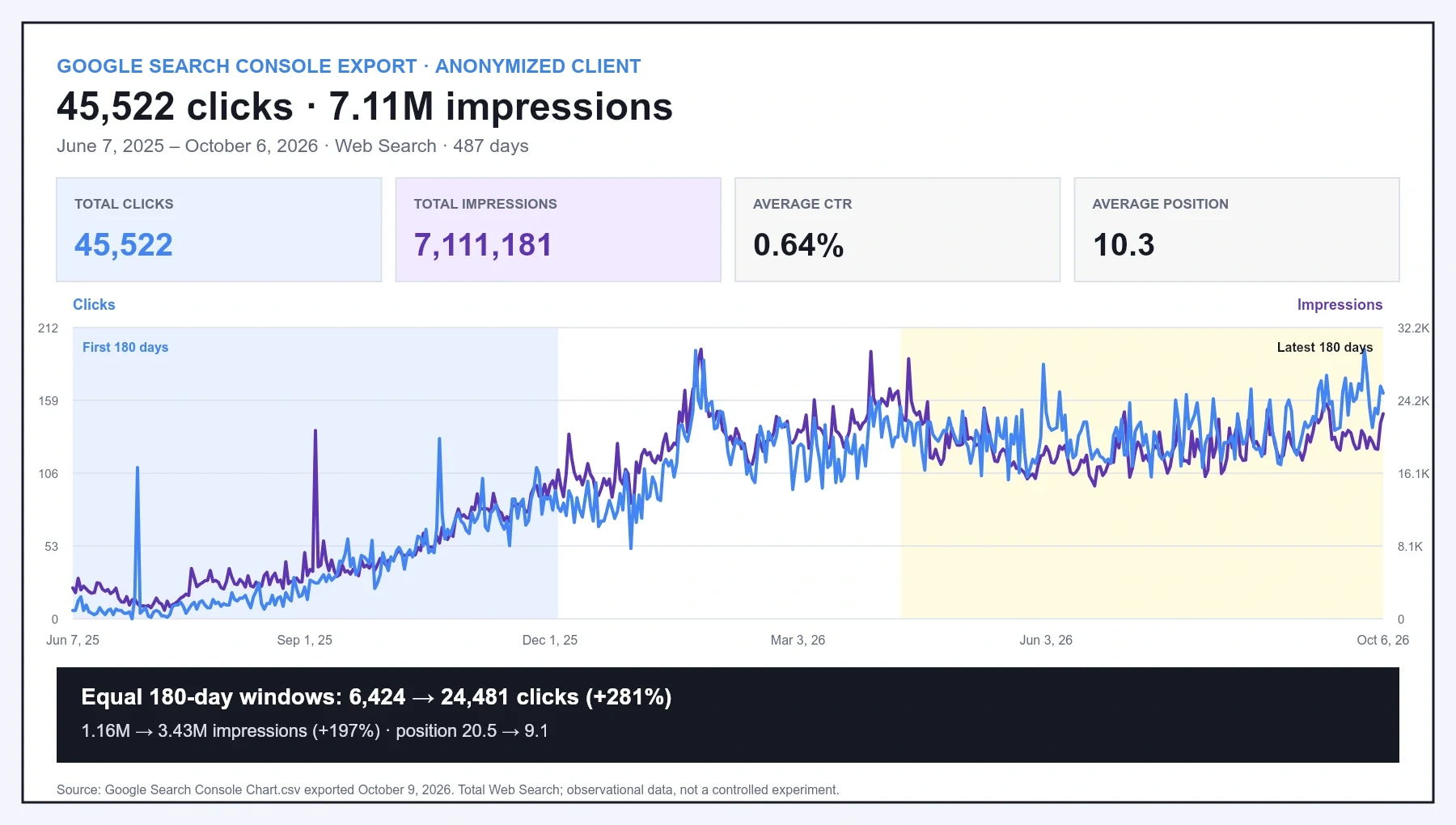
11 / REPORTING
Rankings help diagnose presence in a search engine results page, but they do not show whether the phone rang for a profitable service. Reporting should connect released work to lead generation, booked work and return on investment as the current stack allows.
Which services and markets gained discoverability?
Did the traffic create real opportunities?
Which demand deserves more investment?
Is the brand being retrieved, and from which source?
Google Analytics, call tracking and CRM data are used only to the level they can be configured reliably. The report separates evidence from attribution assumptions.
12 / DIY, CONSULTANT OR AGENCY
A home service company does not need the biggest SEO company. It needs the right SEO delivery model and clear ownership across diagnosis, content, development, profile work and reporting.
Start with correct tracking, one complete profile, primary services, accurate business facts and a small number of useful pages.
Risk: owner time and inconsistent maintenance.Use senior diagnosis, architecture, briefs, QA and prioritization while internal staff or trusted suppliers release the work.
Risk: recommendations without an implementation owner.Use a defined team for research, technical work, pages, local operations, authority and measurement with direct access to the strategist.
Risk: generic SEO practices and an account-manager layer.Who changes the website? Who owns the profiles and accounts? How are local pages approved? Which links are allowed? How are calls and booked jobs attributed? What happens if the engagement ends?
13 / COST AND SCOPE
The cost changes with services, locations, competition, site condition, content, profile count, authority work and implementation ownership. A fixed audit, 90-day sprint and ongoing program solve different problems.
I inspect the site and target markets before proposing a scope. The proposal states what ships, who owns each input, what is excluded and how results will be reviewed.
Compare SEO pricing models and cost drivers14 / POLICY SOURCES
Profile eligibility, review collection and structured data should follow the platform rules, not a shortcut sold as local SEO best practice.
15 / FAQ
Direct answers to the commercial and implementation questions local contractors ask before choosing the work.
Home services SEO is search engine optimization for contractors and service-area businesses such as HVAC, plumbing, roofing, electrical, remodeling, landscaping, pest control and cleaning companies. It improves how the business appears in Google Search, Google Maps and relevant AI-assisted answers for service and location queries. The work combines keyword research, Google Business Profile optimization, service and area pages, technical SEO, reviews, local citations, links and lead measurement. The commercial goal is qualified calls, estimate requests and booked jobs, not traffic alone.
A home services SEO engagement should include demand and competitor research, technical auditing, profile work, service and market architecture, on-page optimization, local citations, review guidance, content planning, authority development and conversion measurement. The exact mix follows the current constraint. A contractor with incorrect listings needs entity cleanup; a company with strong map presence but weak pages needs service content and conversion work. Every activity should produce a released asset, an implementation ticket or a measurable decision.
SEO helps a home service business appear when a homeowner is actively searching for a specific job in a practical service area. That demand can be urgent, as with a burst pipe, or considered, as with a roof replacement. Organic and local visibility can keep producing discovery after a page or profile improvement is released, while paid traffic stops when the budget stops. SEO is worthwhile only when the company can answer the leads, serve the market and measure whether searches become qualified calls or estimates.
Home services SEO usually needs several months to produce meaningful lead movement, although profile corrections, technical fixes and newly indexed pages can show earlier signals. Timing depends on the trade, city, service radius, current website, reviews, competitors, implementation speed and seasonality. The first 90 days should establish a baseline, release the highest-impact fixes and show whether impressions, local visibility and qualified enquiries are moving. No responsible provider can guarantee a map-pack position or a fixed lead date.
Home services SEO pricing depends on the number of services, locations and profiles, market competition, website condition, content production and implementation ownership. A single-market plumbing company needs a different scope from a multi-location HVAC brand. I audit the opportunity before quoting, then define a fixed project, 90-day sprint or ongoing scope with named deliverables. Compare the full production and development requirement, not only a monthly fee. The SEO pricing guide explains the main cost drivers and engagement models. Review the pricing guide.
A service-area business can earn organic visibility in multiple cities it genuinely serves, but it should not create fake offices or duplicate profiles. Each market needs enough demand, operational coverage and useful local evidence to justify a page. Proximity still affects Google Maps, so a single listing may not rank equally across a wide radius. The website can support legitimate coverage areas with differentiated destinations, internal links, proof and tracking while the profile follows Google eligibility and address rules.
Google Business Profile is important, but it is not enough for durable local SEO. The profile confirms categories, services, hours, reviews and business facts, while the website explains each job, market, team, evidence and conversion path in crawlable detail. Organic results, local pack rankings and AI retrieval can use different sources. A strong system keeps the profile, landing pages, citations, schema and public business information consistent instead of expecting one listing to carry the entire market.
A contractor can handle basic local SEO when the business has one market, a small site and enough time to maintain accurate profiles, reviews, pages and measurement. Start with the highest-value services, correct business information, one complete profile, useful landing pages and reliable call or form tracking. Hire specialist help when technical problems, multiple markets, competitive content, migrations or implementation capacity exceed the team. DIY SEO becomes expensive when untracked changes create duplicate pages or profile risk.
There is no single public factor list that guarantees home services rankings. The controllable system includes a technically accessible website, clear service and location relevance, a valid local listing, consistent business facts, useful reviews, internal links, local and topical authority, mobile usability and content that resolves the homeowner's query. Distance also affects local results and cannot be optimized away. I prioritize the weakest part of that system rather than treating one signal as a universal shortcut.
Genuine reviews support reputation and can provide current customer language about services and locations, but review count alone does not guarantee a ranking. A useful process asks real customers consistently, makes participation voluntary, protects private information and responds professionally. Buying reviews, offering incentives or filtering unhappy customers creates policy and trust risk. Review themes should also inform operations and page content: repeated questions or complaints often reveal what a service page needs to explain more clearly.
Common mistakes include fake locations, keyword-stuffed business names, cloned city pages, one thin page for every service-area combination, buying reviews, publishing unchecked AI copy, tracking rankings without calls, and building links by quota. Another mistake is creating content before fixing indexation, mobile conversion or profile ownership. The right sequence starts with the real offer and service area, fixes access and measurement, then expands pages and authority only where the business can deliver.
SEO is still worth evaluating because homeowners continue to use Google Search, Google Maps and AI-assisted discovery to compare local providers. It is not automatically the right investment for every contractor. The business needs search demand, adequate job economics, market capacity, a working sales response and patience for compounding results. Compare the total SEO cost and expected timeline with Google Ads, Local Services Ads, referrals and other channels, then fund the mix that produces profitable, qualified work.
The practical 80/20 approach is to prioritize the small set of services and markets that drive most qualified revenue before expanding the website. It is a planning heuristic, not a Google ranking formula. Start with correct tracking, the primary Google Business Profile, highest-value service pages, real service areas and the technical issues blocking those URLs. Once those foundations produce evidence, expand into supporting questions, additional cities and authority assets instead of publishing dozens of low-value pages at once.
Hire an SEO agency or consultant when organic and local demand is commercially important but the team lacks diagnosis, production or implementation capacity. Ask who performs the SEO work, how local pages are approved, how profile access is governed, which links are acceptable and how calls or booked jobs are attributed. A consultant can direct an internal team; a broader agency may own production. Avoid guaranteed rankings, undisclosed link networks, fake reviews and retainers that deliver only a dashboard.
HOME SERVICE SEO BRIEF
Send the site, primary trade, real service area and the jobs you want more of. I will review the current search system and reply with the first constraint I would address.
Cookies, briefly. Essential ones run the site; analytics cookies (Google) only switch on if you say yes. Details in the Privacy Policy.