Google Business Profile
Categories, services, attributes, hours, photos, Q&A, posts, ownership and policy risk reviewed as one operating asset.
Google Maps + nearby demand + AI answers
Local SEO services for businesses that need nearby searches to become calls, bookings and qualified leads, not a monthly map screenshot.
DIRECT ANSWER
Local SEO services improve how a business appears when customers search for products or services in a specific area. The work connects business profiles, Google Maps, local keyword research, location and service pages, reviews, listings, technical SEO, local authority and conversion tracking. A useful local SEO campaign measures visibility from different points in the market and connects search results to calls, bookings, directions or qualified leads.
Local search engine optimization differs from national SEO because the searcher\'s location, business eligibility and profile signals affect the result. A company can rank well in one neighborhood and disappear a few miles away. Average ranking reports hide that variation, so the baseline has to include a geo-grid, profile actions and landing-page performance. This SEO strategy focuses on improving controllable signals and measured customer actions. Businesses serving the state can use the dedicated Florida AEO agency framework for Google, Maps and generated-answer discovery. Healthcare practices that need treatment, practitioner and clinical-review controls can use the dedicated dental SEO services framework. Legal practices that need office, attorney, review and case-intake controls can use the dedicated law firm SEO services framework.
01 / BUSINESS MODEL
A single storefront, a service-area business and a franchise should not receive the same local SEO package. Choose the closest operating model.
Market strategy
Google Business Profile, primary service pages, business listings, reviews and a focused local link plan.
Priority system
Market strategy
Service-area settings, city and service architecture, proof by market, lead routing and Local Services Ads alignment where relevant.
Priority system
Market strategy
Per-location GBP ownership, unique location pages, NAP controls, review workflows and reporting by branch.
Priority system
Market strategy
Service and practitioner entities, credentials, reviews, location content and conversion paths for clinics, legal, finance and other trust-led categories.
Priority system
02 / SERVICES INCLUDE
Every workstream ends in a changed profile, corrected listing, published page, implementation ticket, operating rule or measurable result.
Categories, services, attributes, hours, photos, Q&A, posts, ownership and policy risk reviewed as one operating asset.
Near-me, service, city and comparison demand mapped to the profile, service pages and location pages that can satisfy it.
Name, address and phone data audited across the local business directories that matter for the market and vertical.
Useful service-area and location pages built from real local intent, evidence and customer questions instead of city-name swaps.
Ethical review requests, response rules, sentiment patterns and operational feedback without buying or filtering reviews.
Indexation, internal links, mobile UX, LocalBusiness schema, landing-page quality and duplicate-location controls.
Relevant community, industry and partner authority earned around useful local assets and real relationships.
Geo-grid rankings, profile actions, calls, forms, organic landing pages and branch-level performance tied to a baseline.
NEARBY DEMAND SYSTEM
03 / RANKING SYSTEM
Successful local SEO is not one Google My Business listing and a batch of directory submissions. The profile, website, local market and reputation have to describe the same business.
Profile ownership, verification, primary and secondary categories, services, attributes, hours, photos, products, questions and review responses are checked against the real business. Optimizing your Google Business Profile means improving completeness and relevance without keyword-stuffing the business name or creating false locations.
The Google My Business listing also needs the right website destination and consistent business information. Profile work without a supporting landing page often plateaus in competitive Maps results.
Location and service pages map local intent to a crawlable destination. Useful pages explain the service, area, proof, availability, team and conversion path. Thin pages that replace only a city name create duplicate content and weak local visibility.
Technical SEO covers indexation, mobile performance, internal links, canonical URLs, structured data and LocalBusiness markup. The goal is visibility in local search results and a page that helps your business convert the visit.
Local citations confirm name, address and phone data across relevant local business directories such as Yelp and sector-specific sources. Old addresses, duplicate profiles and conflicting details weaken credibility. Each local listing should match the business information customers and search engines actually use.
Reviews add customer language, recency and operational feedback. The system asks real customers at an appropriate moment and responds consistently. It never buys reviews, gates negative feedback or invents volume.
Local content answers market-specific questions that the profile cannot cover: service comparisons, pricing context, regulations, local events, neighborhoods and proof. It should support commercial pages instead of becoming a disconnected blog calendar.
Local link building earns relevant mentions from partners, associations, industry publications and useful community resources. A backlink is valuable when it strengthens local authority or sends a real audience, not because a vendor sold a directory count.
CHANNEL DECISION
The right mix depends on how quickly the business needs demand, what it can measure and whether it wants to keep earning visibility after media spend stops.
Google Business Profile, landing pages, reviews, citations and authority improve eligibility and relevance for Google Maps, the local pack and organic results. The work takes time, but a strong market position can keep producing calls without paying for every click.
Best for: durable local visibility and qualified nearby demand.Paid search and Local Services Ads can create traffic quickly while a new market or profile is still building authority. They also test messages and conversion paths. The tradeoff is simple: visibility falls when spend stops, and weak tracking can hide unqualified leads.
Best for: immediate demand, launches and controlled tests.Artificial intelligence systems need consistent entities, crawlable service facts, credible mentions and clear location evidence before they can cite or recommend a business. AEO and generative engine optimization extend the same trusted data into AI answers; they do not replace Maps or the website.
Best for: discoverability across AI-assisted research.Microsoft Bing, Apple Maps and vertical platforms may also matter for the target market. I prioritize the channels that can reach real customers and be tied to calls, bookings or revenue.
04 / MULTI-LOCATION
Multi-location SEO is not the same campaign copied across branches. Every eligible location needs its own verified profile, local market baseline, unique landing page, reviews and conversion path inside a central governance model.
05 / LOCAL SEO PERFORMANCE
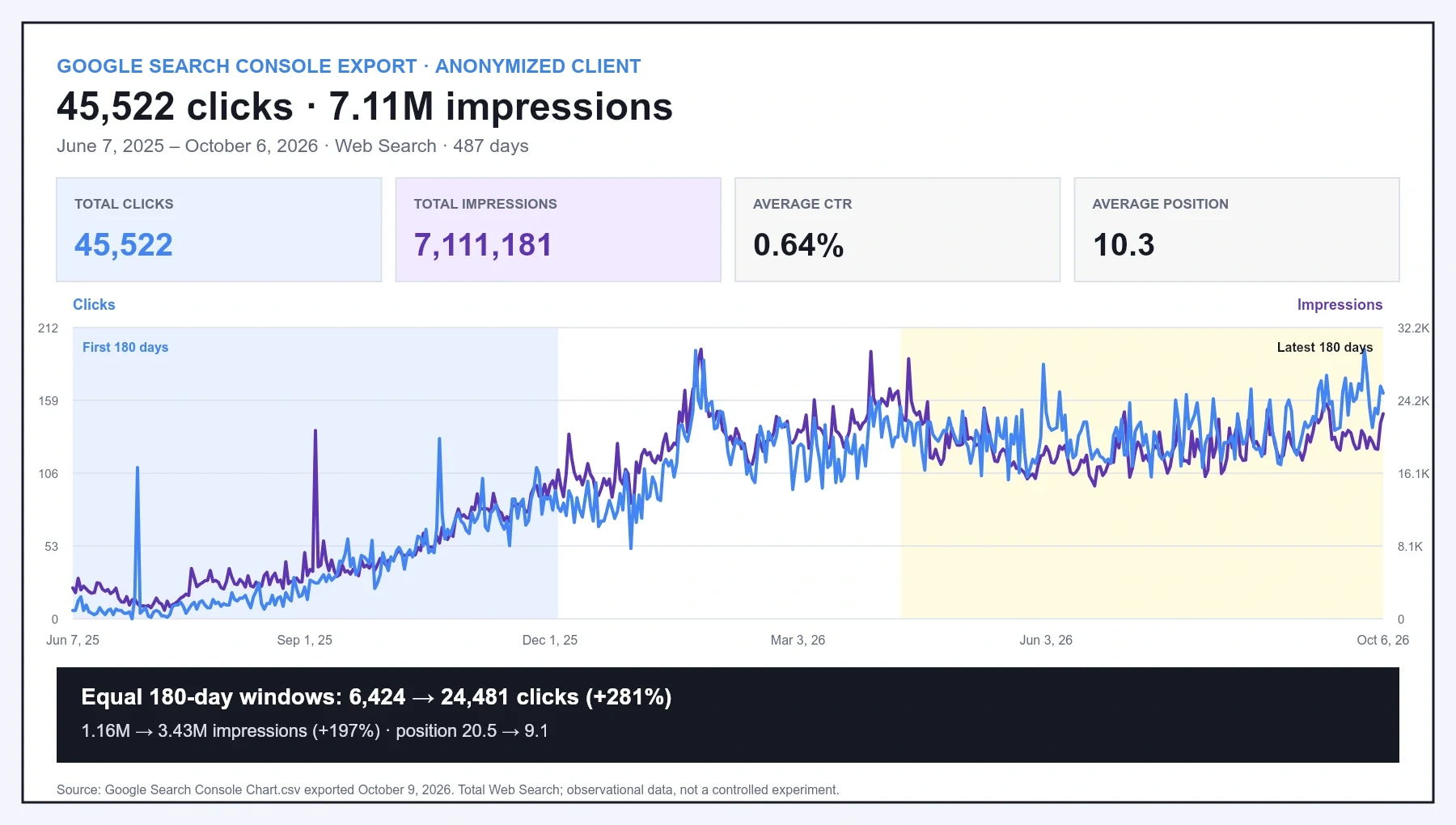
The evidence shows the scale and direction of organic performance for one Dubai workshop. It does not claim that every click came from a map-pack result or guarantee the same outcome for another local market.
Auto repair · one workshop in Al Quoz
Technical priorities, commercial service pages, multilingual content, internal linking and local entity signals supported 45,522 clicks and 7.11M impressions in the retained GSC window.
LCM Express moved multiple competitive courier queries into Yandex Top-10 in Moscow. The supplied report covers August 2018 to February 2019 and limits the claim to the phrases visible in that report.
View courier case →06 / MEASUREMENT
One average position cannot show local search visibility across a service area. Reporting separates market visibility from the actions that create revenue.
Local search rankings from multiple points across the target area, not one office or a personalized search.
Calls, website visits, bookings and directions from the profile where the data is available.
Search Console clicks, impressions and conversions from service and location landing pages.
Calls, forms, bookings and CRM outcomes assigned to the location or market that produced them.
Review velocity, responses, recurring themes and operational issues that affect customer choice.
Local recommendations, citations and referrals from AI systems tracked without guaranteed placement.
07 / PROVIDER FIT
The top local SEO company for one business can be the wrong delivery model for another. A home service brand, local business and franchise need different capacity. Compare ownership, implementation and evidence, not just the size of the sales team. Contractors that need trade, service-area and booked-job detail can review the dedicated Home Services SEO service. Roofing contractors can use the more specific roofing search plan, heating and cooling companies can review the HVAC search plan, plumbing companies can review the plumbing search plan, and pest control companies can review the pest control search plan.
Direct senior access fits a business with internal developers or marketers that can execute a clear strategy. It works well when the problem crosses profile, website, technical and reputation decisions.
A local SEO team can fit multi-location brands that need content, citation operations and project management at scale. Ask who handles strategy after the sale and how branch-level quality is controlled.
A local SEO marketing company may combine search, paid media, digital marketing services, web design services and reputation. Confirm that a local search engine optimization service is a real competency rather than an add-on to advertising.
Start with the current local SEO efforts. Ask how the proposed local SEO tactics connect to measurable local SEO goals, and which changes can create better local rankings.
08 / LOCAL SEO PRICING
Affordable local SEO services use a scope that matches the business problem, not the lowest recurring fee. Location count, market competition and implementation ownership change the cost. Boosting local SEO responsibly means funding the bottleneck, not every possible task.
For teams that need a baseline, competitor view and prioritized plan across profile, citations, reviews, website and tracking.
Defined project · fixed deliverablesFor businesses with an internal team that needs senior decisions, implementation review and market-level reporting.
Monthly access · client executionFor single or multiple locations that need ongoing profile, content, citation, authority and measurement work.
Monthly program · scoped after reviewPricing is set after reviewing the locations, profiles, market and website. A single-location business with clean data needs a different program from a franchise with duplicate listings, weak location pages and central approval. The proposal names the deliverables, owner and reporting model instead of hiding the work inside generic marketing services.
09 / FIRST 90 DAYS
No guaranteed map position and no static setup. Each month produces visible changes and a stronger nearby-demand baseline.
Market audit, competitor and geo-grid baseline, profile review, citation scan, website and conversion checks.
Profile optimization, listing cleanup, priority service and location pages, schema, internal links and review workflow.
Local rankings, calls, leads, profile actions, index quality and AI referrals determine the next market and content cycle.
10 / FAQ
Scope, eligibility, timing and ownership should be clear before the campaign starts.
START HERE
Send the business, target market and location count. I will identify the biggest visibility gap, the first controllable fix and whether an audit, consulting or managed engagement fits.
Cookies, briefly. Essential ones run the site; analytics cookies (Google) only switch on if you say yes. Details in the Privacy Policy.