Emergency and same-day care
Patients need a nearby practice now. The page, Google Business Profile and booking path must confirm availability, location and the next action without forcing research.
GOOGLE + MAPS + AI SEARCH FOR DENTAL PRACTICES
Dental SEO services built around the treatments you want to grow, the locations you serve and the new patient enquiries you can actually measure.
01 / DIRECT ANSWER
Dental SEO is the process of improving a dental practice’s visibility in organic search, Google Maps and relevant AI answers for treatment and location queries. Dental search engine optimization connects technical SEO, dental keyword research, Google Business Profile optimization, treatment pages, local authority, reviews and conversion measurement.
The goal is qualified patient demand, not an isolated position report. A person searching for an emergency dentist needs a different page and next step from someone comparing dental implants or Invisalign. Effective Dentist SEO maps those journeys before content is created and makes the dental website useful at each stage.
Search visibility also depends on trust. Practice details, dentist credentials, dental care content, reviews and claims must be accurate and governed. That makes dental SEO a commercial growth system with healthcare-content constraints, not a generic local SEO package with the industry name changed.
02 / PATIENT INTENT
A dental SEO strategy should start with the dental services the practice can deliver and the local patients it wants to attract. Search volume is useful, but urgency, treatment value, travel distance, clinical fit and booking capacity decide what deserves priority. The dental keywords follow that business decision.
Patients need a nearby practice now. The page, Google Business Profile and booking path must confirm availability, location and the next action without forcing research.
High-value treatment searches need clinical depth, realistic options, trust signals, financing context and a clear consultation path. A generic services page cannot carry every intent.
Map Pack visibility depends on a complete, accurate practice entity plus relevant location pages, reviews, prominence and a website that supports the same facts.
Patients compare dentists, credentials, reviews, treatment approach, prices and evidence. Search visibility only becomes useful when the page resolves those objections.
03 / PRACTICE MODEL
A single-location family dentist, a specialist clinic and a multi-location dental group do not need the same site architecture or reporting. The engagement starts by defining the real operating model.
Connect core care, emergency intent, family needs, the dentist team, reviews and local relevance to one clear practice entity.
Explain candidacy, process, alternatives, proof and consultation steps for high-consideration services without publishing unsupported clinical claims.
Govern treatment templates, location facts, practitioner data, GBP ownership and reporting while preserving useful evidence for each real clinic.
04 / SEARCH SERVICE SCOPE
A comprehensive dental SEO campaign covers the layers that can block new patient acquisition, but it is not delivered as nine disconnected retainers. The first work removes the current constraint and reaches production. Technical, on-page SEO and off-page SEO decisions stay inside one plan.
Indexation, templates, internal links, Core Web Vitals, local signals, treatment coverage, competitors, analytics and conversion paths are reviewed together. The output is a prioritized implementation backlog.
Queries are grouped by treatment, urgency, location, patient stage and commercial value. “Dentist near me” is not the whole market; implants, emergency care, orthodontics and questions create different journeys.
Google Business Profile categories, services, practitioners, locations, NAP consistency, landing pages, citations and map-grid visibility are aligned without creating duplicate or misleading listings.
Each page receives one defensible intent, useful clinical detail, local proof and a clear booking path. Multi-location groups get controlled templates with enough local evidence to avoid thin duplication.
Crawl paths, canonicals, redirects, sitemaps, rendering, schema, mobile performance and appointment technology are checked by template. Critical content stays available in the HTML.
Treatment comparisons, eligibility questions, recovery expectations, cost context and local decision queries are mapped to pages that support patient decisions and strengthen the commercial cluster.
Relevant local, dental, health, association and editorial opportunities are assessed by real audience and topical fit. Link acquisition supports expertise; it does not manufacture clinical credibility.
Brand facts, dentist credentials, direct answers, corroborating sources and structured entities make the practice easier to retrieve in AI Overviews, ChatGPT and Perplexity where measurement is available.
Non-brand search, Map Pack visibility, treatment-page conversions, calls, forms and booked consultations are separated from branded demand. Reporting connects work released to patient acquisition signals.
Every workstream ends in a released fix, approved page, corrected entity, evidence-backed authority asset or measurement decision. The engagement has implementation ownership; it is not a slide deck and monthly keyword export.
05 / SPECIALIST MODEL
A dental SEO expert should understand the commercial and editorial limits of the dental industry, then turn them into practical SEO strategies. The role is not to replace the dentist, web design team or practice manager. It is to coordinate the search system so each owner knows what must be approved and released.
General digital marketing strategies can mix SEO and PPC, social media, web design and campaigns without resolving the organic constraint. Dental SEO marketing works when treatment demand, the dental practice website, the local entity and patient conversion are planned together. That is the difference between a specialist SEO service and generic online marketing activity.
Keyword mapping, technical SEO, local SEO strategy, internal links, content briefs and SEO performance have a named owner.
The dentist approves relevant dental content, providers, dental services, risks, offers and availability before publication.
Developers, editors and the dental office publish approved changes instead of leaving SEO efforts inside a report.
06 / PAGE SYSTEM
A dental website often fails in two opposite ways: one services page tries to rank for every treatment, or hundreds of treatment-city pages repeat the same copy. A defensible structure gives each URL a distinct purpose and connects it to the dental practice.
When patients search for dentists or search for dental services online, the right page must explain the treatment and confirm local availability. The job is to optimize your website for that decision, not publish every relevant dental keyword as a separate URL.
Read the local SEO for dentists checklist →Real location, providers, hours, contact and patient proof.
Clinician-reviewed detail, process, options and next step.
Local team, access, services, reviews and distinctive facts.
Direct answer, named reviewer, sources and update date.
07 / GOOGLE MAPS
Google Business Profile, the dental website and trusted third-party references should describe the same real practice. Categories, services, hours, location, phone, dentists and appointment links need explicit ownership. That consistency supports higher visibility in local search results without pretending proximity can be optimized away.
Reviews are part of the decision path, but the process must stay genuine. Google says incentives for posting, changing or removing reviews are prohibited. I build the workflow around neutral requests, consistent responses and privacy-aware operations.
Read Google’s review guidance →Primary and secondary categories, services, hours, links and practitioner relationships reflect the real location.
The landing page confirms the same treatment, location and booking details in crawlable HTML.
One accurate local citation, relevant local references, reviews and editorial mentions reinforce the entity without mass directory spam.
08 / YMYL + EDITORIAL CONTROL
I structure the search intent, page brief, technical delivery and evidence requirements. A qualified clinician or named practice reviewer owns medical accuracy, treatment eligibility, risk language and regulated claims. Effective dental content needs both owners.
Query intent, architecture, on-page structure, internal links, accessibility, structured data and measurement.
Clinical accuracy, limitations, procedure descriptions, risk, candidacy and approved claims.
Prices, finance, availability, providers, locations, policies and the real booking process.
09 / FIRST 90 DAYS
The first quarter establishes the baseline, removes the biggest constraint and tests the first patient journeys. The roadmap changes when the evidence changes, but every month has an implementation outcome.
Map treatments, locations and competitors; audit the site and GBP; confirm tracking; prioritize technical, trust and conversion constraints.
Fix priority templates, improve core treatment and location pages, align local entities, and publish the first supporting answers with clinical review.
Compare non-brand visibility, map-grid movement and enquiries, then expand only the treatments and locations that have a viable patient and delivery path.
See the full SEO and AI search methodology.
10 / EVIDENCE BOUNDARY
I have first-hand experience auditing dental Google Business Profiles and mapping the location, service and review issues that block visibility. I do not currently present a quantified dental retainer case on this site.
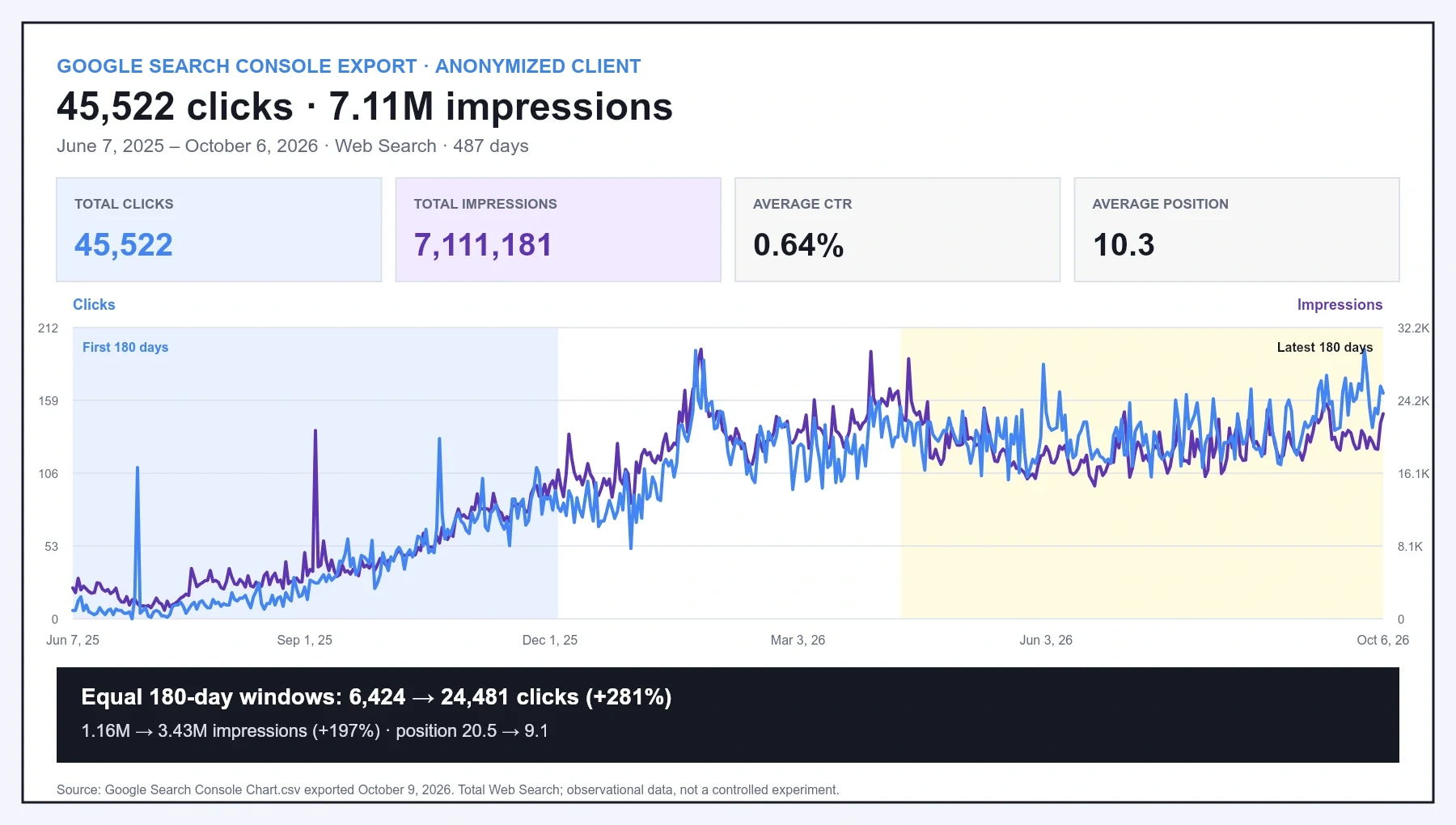
The chart is from a separate, anonymized Dubai auto repair project. It demonstrates work in contested local commercial search: technical priorities, service architecture, multilingual content, internal linking and local entity signals supported a 281% click increase across equal 180-day windows. It is evidence for the local-search mechanism, not a claim that a dental practice will reproduce these numbers.
11 / MEASUREMENT
Dental SEO reporting should separate work released, search response and patient response. Those dental SEO strategies are judged by new patient response, not an average position alone. SEO results must also match dental business capacity: a clinic should not scale demand for a treatment it cannot schedule or deliver.
Did approved work reach production?
Can new patients discover the practice?
Does the search visit become an enquiry?
Should the practice expand or change the strategy?
12 / PARTNER SELECTION
A dental SEO agency can be useful when the practice needs a dedicated content, local and development team. A dental SEO consultant can fit better when the clinic already has implementation resources and needs direct strategy, governance and specialist coordination.
Whether you compare a dental marketing company, an SEO company for dentists or an SEO agency for dentists, check the same evidence. Ask to see the page system, implementation ownership, review standards and reporting model. A polished dashboard does not prove that booked-patient demand is growing.
The best dental SEO company for one clinic may be wrong for another. Small business SEO for a single dental office differs from a multi-location program for dental practices across several markets. Proven SEO strategies still need the right practice model, budget and implementation team.
Named or anonymized proof should state the market, timeframe, metric source and the partner’s actual role. Proven SEO in another local niche is useful context, not dental proof.
The process needs a named practice reviewer. SEO expertise does not make someone a dentist.
Strategy, copy and technical recommendations need owners, deadlines and release acceptance.
No legitimate dental SEO company controls Google, AI citations or patient feedback. Generic SEO techniques and packaged SEO solutions do not change that boundary.
13 / FAQ
Direct answers to the commercial and implementation questions that affect a dental SEO campaign.
Dental SEO is search engine optimization for dentists, dental practices and multi-location dental groups. It improves how a practice appears in organic results, Google Maps and relevant AI answers for treatment, location and patient-decision queries. The work combines technical SEO, dental keyword research, Google Business Profile optimization, treatment and location pages, reviews, authority and conversion measurement. Its commercial purpose is not traffic alone; it is qualified visibility that can produce calls, consultation requests and booked patients.
Dental SEO applies general search principles to a local, healthcare-adjacent decision with higher trust requirements. Patients search by treatment, urgency, location, insurance or financing, provider and symptoms, then compare credentials and reviews before booking. The strategy therefore needs accurate clinical content, practitioner and practice entities, strong local signals, review-policy compliance and treatment-level conversion tracking. A generic keyword plan can miss the patient journey and create thin pages that neither users nor search engines can trust.
Dental SEO usually needs several months to produce meaningful non-brand visibility, but timing depends on the market, website, competition, treatment mix and implementation speed. Technical fixes and Google Business Profile improvements can be visible sooner, while competitive implant, cosmetic or “dentist near me” terms may require sustained content and authority work. I separate early indicators such as released pages, indexation and impressions from later outcomes such as qualified calls, consultation requests and booked treatments.
A dental SEO service should include market and keyword research, technical auditing, treatment and location architecture, on-page optimization, Google Business Profile work, review guidance, content planning, authority development and measurement. The exact scope should follow the current constraint. A practice with weak indexation needs technical work before more articles; a practice ranking locally but not converting needs stronger treatment pages and booking paths. Every task should map to a released asset or measurable decision.
Most dental practices need local SEO because patients commonly choose a provider within a practical travel area. A complete and accurate Google Business Profile supports visibility in Google Maps and the local pack, while the website confirms treatments, practitioners, location and trust. GBP work cannot replace the website, and location pages cannot compensate for inaccurate profile data. The strongest system keeps categories, services, contact details, hours, practitioner information and landing-page facts consistent.
A treatment should have its own page when it represents a distinct patient intent and the practice can provide useful, clinically reviewed information about it. Dental implants, Invisalign, emergency dentistry, veneers, pediatric care, root canal treatment and sedation can require separate journeys. The page should explain candidacy, process, alternatives, expected next steps and local availability without making unsupported promises. Closely related variants should stay together when separate pages would only repeat the same answer.
Dental practices can ask genuine patients for Google reviews, but incentives, review gating and fabricated engagement should be avoided. Requests should be neutral, voluntary and appropriate for local privacy and healthcare rules. Google states that incentives in exchange for posting, changing or removing a review are prohibited. A sustainable review workflow asks consistently, protects patient information, responds professionally and treats negative feedback as operational evidence rather than something to suppress.
A dental website does not automatically create qualified search visibility or new patient demand. Dental website design may establish the visual experience, while SEO checks whether search engines can crawl the pages, whether relevant dental keywords map to distinct intents, and whether treatment and location pages lead to an enquiry. The right plan does not rebuild a functional site by default. It identifies the technical, content, authority or conversion work required to optimize your website before adding more pages.
SEO and Google Ads solve different acquisition problems. Ads can place a dental practice in front of demand quickly, but the traffic stops when spending stops. SEO builds organic and local visibility that can compound, but it requires implementation and time. Many practices use SEO and PPC together, then compare cost, lead quality and booked treatment value by channel. A dental marketing strategy should fund the channel that matches current capacity rather than declaring one universally better.
Dental SEO can improve the source material and entity signals that AI systems use, but no consultant can guarantee a citation. Clear practice facts, dentist credentials, treatment pages, direct answers, structured data, reviews and corroborating mentions make the brand easier to understand and retrieve. AI visibility should be monitored alongside Google Search and Maps, not sold as a separate magic channel. The same factual, technically accessible content supports both classic search and generative search.
Dental SEO pricing depends on market competition, number of locations, treatment priorities, website condition, content production and implementation ownership. A single-location general practice has a different scope from a multi-location group targeting implants and cosmetic care across several cities. Pricing should state what is included, who publishes changes, how clinical review works and what reporting connects to patient acquisition. A low monthly fee is not efficient when it only buys generic articles and an activity report.
Choose a dental SEO partner by reviewing the actual strategy, evidence and delivery model. Ask how treatment intent is mapped, who reviews clinical copy, how Google Business Profile changes are governed, which metrics separate branded from non-brand demand, and who implements technical fixes. Dental SEO companies should disclose whether they have dental-specific case evidence. Avoid guaranteed rankings, fake reviews, cloned city pages, undisclosed link networks and claims that every AI platform can be controlled.
One page rarely serves every dental treatment and location well because the search intent, evidence and conversion path change. A broad practice page can summarize the offer, but high-value treatments and real locations usually need dedicated pages when there is enough unique information. The solution is not unlimited page generation. A controlled architecture assigns one primary purpose to each URL, connects related pages and prevents near-duplicate city or treatment combinations from competing with one another.
14 / DENTAL SEO BRIEF
Send the practice website, locations and priority treatments. I will review whether the first constraint is technical, local, content, authority, conversion or measurement.
Cookies, briefly. Essential ones run the site; analytics cookies (Google) only switch on if you say yes. Details in the Privacy Policy.