Traffic fell
Organic clicks or impressions dropped after a release, migration, redesign or algorithm change, and the team needs evidence before changing more pages.
CRAWL + INDEXATION + PERFORMANCE + AI ACCESS
Technical SEO audit services that turn crawl data, Search Console evidence and template problems into a prioritized action plan your developers can implement.
DIRECT ANSWER
A technical SEO audit service is a structured review of how search engines crawl, render, index and understand a website. It checks robots.txt, XML sitemaps, canonicals, redirects, internal linking, page speed, Core Web Vitals, structured data and template behavior. Professional SEO auditing does more than list errors: it identifies the root cause, shows affected URL patterns and produces a prioritized action plan with an owner and a QA method for every material fix.
The objective is search visibility, not a perfect tool score. Google Search Console, analytics, crawl data and manual inspection are compared because no single web crawler sees the whole system. For AI search projects, the same audit also checks whether important content is available in clean HTML and whether GPTBot, OAI-SearchBot, PerplexityBot and other relevant agents are blocked by robots.txt, a CDN or a web application firewall.
01 / WHEN TO AUDIT
An SEO audit service is useful when it can resolve a real uncertainty. These are the situations where a technical diagnosis usually comes before more content, backlinks or redesign work.
Organic clicks or impressions dropped after a release, migration, redesign or algorithm change, and the team needs evidence before changing more pages.
Google Search Console shows the wrong canonical URLs, excluded money pages, duplicate clusters, soft 404s or an indexed page count that does not match the intended site.
A new market, ecommerce catalog, programmatic template or multi-location rollout could multiply one technical mistake across hundreds or thousands of URLs.
Content and backlinks are increasing, but search visibility is flat because crawl paths, internal linking, rendering or template quality are holding the site back.
02 / AUDIT COVERAGE
A website SEO audit has to connect machine access, page templates and measurement. Each layer below ends in a reproducible finding, not a generic best-practice statement.
robots.txt, XML sitemap, status codes, blocked resources, crawl traps, parameters and bot access
Can Google, Bing and relevant AI crawlers fetch the right URLs cleanly?canonicals, noindex, duplicates, soft 404s, pagination, hreflang and migration signals
Is the search engine storing the version the business actually wants to rank?internal linking, click depth, orphan pages, navigation, hubs, facets and template hierarchy
Do authority and context reach the commercial pages that need them?server HTML, JavaScript dependency, mobile parity, lazy loading and client-side content
Is critical content present when a web crawler or retrieval system reads the page?Core Web Vitals, TTFB, LCP, INP, CLS, image delivery, fonts and third-party scripts
Does the page load and remain stable enough for users and search systems?Organization, Person, Service, Product, Article, FAQ and breadcrumb schema
Does schema confirm visible facts without inventing entities or claims?Google Search Console, analytics, log files, conversion events and release annotations
Can the team connect a technical change to crawl, visibility and business outcomes?GPTBot, OAI-SearchBot, PerplexityBot, ClaudeBot, WAF rules and extractable answer blocks
Can AI systems access and understand the same source content as traditional search engines?03 / WHAT I CHECK
Screaming Frog, Google Search Console, PageSpeed Insights, browser developer tools and server data can surface clues. The audit determines which clues represent a ranking or conversion constraint and which are only tool noise.
Robots directives, crawl traps, faceted navigation, status-code chains, broken links, server errors, wasted parameters and bot behavior.
Remove blocked paths and wasted crawl targets before trying to increase crawl volume.Canonical tags, noindex rules, duplicate content, soft 404s, alternate URLs, sitemap coverage and Google-selected canonicals.
Define one indexable version and make every technical signal support it.Navigation, internal linking, click depth, orphan pages, breadcrumbs, pagination, category relationships and hub-and-spoke structure.
Move authority and semantic context toward priority service, product and location pages.Server-side HTML, hydrated content, lazy loading, blocked resources, modal dependence and differences between desktop and mobile output.
Keep critical copy, links and structured facts accessible without a user interaction.Largest Contentful Paint, Interaction to Next Paint, Cumulative Layout Shift, TTFB, images, fonts, scripts and third-party tags.
Fix template-level causes that affect real visitors instead of chasing laboratory scores alone.Schema markup validity, entity IDs, visible-content parity, nested types, eligibility and consistency across templates.
Use structured data implementation to confirm the page, not to manufacture claims.Hreflang, language-region mapping, redirects, legacy URLs, domain changes, staging leakage and release history.
Make the migration path and intended market unambiguous to every search engine.Conversion events, Search Console segmentation, AI referrers, crawler logs, hallucinated 404s and access by generative search systems.
Create a baseline that can prove whether implementation changed visibility and outcomes.04 / DELIVERABLE
A quality SEO audit has to survive handoff. Every priority finding explains what is wrong, how it was verified, which templates are affected, why the issue matters and how the team can confirm the repair after release.
05 / AUDIT PROCESS
The sequence matters. I define the intended website before collecting data, diagnose root causes before writing tickets and verify changed templates after deployment when implementation support is in scope.
I confirm markets, priority templates, historic migrations, known incidents, development constraints and which URL set should be indexed. That prevents a tool from defining the business architecture by accident.
A full crawl is compared with XML sitemaps, Google Search Console, analytics, server responses and log files when available. I inspect representative templates manually on mobile and desktop.
Findings are grouped by root cause and affected template. One canonical bug across 20,000 URLs is treated as one engineering problem, not 20,000 rows in a spreadsheet.
Each issue receives impact, effort, dependency, owner and a QA method. Blocking crawl and indexation errors come before optional enhancements or cosmetic tool warnings.
I walk the team through the roadmap, answer implementation questions, review tickets or pull requests and re-crawl the affected patterns after deployment when QA is included.
CHOOSE THE RIGHT SCOPE
These engagements overlap, but they answer different questions. Starting with the narrowest valid scope keeps the work useful and avoids paying for a report the team cannot implement.
Crawlability, indexation, architecture, rendering, page speed or schema may be blocking growth.
Technical SEO AuditEvidence-backed engineering backlog and fix order.Technical, content, backlink, competitor and commercial factors all need diagnosis.
Full SEO AuditCross-functional strategy covering the complete organic system.The team already has data but needs priorities, governance and implementation decisions over time.
SEO ConsultingRoadmap, working sessions, decision support and reporting.The site needs discoverability in ChatGPT, Perplexity, AI Overviews and other AI systems.
AI SEOEntity, answer-format, citation and generative visibility work.SCOPE BOUNDARIES
Technical SEO auditing is one layer of search engine optimization. This section makes the boundary explicit so the team knows which SEO issues belong in the engineering backlog and which need a broader strategy.
A comprehensive technical SEO review covers access, indexation, architecture, rendering, website performance and structured data. It identifies crawl error patterns, broken links, redirect logic, robots.txt conflicts, meta directives and other technical issues that affect users and search engines.
The analysis of your website is based on evidence from SEO tools and platform data, but the output is not a free SEO checker report. Automated best practices cannot prioritize dependencies or explain why a warning matters to current SEO performance.
A comprehensive audit can add a content audit, on-page SEO, off-page SEO, keyword strategy, local SEO and backlink profile analysis. Those SEO elements matter for overall SEO success, but they are not disguised as technical findings simply to make the report longer.
If search engine rankings are limited by weak pages or authority rather than infrastructure, the SEO recommendations move into content, backlink or digital marketing strategy. That is when a full SEO audit is a better fit than an SEO technical audit alone.
The audit uses ranking, organic traffic, organic search results and conversion rate data to prioritize engineering work. The objective is to improve website access and user experience, then measure search performance on the affected templates.
SEO optimization cannot guarantee search rankings after an algorithm update. It can remove technical constraints, protect search visibility and give SEO strategies a reliable platform. Content quality, brand demand and backlinks still influence the final search results.
You work directly with Dima rather than through an SEO audit agency account team. That gives founders, developers and SEO specialists one source for diagnosis, priorities and QA. I bring SEO insights to the engineering conversation without reselling unrelated marketing services.
A large SEO agency or SEO audit company may be useful when a client needs many disciplines at once. My model is focused: professional SEO audit services, direct access and technical SEO services that help a capable team ship the right solutions.
A free SEO tool can reveal a missing title, broken link or obvious crawl error. It cannot reliably determine the affected template, business impact, dependency, owner or implementation risk. Use it for a quick check, not as a substitute for accountable SEO auditing.
06 / IMPLEMENTATION
An audit can be delivered as a fixed-scope diagnosis, but technical SEO services create value only after the right fixes reach production. I can work directly with a founder, an in-house SEO team or developers without turning the engagement into an indefinite retainer.
07 / REAL IMPLEMENTATION PROOF
This result came from diagnosis followed by technical, on-page and commercial implementation. It is evidence that the process can find and remove constraints; it is not a claim that an audit PDF alone creates traffic or leads.
Vehicle certification marketplace
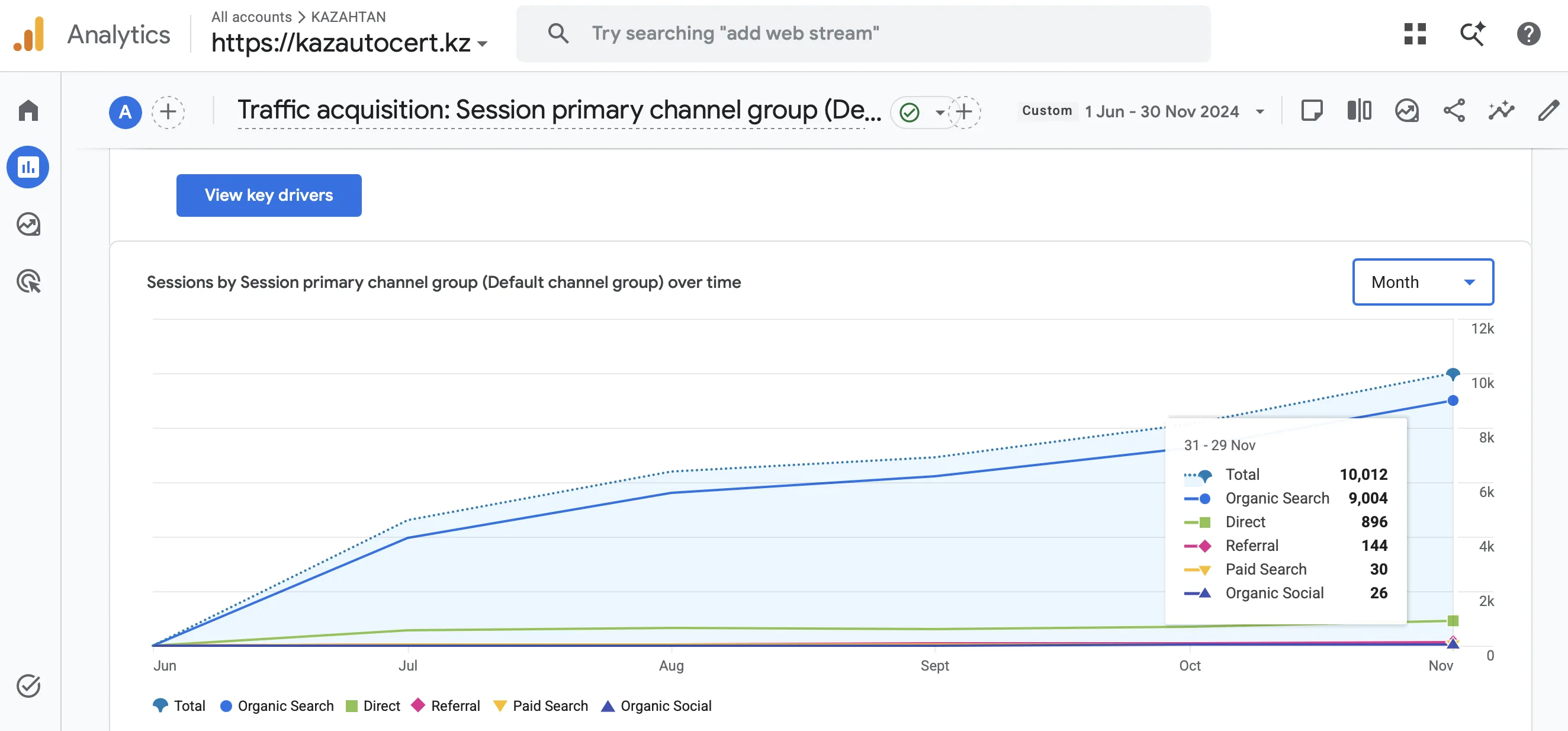
The project started with technical and structural diagnosis, then moved through indexation fixes, commercial page work and implementation. Organic Search reached 9,004 sessions in the measured month, 80% of tracked keywords entered the Top 10 and the lead inbox recorded 86 enquiries.
08 / TIMELINE AND PRICING
A 40-page service website and a 40,000-URL ecommerce catalog are not the same technical audit. Pricing is quoted after the URL count, template count, stack, markets, historic migrations, data access and implementation responsibility are clear.
A focused service-site audit can move faster. Large ecommerce, international or JavaScript-heavy websites need more crawl time, representative template testing and stakeholder access. Urgent migration or traffic-drop investigations can be scoped around the highest-risk evidence first.
Ten thousand URLs generated by five clean templates can be easier to audit than 500 URLs spread across several systems. The quote reflects diagnostic depth, data sources, markets, implementation notes and whether post-release QA is required.
The best evidence usually comes from Google Search Console, analytics, crawl access, sitemap and server behavior. CMS, log-file or staging access improves the diagnosis when available, but I separate required access from useful access before work begins.
You receive a defined deliverable, timeline, ownership boundary and fee before the audit starts. If the problem is clearly broader than technical SEO, I will say so instead of expanding the report with low-value checks.
09 / MEASUREMENT
A technical audit is not judged by the number of red cells it produces. After implementation, the first question is whether the intended pages became crawlable, indexable, faster and easier to understand. Organic growth is measured on the affected templates after those constraints change.
FAQ
Direct answers to the scope, cost, implementation and AI-access questions buyers usually ask before an audit.
A technical SEO audit is a structured review of how search engines crawl, render, index and understand a website. It checks robots.txt, sitemap, canonicals, redirects, internal links, structured data, Core Web Vitals, mobile rendering and template-level issues before content or link work begins.
You need one before a migration, after a traffic drop, when indexed pages do not match the pages you expect, when Core Web Vitals or rendering problems block growth, or before investing heavily in content and links. The audit prevents you from building on a broken foundation.
Yes. A full SEO audit also covers content strategy, competitors, backlink gaps and commercial positioning. A technical SEO audit focuses on crawlability, indexation, architecture, performance, structured data and implementation issues that developers can fix.
You get a prioritized issue list, evidence for each finding, affected URL patterns, recommended fixes, developer-ready notes and a short strategic summary that explains what should be fixed first and what can wait.
I can implement lightweight CMS and markup fixes directly when access allows, or work with your developers through tickets, PR review and QA. The audit itself is scoped separately from implementation so the diagnosis stays clean.
Yes. For this site category, technical SEO now includes GPTBot, OAI-SearchBot, PerplexityBot, ClaudeBot and other AI crawler access, plus whether important content is available in clean HTML that retrieval systems can parse.
Pricing is quoted after I know the site size, templates, crawl depth, stack and urgency. I do not publish fixed packages because a 40-page service site and a 40,000-URL ecommerce site are different audits.
Yes, and it usually should. AI search visibility depends on crawlability, clean entities, structured content and reliable HTML. If those are broken, GEO and AEO work gets built on weak infrastructure.
Ongoing engineering-side SEO work: crawl and indexation management, site speed, structured data, migrations and log analysis. An audit is the diagnostic snapshot; technical SEO services are the continuing practice that keeps the machine layer healthy.
The layer of SEO that makes a site machine-readable: crawlability, indexation, speed, rendering, structured data and architecture. Content can't rank or get cited if the technical layer blocks the machines from reading it.
Technical SEO is one of three layers; full SEO adds content (intent, quality) and authority (links, mentions). A full audit covers all three, a technical audit goes deep on the machine-access layer alone.
Crawl the site, compare against Search Console data, check robots/canonicals/redirects/sitemaps, measure Core Web Vitals, validate structured data, and verify AI-crawler access (CDN and WAF included). Then fix in impact order, template-level first.
START HERE
Send the website, target markets and the symptom you are trying to diagnose. I will identify the likely audit boundary, required access and whether a technical audit, full audit or consulting engagement is the better fit.
Cookies, briefly. Essential ones run the site; analytics cookies (Google) only switch on if you say yes. Details in the Privacy Policy.