a zine about getting found — issue 01
filed under: home / services / seo audit

SEO Audit services

Full-site diagnosis: technical, content, authority, AI visibility. The flagship — everything else feeds into it.

every engagement here starts with this
I run this myself — no juniors
Q: What is SEO Audit?

A full SEO audit that diagnoses technical health, content quality, authority and AI-search visibility, and turns the findings into a prioritized roadmap with owners and expected impact.

What’s inside.

the full stack, one strategist
01Technical layer
Crawl, indexation, canonicals, redirects, Core Web Vitals, structured data and AI-crawler access.
02Content layer
Intent match, cannibalization, thin and outdated pages, answer-format readiness, E-E-A-T signals.
03Authority layer
Backlink profile quality, anchor risks, competitor gap, unlinked mentions worth claiming.
04AI visibility layer
How ChatGPT, Perplexity and Google AI Overviews currently see, describe and cite the brand.
05Prioritized roadmap
Findings ranked by impact vs effort, with owners, a plan a team can execute, not a PDF that gets archived.

What a full SEO audit covers

A useful audit answers one question: what exactly is holding this site back, and in what order should it be fixed? To answer it honestly you have to look at four layers at once. The technical layer, can search engines and AI crawlers reach, render and index the site. The content layer, does what's published match what buyers actually search, and is it structured so answer engines can lift it. The authority layer, do links and mentions support the rankings the content deserves. And the AI visibility layer, when someone asks ChatGPT or Google AI Overviews about your category, does the brand appear, and if not, who does.

Most audits on the market cover the first layer and call it a day. That's how sites end up with a clean crawl report and flat traffic: the crawl was never the bottleneck. The point of auditing all four layers together is that the bottleneck is usually in the layer nobody was looking at.

How the audit works, step by step

First week: access to Search Console and analytics, a full crawl, and a baseline of current AI-answer visibility for the query set that matters to your business. I look at what Google already tells us, impressions with no clicks, pages that rank 8–15, queries where you're invisible, because the fastest wins usually hide there.

Second week: the deep pass. Template-level technical issues, content mapped against real intent, backlink profile against the competitors who actually outrank you (not the ones you think of as competitors). Every finding gets evidence attached: a screenshot, a crawl export, a GSC query, so nothing rests on my opinion.

Third week: the roadmap. Findings ranked by impact against effort, each with an owner, developer, content, or SEO, and a walkthrough call. The deliverable is designed for execution, which is why the natural next step is either your team running it or consulting where we run it together.

SEO audit vs technical SEO audit — which one do you need

If you already know the symptom is technical, the site is slow, pages drop out of the index, a migration went wrong, the narrower technical SEO audit is cheaper and faster. If the symptom is business-level, traffic is flat, leads dried up, a competitor overtook you and nobody knows why, you need the full audit, because assuming the cause is technical is exactly the kind of guess that wastes a quarter.

SituationRight scope
Migration broke something, index is shrinkingTechnical audit
Traffic flat for 6+ months, cause unknownFull SEO audit
Competitor cited by AI instead of youFull audit (AI visibility layer)
New site before launchTechnical audit + content review

What the audit keeps finding

After dozens of these, the same patterns repeat. Sites that rank 8–15 for money queries with pages that answer the question in paragraph six, a structure fix, not a content rewrite. Templated pages competing with each other because nobody decided which URL owns which intent. Robots rules written years ago that now block the AI crawlers the business wants attention from. Authority concentrated on the homepage while the money pages sit unlinked. And almost universally: zero visibility into what AI assistants say about the brand, because nobody has ever asked them.

None of these show up in an automated tool score. All of them show up in lost revenue.

What you get, concretely

A prioritized roadmap, typically 25–60 findings depending on site size, where every line has evidence, a fix, an owner and an impact estimate. The top of the list is always the same kind of item: highest impact, lowest effort, fastest to ship. You could stop reading after the first ten items and still get most of the value, which is the point: an audit that only works if you implement all of it is a bad audit.

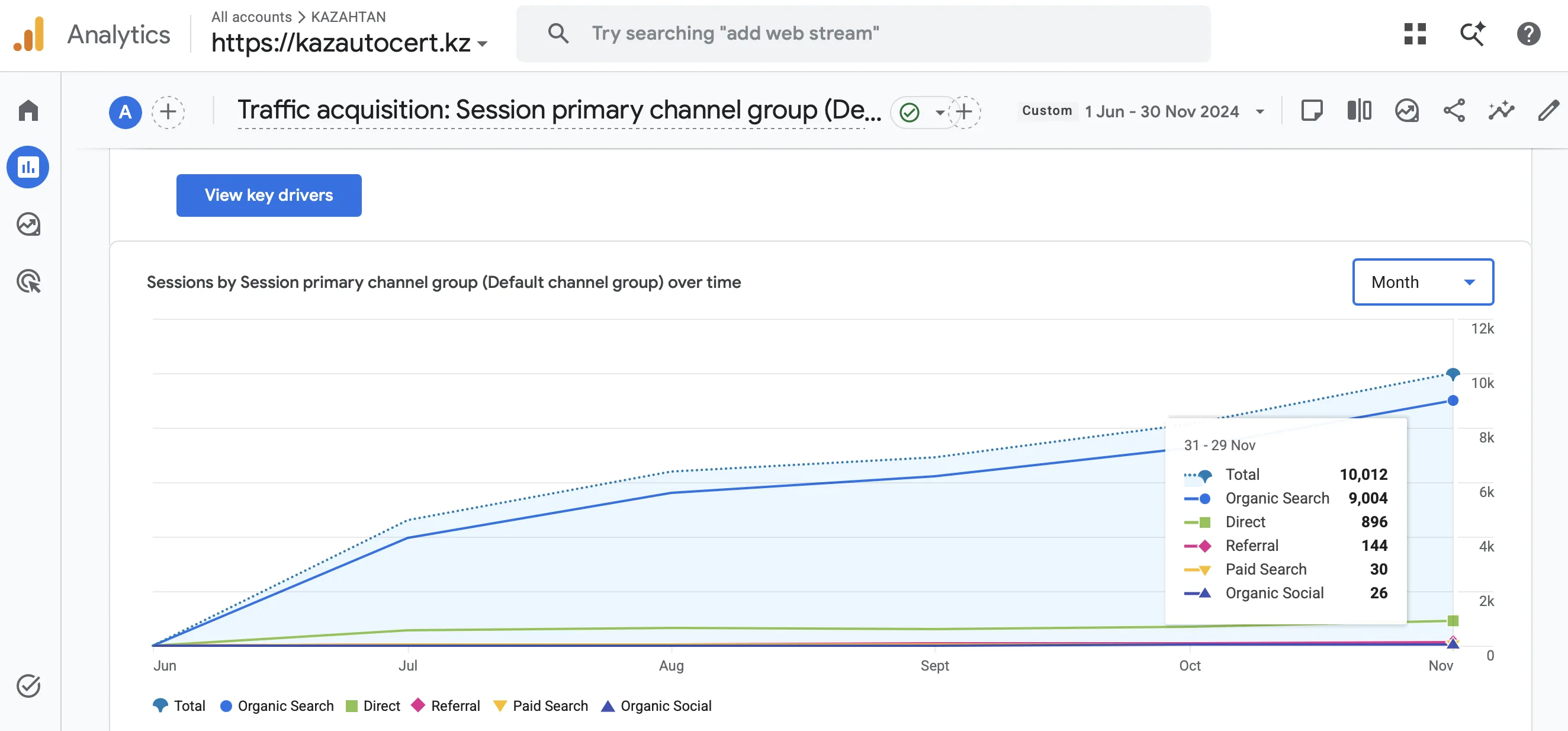
Real example of the shape this takes: for a certification-services site that had zero organic leads, the audit-first approach found the intent mismatch and technical blockers, and the roadmap took the site from zero to 4–5 organic leads per day with 80% of keywords in Top-10. For an AI mental-health startup, the same process delivered 9× growth in daily clicks over six months.

How audit results are measured

The audit itself has a binary measure: can your team execute from it without asking me what each line means. The work it unlocks is measured the normal way, impressions and clicks in Search Console, rankings for the mapped query set, and AI-answer presence tracked month over month for the prompt set we define during the audit. I set the baseline during the audit precisely so that three months later 'did it work' is a data question, not a feelings question.

If you want the recurring version, where the roadmap is re-checked and re-prioritized quarterly as the site and the SERPs move, that's the consulting engagement; the audit is its first deliverable.

Related results.

cut from real reports

FAQ.

answer-format on purpose
What is an SEO audit?
An SEO audit is a structured diagnosis of everything that affects a site's search performance: technical health (crawl, indexation, speed), content quality and intent match, authority signals, and, in 2026, visibility inside AI answers. The output is a prioritized list of issues with fixes, not just a report.
What's the difference between an SEO audit and a technical SEO audit?
A technical SEO audit covers one layer: crawl, indexation, rendering, performance and structured data. A full SEO audit adds the content layer (intent, quality, cannibalization), the authority layer (backlinks, mentions) and AI-search visibility. If you already know the problem is technical, start narrow; if you don't know where the problem is, start full.
How long does an SEO audit take?
For most sites, 2–3 weeks from access to the delivered roadmap. Large platforms with templated page types can take longer, but the first critical findings usually surface within the first week.
What do you need from me to start?
Read access to Google Search Console and your analytics, and a short call about your business priorities. That's enough for the audit; nothing on your site is changed during it.
How much does an SEO audit cost?
It's a fixed-scope, fixed-price engagement quoted after a quick look at the site's size and stack, a 50-page services site and a 50,000-URL platform are different jobs. See the pricing page for how engagements are priced; there is no one-size rate card.
What does the deliverable look like?
A prioritized roadmap: each finding with evidence (screenshots, crawl data, GSC queries), the fix, who should own it (developer, content, SEO), and expected impact. Plus a walkthrough call so nothing depends on interpreting a document alone.
Do you audit AI visibility too?
Yes, it's a standard layer. The audit checks how AI assistants currently describe the brand, whether AI crawlers can access the site, whether content is structured for extraction, and which competitors are being cited in your place.
What happens after the audit?
Three options: your team executes the roadmap, we execute it together through SEO consulting, or a mix — I take the technical and strategic items, your team takes content. The audit is written so any of the three works.

Also see: AI SEO · Generative Engine Optimization · SEO Consulting · Technical SEO Audit

Wondering about cost? How SEO pricing works here — audit first, quote after.

Dima Mochalov
Dima Mochalov
SEO & AEO Specialist · 9+ years · Head of SEO, Marketing Bear (Dubai)
written by a human who ranks things
About the author

Be the answer, not a footnote.

reply is fast — it’s just me here
iNevidimka — Dima MochalovPrivacy · Terms · © 2026
Operated by Mochalov Dmitri Andrei IE (Individual Entrepreneur (Armenia)) · Reg. 20268705 · Arghishti str. 7, suite 0015, Yerevan, Kentron, Armenia. All engagements are governed by our Terms of Service.