One defect becomes thousands of defects.
A canonical, rendering or internal-link mistake in one component can affect thousands of pages before a monthly audit notices the pattern.
GOVERNANCE + SCALE + ORGANIC GROWTH
Enterprise SEO services for complex websites and organizations that need search standards to survive thousands of pages, multiple teams, global markets and continuous releases.
DIRECT ANSWER
Enterprise SEO is search engine optimization designed for a large organization, complex website or portfolio where scale and coordination materially change how search work reaches production. It combines technical SEO, content strategy, authority, analytics and governance across thousands of pages, multiple teams, platforms or markets.
Enterprise search engine optimization is operational. A recommendation for one page can be edited directly. A recommendation affecting a product template, international route or navigation component needs an owner, impact model, acceptance criteria, release window, QA sample and monitoring plan. Enterprise SEO requires a system that makes the correct behavior repeatable.
That system should support Google Search, organic search results and AI discovery without turning SEO into a detached digital marketing activity. Search demand is connected to products, target audiences and business outcomes. Technical issues are grouped by pattern. Content creation follows explicit page roles. Reporting shows visibility, conversion, revenue and risk, with attribution limits stated. Teams expanding across countries can use the dedicated international SEO services model for market selection, localization and hreflang governance.
01 / THE DIFFERENCE
Scale changes both the failure mode and the delivery model. The work must fit the organization that owns the website.
02 / THE CONSTRAINT
The problem is rarely a missing checklist. It is the multiplication of small defects and disconnected decisions across a live organization.
A canonical, rendering or internal-link mistake in one component can affect thousands of pages before a monthly audit notices the pattern.
Product, engineering, content, brand, legal, analytics and regional teams can all control part of the same search outcome.
Migrations, redesigns, taxonomy changes and JavaScript releases need parity checks, rollback criteria and monitoring before launch.
International and local SEO need shared technical rules with enough market flexibility to match language, demand, regulation and customer intent.
03 / BUYER FIT
Enterprise level work is defined by complexity and risk, not only company headcount. The purpose is to help enterprise teams control a search system they can no longer manage through isolated page edits.
Marketplaces, publishers, SaaS platforms and e-commerce SEO programs need crawl, index and content rules applied at the system layer.
International, multi-language and local SEO programs need shared standards without erasing market-specific demand and legal requirements.
Redirects, parity, rendering, analytics and launch monitoring need independent review before organic demand is exposed to irreversible decisions.
04 / SERVICE SCOPE
A tailored enterprise SEO strategy connects research, standards, tickets, releases, authority and measurement. Each workstream must produce an owned artifact or shipped outcome.
Keyword research, search intent, audience and business value are mapped across products, markets and funnel stages. The output is an information architecture and ownership model, not a keyword spreadsheet.
Crawl paths, rendering, indexation, canonicals, pagination, faceted navigation, structured data, Core Web Vitals and log patterns become prioritized engineering work.
SEO requirements are translated into reusable design-system rules, acceptance criteria and automated checks so every release does not require a fresh audit.
Enterprise SEO and content teams receive page roles, quality standards, approval paths, internal-link rules, refresh triggers and consolidation criteria across the portfolio.
Hreflang, market routing, localization, content parity, location templates and Google Business Profile governance are coordinated without creating duplicate content.
Inventories, redirect and canonical matrices, staging parity, launch checks, monitoring and rollback thresholds protect organic search during high-risk change.
Original data, experts, category evidence, relevant link building and brand mentions reinforce priority topics instead of purchasing disconnected backlinks.
Crawlable facts, entity consistency, answer-ready content, external corroboration and prompt measurement improve visibility in Google AI Overviews, ChatGPT and Perplexity.
Search Console, analytics, CRM and business data connect visibility to conversions, revenue, risk avoided and return on investment with stated attribution limits.
05 / OPERATING MODEL
Enterprise organizations do not need another channel demanding priority. They need a search framework that works inside planning, development, compliance and reporting.
See the working methodology →Quantify the affected URLs, search demand, business value, dependency and cost of delay.
Name the decision maker, implementer, reviewers and the condition that proves the work is complete.
Test representative templates, monitor the rollout and keep rollback criteria for high-risk changes.
Compare expected and realized impact, then update standards and the next priority queue.
06 / TECHNICAL SCALE
Advanced technical SEO begins by finding the layer where a defect originates. The objective is durable control across enterprise websites.
Titles, headings, canonicals, schema markup, internal links, media and index rules are defined by page role and tested in rendered HTML.
Log files, crawls and Search Console expose waste, orphan patterns, duplicate content, faceted traps and mismatched canonical signals.
Core Web Vitals, JavaScript rendering, image delivery and component weight receive thresholds that design and engineering can enforce.
URL inventories, redirects, metadata, content, links, schema, analytics and index controls are compared before and after release.
07 / SITE MODEL
Successful enterprise SEO does not force every business into one comprehensive SEO package. The same standards for evidence and accountability apply, but the inventory, workflow and commercial event differ.
Enterprise e-commerce SEO connects categories, products, variants, facets and availability to real search demand. The SEO framework defines which combinations deserve indexation, how discontinued inventory is handled, and how templates preserve unique product data. Organic growth depends on useful catalog coverage, not the number of filter URLs a search engine can discover.
SEO for SaaS companies maps category, use case, integration, comparison, alternative and documentation demand to trials, demos or pipeline. Enterprise scale adds several product lines, application subdomains, release dependencies and buying committees. SEO and content teams need one narrative across marketing pages, product documentation and AI-search sources.
Publishers and marketplaces manage large data models, user-generated pages and programmatic templates. Structured enterprise SEO defines minimum value, internal-link rules, freshness, consolidation and removal. This prevents low-value inventory from consuming crawl resources while important entities and topic relationships remain buried.
Large location networks combine enterprise standards with local SEO services. A central team controls names, addresses, categories, structured data and template quality; regional owners contribute accurate services, evidence and market context. The result must serve customers in each location rather than create near-duplicate city pages for optimization services alone.
A full-service digital marketing agency may coordinate paid media, creative, CRO and analytics across the same enterprise clients. That breadth is useful only when specialist SEO performance still has clear ownership. Enterprise SEO initiatives should not disappear inside a general campaign calendar: technical dependencies, organic demand and search-engine risk need their own backlog, standards and decision rights.
08 / FIRST 90 DAYS
The first quarter establishes control, ships priority improvements and proves a repeatable operating model. Structured enterprise SEO typically creates operational evidence before it creates a smooth upward traffic line.
Audit the site, organization, markets, platforms and measurement. Quantify opportunity and risk, define ownership, and create one prioritized backlog.
Resolve the highest-impact technical patterns, establish template requirements and improve priority commercial destinations.
Review releases, indexation, market movement and commercial impact. Turn what worked into repeatable workflow and the next quarterly roadmap.
08 / FIRST-HAND EVIDENCE
Restoclub is direct evidence of scalable SEO work, not a generic agency claim. The program combined semantic architecture, city and venue templates, internal linking, technical execution and content operations across a restaurant-discovery platform.
GA4 verifies the measured organic scale. The result does not guarantee that another enterprise business will reproduce the same numbers; it proves experience with a large page system and multi-market execution.
Open the case evidence →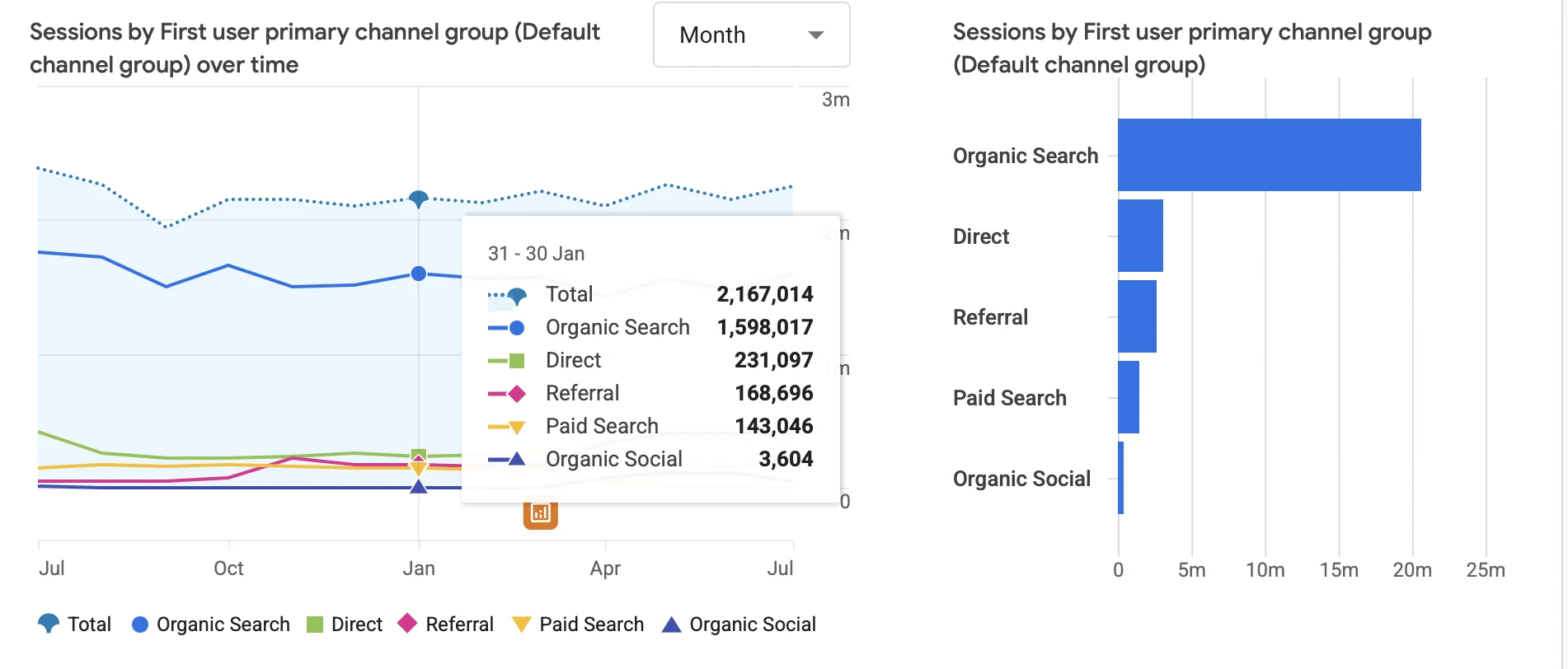
09 / AI SEARCH
Artificial intelligence changes discovery, not the need for reliable evidence. Google AI Overviews, ChatGPT and Perplexity retrieve and synthesize information from pages and third-party sources. Enterprise GEO extends the same technical, content and authority system into AI measurement.
See GEO services →Important content is available in clean HTML, and relevant search and AI crawlers are not accidentally blocked by robots, security rules or client-only rendering.
Products, experts, markets and claims use stable names, relationships, structured data and corroborating sources.
Prompts, citations, mentions, referral sessions and self-reported discovery complement classic SERP and conversion data.
11 / EXECUTIVE SCORECARD
Data-driven SEO needs enough detail for SEO specialists and enough business context for executives. Every KPI has an owner and a decision attached, so the company can manage SEO as an investment rather than dashboard decoration.
Which technical risk ships first?
Where is the commercial gap?
Which journey needs revision?
Where should investment expand?
Which entities lack corroboration?
12 / PARTNER SELECTION
Evaluating enterprise SEO is not about finding the agency with the longest generic service list. The best enterprise SEO company for one organization may be the wrong fit for another. The right partner fits the website, operating model and implementation gap.
Look for template, platform, stakeholder, migration or market experience, not only a traffic graph from an unrelated small site.
Confirm who audits, writes requirements, reviews releases and communicates with executives after the sales process ends.
A credible enterprise SEO company can explain ownership, acceptance criteria, QA and what happens when internal constraints block the ideal fix.
Transparent enterprise SEO reports risk, attribution limits and work that did not ship instead of converting every organic session into claimed revenue.
Ask enterprise SEO agencies to diagnose one live constraint and show how their recommendation would move through your organization. A useful SEO partner will name the affected template or audience, estimate opportunity and risk, identify owners, and define QA. A digital marketing agency that can only promise content volume or rankings has not yet shown it can manage SEO at enterprise scale or deliver enterprise SEO success.
13 / SCOPE + COST
Scope follows site scale, technical risk, markets, data access, competition and implementation ownership. Enterprise SEO packages should not be generic: an audit, embedded consulting engagement and managed enterprise SEO campaign solve different capacity problems.
See SEO pricing factors →For a defined risk, redesign, platform move or portfolio diagnosis with implementation-ready deliverables.
For enterprise teams that can execute but need senior research, prioritization, standards and release QA.
For organizations that need coordinated technical, SEO and content, authority and measurement capacity.
14 / FAQ
Direct answers about scale, services, platforms, teams, AI search, timing and investment.
Enterprise SEO is search engine optimization for a large organization, complex website or portfolio where scale, technical dependencies and cross-team coordination change how the work must be managed. It combines technical SEO, content strategy, authority, analytics and governance. The goal is not simply to optimize more pages. It is to create standards and workflows that protect search visibility, help teams ship improvements consistently and connect organic search performance to business outcomes.
Traditional SEO and enterprise SEO use the same search fundamentals, but enterprise programs operate across thousands of pages, several platforms, multiple markets and many stakeholders. A standard SEO recommendation may be a direct page edit. An enterprise SEO solution often requires a template rule, engineering ticket, legal approval, market exception, release check and monitoring plan. Governance, automation, prioritization and change-risk control therefore become part of the SEO strategy itself.
Enterprise SEO services include demand and information architecture, advanced technical SEO, template standards, content governance, international or local SEO, migration support, digital PR and link building, analytics, executive reporting and AI-search optimization. The exact scope depends on the website and team. Useful services produce decisions, standards, tickets, releases and measurable outcomes rather than a fixed package of recurring reports.
A company should consider enterprise SEO when its website has thousands of pages, several products or markets, multiple CMS platforms, frequent releases, complex approval paths or material migration risk. Headcount alone is not the deciding factor. A smaller company with a large marketplace, e-commerce catalog or programmatic site may need enterprise-level SEO, while a large enterprise with a small corporate website may not.
Coordination begins with named owners and a RACI model for product, engineering, content, analytics, brand, legal and regional stakeholders. Recommendations become tickets with business impact, acceptance criteria and QA steps. SEO participates in the planning and release workflow already used by enterprise teams. A decision log, change windows and escalation rules prevent the strategy from becoming another presentation that no department owns.
Technical SEO at scale starts by grouping URLs by template, component, data source and crawl behavior. Log files, crawls, Search Console and rendered HTML show whether a problem is isolated or systemic. The fix is then applied at the correct layer and validated on a representative sample before broad release. Monitoring checks indexation, crawl anomalies, rendering and key query groups after deployment.
Yes, when the organization operates physical locations or regional service areas. Enterprise local SEO services can include location architecture, template standards, Google Business Profile governance, listings, reviews, local content, store-locator behavior and conversion measurement. The enterprise layer defines shared rules and data quality; each location still needs accurate information and enough local relevance to deserve its own indexable page.
An enterprise SEO platform is software that helps large teams monitor rankings, technical health, content, competitors, workflows or AI visibility across many pages and markets. Platforms can support automation, dashboards and data access, but they do not decide business priorities or make organizational tradeoffs. The useful stack may combine Search Console, analytics, crawlers, log analysis, a data warehouse and specialist SEO tools rather than one all-in-one product.
Enterprise SEO supports AI search by making important facts accessible, consistent and corroborated across the brand website and reliable external sources. Clean HTML, entity relationships, structured data, direct answers, expert evidence and strong topic coverage help retrieval systems understand the organization. Enterprise GEO also tracks mentions and citations across AI Overviews, ChatGPT and Perplexity while preserving the technical and authority foundations required for classic search.
Technical fixes can improve crawling or indexation after the affected URLs are recrawled, while competitive organic growth usually takes several months. Enterprise timelines also depend on release cycles, approvals and the authority gap. The first 90 days should still produce measurable operational progress: a prioritized backlog, shipped fixes, template standards, risk controls and an agreed scorecard. Revenue outcomes cannot be guaranteed on a fixed calendar.
Enterprise SEO cost depends on site scale, markets, platforms, competition, data access, implementation ownership and the number of teams involved. A focused audit or migration review differs from embedded consulting or managed execution. Pricing should follow the actual operating burden and deliverables, not a generic enterprise label. The proposal should state what the client team owns, what the SEO partner ships and how additional markets or production capacity change scope.
Build an in-house SEO team when organic search needs daily ownership, deep product context and permanent influence over releases. Hire an enterprise SEO agency or consultant when the organization needs specialist diagnosis, temporary leadership, independent risk review or additional execution capacity. A hybrid model is common: internal leaders own business context while an external enterprise SEO partner provides strategy, technical depth, benchmarks and QA.
Evaluate enterprise SEO agencies by their experience with comparable scale, direct access to senior specialists, technical and organizational depth, implementation model, reporting quality and evidence. The best enterprise SEO agency for one company may be wrong for another. Ask how the agency handles templates, migrations, internal teams, market exceptions, AI search and attribution. Avoid providers that define enterprise work only as a larger content or backlink package.
START WITH THE SYSTEM CONSTRAINT
Send the website, markets, platforms, current team and the change or organic growth outcome under pressure. I will identify the first likely constraint and whether an audit, consulting project or managed scope fits.
Cookies, briefly. Essential ones run the site; analytics cookies (Google) only switch on if you say yes. Details in the Privacy Policy.