Competitors own the generated shortlist
ChatGPT, Perplexity, Gemini or Google AI repeatedly recommend other brands for commercial prompts where your company should be considered.
GENERATIVE ENGINE OPTIMIZATION + SOURCE AUTHORITY
GEO services help your brand become accurately understood, cited and recommended across AI-driven search, ChatGPT, Perplexity, Gemini and Google AI, with the source work and measurement behind the claim.
DIRECT ANSWER
Generative engine optimization (GEO) improves the likelihood that a brand is accurately mentioned, cited or recommended inside AI-generated answers. The work combines prompt research, technical retrieval, entity optimization, source-grade content, structured data, digital PR, links and independent corroboration. It targets the evidence used by AI engines and large language models (LLMs), not a secret switch inside an AI model.
GEO complements search engine optimization and answer engine optimization. Strong rankings, accessible pages and authority can help a source become discoverable, while GEO adds the query, source and entity work needed for generative engines like ChatGPT, Perplexity, Gemini, Copilot and Google AI to interpret the brand correctly. The commercial objective is AI visibility when buyers ask for a comparison, recommendation or trusted provider.
01 / WHEN TO INVEST
Generative engine optimization matters when buyers use AI search to build a shortlist, compare options or validate a provider and your brand is absent, inaccurate or unsupported.
ChatGPT, Perplexity, Gemini or Google AI repeatedly recommend other brands for commercial prompts where your company should be considered.
Generative AI systems confuse the company, use outdated facts or omit the products, locations and proof that matter to a buying decision.
Content ranks or earns traffic, but the passages are difficult to retrieve, verify or quote and third-party corroboration is weak.
The team has screenshots but no fixed prompt landscape, citation baseline, source map, implementation log or connection to qualified demand.
02 / GEO SERVICES
A complete GEO service joins diagnosis, content optimization, technical implementation, entity work, off-page authority and measurement. Monitoring alone can reveal absence, but it cannot change the source ecosystem causing it.
Map high-intent prompts, follow-up questions, brand mentions, citations, answer accuracy, competitor share and the recurring sources each generative engine uses.
Compare the domains, pages, formats and claims that earn citations. Separate gaps on the owned website from gaps requiring third-party authority.
Align company, people, products, services and locations across visible copy, profiles, structured data and authoritative references so the brand is unambiguous.
Optimize expertise, original data, case studies, comparisons and direct answers into structured content with factual passages that can stand alone when retrieved.
Audit and optimize crawling, indexing, rendering, canonicals, internal links, server-rendered HTML, bot access and structured data that matches visible content.
Earn relevant coverage, links and expert mentions on publications and communities that buyers read and generative systems repeatedly retrieve.
Identify outdated or incorrect descriptions, close evidence gaps and improve the sources that shape how AI systems summarize the company.
Track prompt coverage, named mentions, citation share, source URLs, sentiment, AI referrals, assisted leads and commercial outcomes against one baseline.
03 / OPERATING MODEL
Generative engines use different AI models, search indexes and source-selection systems. Effective GEO strategies optimize the layers the brand can control instead of pretending there is one universal ranking algorithm.
Priority pages need crawlability, indexation, internal links, stable canonicals and meaningful server-rendered HTML. Technical SEO and technical optimization remain the entry point for generative search.
Names, offers, people, products and locations must agree across the website, structured data and credible external profiles so AI systems and language models understand the correct brand.
Original evidence, named expertise, useful case studies, links and independent mentions help generative engines compare claims without relying on self-description alone.
Prompt coverage, citations, answer accuracy and source share connect to AI referral traffic, assisted journeys, leads and conversion instead of ending at a dashboard score.
04 / GEO AND SEO
SEO optimizes for search engine result visibility and clicks. GEO targets how brands and sources are represented inside generative results. It requires technical SEO, useful content and authority from traditional search, then adds entity and citation signals for optimization for AI-generated answers.
05 / AI SEARCH OPTIMIZATION
The prompt landscape is tested separately across relevant generative AI platforms because source use and answer output vary. This approach to GEO keeps the website, entity and authority work coordinated.
Track whether the brand is named, how it is described, which pages are cited and which external sources repeatedly shape commercial recommendations.
Track: mentions, citations, accuracy, referralsIndexed and snippet-ready pages still depend on normal SEO fundamentals. Monitor supporting links, citation patterns and the queries where generative results appear.
Track: AI visibility, supporting links, clicksPrompt tests expose recurring domains, source diversity and whether owned or earned pages supply the factual passages used in an answer.
Track: source share, mentions, visits, leadsCoverage expands when these platforms matter to the audience. Reporting remains focused on buying behavior rather than a large list of low-value LLM tests.
Track: presence, accuracy, commercial relevanceWHO GEO IS FOR
Generative engine optimization services help when AI search influences a real purchase or shortlist. The foundation for effective GEO is enough first-hand expertise, product data or service evidence to optimize and corroborate.
B2B buyers ask LLMs to compare platforms, integrations, risks and vendors. GEO work connects category pages, product evidence, documentation and third-party validation.
Product facts, categories, reviews, merchant data and comparison content help AI engines understand which offer fits a specific query and buying constraint.
Healthcare, legal, finance and consulting brands need named expertise, careful claims, local or sector evidence and strong human review before generative AI can be useful.
Locations, services, profiles, reviews and consistent business facts support local AI visibility without creating a separate page for every possible prompt.
PRACTICAL SCOPE
Generative AI optimization improves discoverability, understanding and corroboration. It does not create model control or turn thin content into trusted evidence.
Commercial pages, documentation, research, comparisons and case studies need clear facts, original value and useful structure. Optimize the page for people first; more AI-generated copy is not the objective.
Visible naming, authorship, offers, locations and schema should agree across the site and credible profiles. Structured data supports clarity but does not create authority by itself.
Relevant links, expert mentions, reviews, digital PR and community references help generative search systems verify important claims beyond the company website.
Subject-matter review, source checks and named ownership matter when content affects health, finance, legal or other high-trust decisions.
06 / IMPLEMENTATION
The program establishes the prompt and source baseline, ships the highest-value technical, content and authority work, then retests the answers and reinforces what moves.
Build the prompt landscape, record current mentions and citations, map competitor sources, audit technical retrieval and define the entities, claims and commercial decisions the brand can prove.
Rebuild priority pages around clear claims and first-hand proof, publish missing source assets, validate entity markup and begin targeted digital PR around evidence worth referencing.
Rerun the controlled prompt set, compare source use and answer accuracy, inspect AI referrals and assisted conversions, then reinforce the pages and third-party sources showing useful movement.
07 / FIRST-HAND EVIDENCE
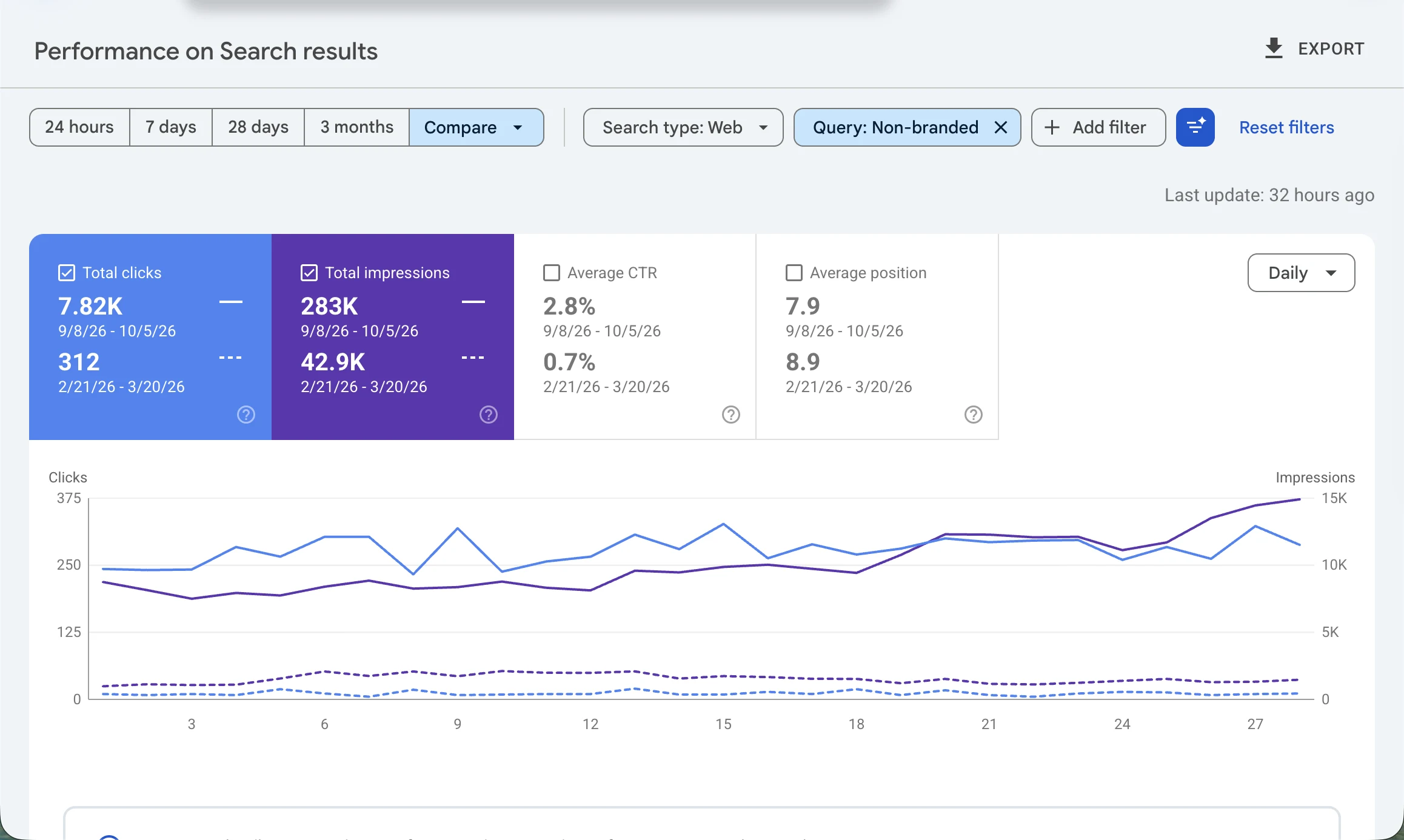
An early-stage AI startup in the mental-health space needed search and generative visibility direction across the US, UK, Canada and Australia. I built the complete strategy and worked with the client team to implement it in full from February through April 2026. Every planned page was created and published during the engagement.
AI STARTUP · YMYL HEALTH
After the completed rollout, manually corrected equal GSC windows moved from 277 to 7,767 clicks and 41,790 to 281,799 impressions.
This is observational evidence of the integrated strategy, not proof that one GEO tactic caused every movement or a claim of guaranteed AI citations.
08 / GEO PERFORMANCE
Every comparison records the prompt, platform, market, date, output and source URLs. The report connects AI visibility to the commercial actions the brand can measure.
Brand presence, competitor share, recommendation position and coverage across the controlled prompt landscape.
Cited pages, source diversity, factual accuracy, entity fit, outdated claims and whether the answer uses evidence correctly.
AI referrals, landing paths, assisted journeys, leads, revenue and self-reported attribution beside organic performance.
09 / ENGAGEMENT MODEL
The right format depends on the search foundation and the SEO, content, engineering and PR resources already in place. Scope follows the baseline.
I provide the prompt and citation baseline, source gap, technical and content audit, entity map, implementation priorities and measurement specification.
Best fit: mature in-house teamsI own research, page architecture, briefs, technical tickets, schema specification, authority planning, QA and retesting while coordinating implementation.
Best fit: accountable end-to-end deliveryI review an existing SEO or PR program, test its assumptions, establish generative visibility reporting and join the decisions where specialist experience matters.
Best fit: active marketing teamsPrice depends on markets, products, prompt volume, priority pages, competitors, platforms, source gaps and implementation ownership. A focused audit costs less than a managed program including content, digital PR, technical changes and ongoing monitoring. Paid media services are outside this scope unless the proposal explicitly adds them. Every proposal defines deliverables, owners, cadence and exclusions after the baseline review.
10 / BUYER CHECKLIST
Rankings of top GEO agencies or top generative engine optimization providers can help build a shortlist, but strong GEO agencies focus on research, source gaps, implementation and measurement. The right partner can work with existing SEO agencies, an in-house digital marketing or digital PR team without selling renamed SEO services, AI SEO services or generic search optimization services.
Effective GEO ensures the brand has a documented path from prompt to source to commercial action. Entity optimization to increase clarity is useful, but nobody can guarantee that a brand will appear at the top of every generated response.
PRIMARY-SOURCE CHECK
Google states that normal SEO best practices remain relevant for its AI features, eligible pages must be indexed and snippet-ready, and no special schema is required for inclusion. Structured data must also represent visible content. GEO therefore extends a sound search foundation with source, entity and measurement work rather than bypassing it.
Read Google’s AI features guidance · Read the markup guidelines
11 / FAQ
Visible answers and FAQ schema use identical text. Nothing appears in structured data that a reader cannot inspect here.
START WITH THE BASELINE
Send the website, target market and the questions buyers ask before choosing you. I will review the current search foundation, prompt landscape and source gaps, then show whether the next move is technical GEO, better evidence, entity work or stronger authority.
Cookies, briefly. Essential ones run the site; analytics cookies (Google) only switch on if you say yes. Details in the Privacy Policy.