Is there qualified search demand?
Compare non-brand demand, SERP intent, local competitors, sales value and realistic entry cost before committing to a country.
MULTI-MARKET / MULTI-LANGUAGE / GOOGLE + AI SEARCH
International SEO services for companies that need the right pages to rank, explain the offer and convert in each target market.
01 / DIRECT ANSWER
International SEO is the process of making a website discoverable and commercially useful across more than one country or language. International search engine optimization connects market selection, international keyword research, technical SEO, content localization, authority and country-level measurement.
The work is not finished when a page is translated. Search behavior, competitors, proof, terminology and conversion expectations differ by market. Search engines also need a clear relationship between country and language versions through crawlable URLs, self-consistent canonicals and, where appropriate, valid hreflang annotations.
International SEO helps search engines select the right version, but successful international SEO also helps a global audience understand and trust the offer. That makes it part of SEO and digital marketing, not an isolated tagging task.
02 / MARKET SELECTION
Global reach is not a reason to launch every country at once. Effective international SEO strategies compare demand, delivery and authority across international markets. A global market can contain several local search engines, query habits and purchase expectations, so the same page will not automatically serve every international audience. A market scorecard turns expansion into a controlled investment instead of a translation project.
Compare non-brand demand, SERP intent, local competitors, sales value and realistic entry cost before committing to a country.
Validate language, pricing, currency, legal requirements, fulfillment, support and the conversion path. SEO cannot repair a market the business cannot serve.
Review local publishers, communities, competitors, references and entity signals. Authority in one market does not automatically transfer to another.
Define country and language segments, conversions, revenue or pipeline, and a baseline before pages are released. Blended global traffic hides weak markets.
03 / INTERNATIONAL ARCHITECTURE
The architecture should make each audience explicit without splitting authority by accident. I document the trade-offs before development begins, then align the URL model, canonicals, sitemaps, internal links and analytics.
Authority, maintenance and release processes are divided across domains.
Templates can feel generic if local teams cannot adapt intent and evidence.
Complexity increases, while authority and ownership still need active coordination.
Rules become difficult to govern without a documented market matrix.
04 / INTERNATIONAL SEO SERVICES
International SEO services help a company turn global search demand into country-level work. The tailored SEO scope follows the first constraint. Every workstream must produce a released fix, a useful localized page, a verified targeting rule, an authority asset or a measurement improvement. Strategy decks are not the final deliverable.
Search demand, commercial intent, local competitors, SERP features, AI answers and business constraints are compared market by market. The result is a rollout priority, not a list of every country with search volume.
Native query patterns, terminology, products, modifiers and funnel stages are mapped to the offer. Direct translation is rejected when people in the target market search differently.
ccTLD, subdomain, subfolder and hybrid options are evaluated against authority, governance, development cost and future expansion. One scalable model is documented before URLs multiply.
Crawlability, canonicals, redirects, sitemaps, rendering, geotargeting and hreflang reciprocity are audited by template. Each language or region version must be indexable and self-consistent.
Pages are adapted for local search behavior, examples, proof, currencies, terminology and objections. Localization keeps the intent and commercial meaning; translation alone only changes the words.
Service, product, category, comparison and educational pages are assigned to local demand. Global templates keep quality stable while market owners can add evidence that actually belongs to their audience.
Local editorial mentions, partnerships, directories, research and expert contributions are selected for relevance and real audience access. The plan does not assume that generic global links create country-level trust.
Google Search, AI Overviews, ChatGPT and Perplexity are reviewed by market and language where measurement is practical. Stable entities, direct answers and corroborated facts support both ranking and retrieval.
Google Search Console, analytics and CRM data are segmented by market, landing page and conversion. Reporting separates launches, indexation, non-brand visibility, leads and commercial outcomes.
International SEO involves coordinated on-page SEO, technical SEO, content localization, off-page SEO and market analytics. These tailored SEO strategies keep the global SEO system consistent while allowing the keyword map, proof and conversion path to adapt locally. The SEO work is prioritized by market value and implementation capacity, not by a generic activity quota.
05 / TECHNICAL FOUNDATION
International SEO agencies often present hreflang as the strategy. It is only one targeting layer. Each version first needs a crawlable, indexable and self-canonical URL with a valid alternate relationship.
See technical SEO audit services →If page A names page B as an alternate, page B must return the relationship. Broken return tags make the cluster unreliable.
Canonicalizing every localized page to the English version tells search engines to consolidate the pages that are supposed to rank separately.
An x-default URL should serve users who do not match a targeted variant. It does not replace specific language-region annotations.
06 / LOCALIZATION
Multilingual SEO needs a controlled content system. Global positioning can stay consistent, but the query, evidence and next step must make sense to a person in the target market.
Product names, capabilities, legal claims, entity relationships, brand language and structured data stay governed from one source.
Keyword research checks native terminology, demand, modifiers and SERP intent instead of translating an English keyword list.
Examples, clients, authors, institutions, reviews and sources should support the audience rather than merely changing the currency symbol.
Forms, sales coverage, pricing, contact methods, time zones and fulfillment match what the business can deliver in that country.
07 / ROLLOUT
A successful international SEO strategy reduces irreversible decisions early and delays scale until targeting, production and measurement work together. The same global SEO strategy can then support additional international markets without repeating the architecture debate or fragmenting the SEO team.
Size demand, inspect local SERPs, validate commercial fit and record the baseline. A weak market is stopped before translation and development consume budget.
Select the domain and URL model, define hreflang and canonical rules, map queries to pages, and specify local review and analytics ownership.
Launch one controlled market or page set, validate indexing and targeting, then compare qualified visibility and conversions before expanding the system.
This rollout sits inside the complete SEO and AI search methodology.
08 / FIRST-HAND EXPERIENCE
An early-stage AI startup in mental health needed SEO and GEO direction for four English-speaking markets. I built the complete strategy, mapped non-brand demand and content gaps, defined technical, authority and AI-citation work, and worked with the client team to implement it in full from February through April 2026. Every planned page was created and published during the engagement.
The final September-October window shows the growth after the completed rollout. This evidence supports multi-market research, prioritization and implementation for English-speaking markets. It does not claim a multilingual hreflang implementation or guarantee the same result for another company.
Open the complete startup case →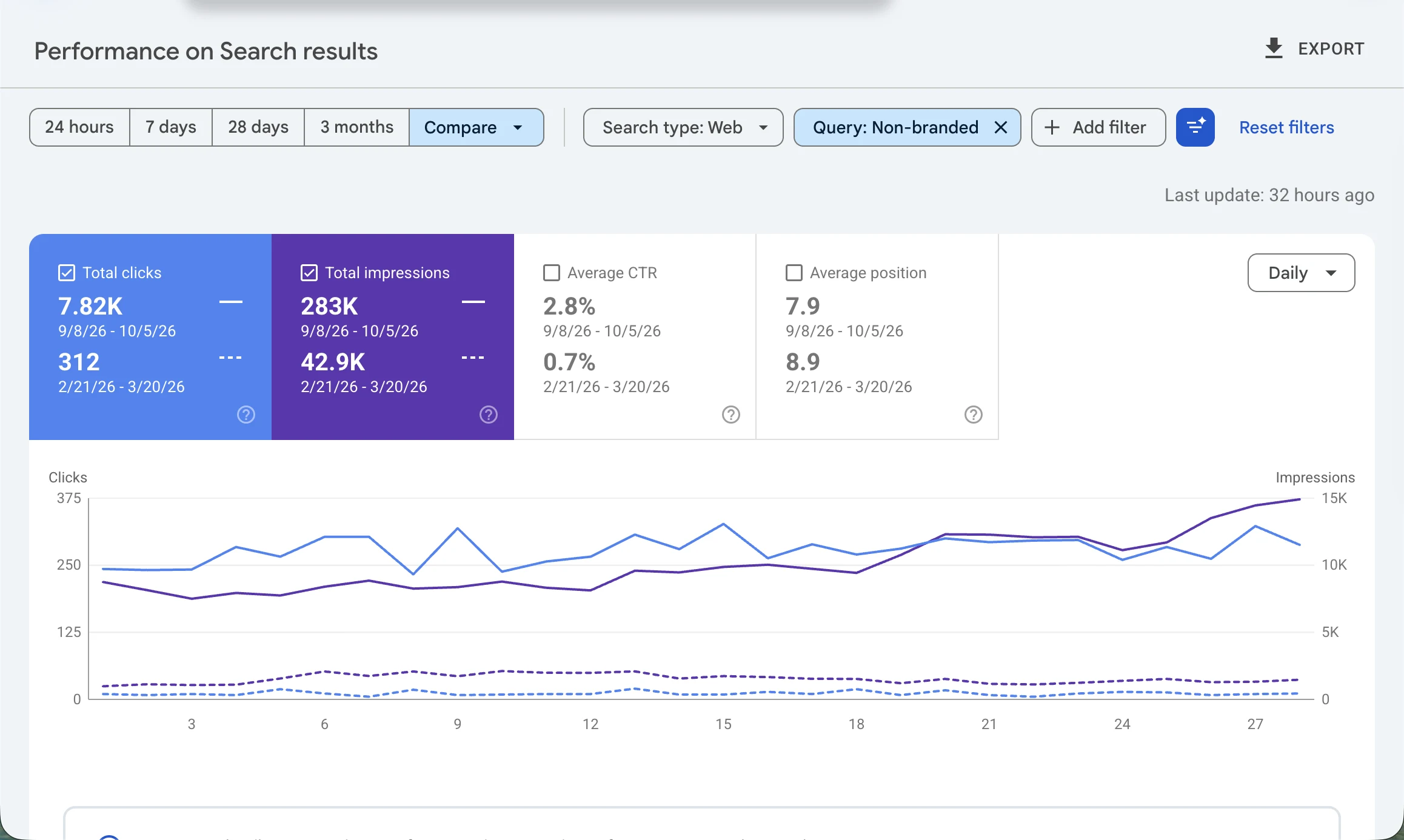
09 / REPORTING
International SEO success is evaluated per market and then rolled up. The scorecard distinguishes work released, search response and business response so a growing traffic line cannot conceal poor commercial fit.
Did the planned work reach production?
Can the correct version be selected?
Is the market discovering the brand?
Should investment expand, change or stop?
10 / PARTNER SELECTION
Hiring an international SEO agency makes sense when a rollout requires native teams, developers and production across many languages at once. International SEO consultants are often a better fit when the company first needs a defensible market decision, architecture, roadmap and direct coordination with its existing team.
SEO companies use different delivery models. Some international SEO companies operate a permanent international SEO team; other global SEO agencies coordinate local partners. A global SEO company is not automatically local in every country. Compare named international SEO expertise, review resources, technical ownership, SEO best practices and the ability to connect marketing services to commercial data.
Lists of the best international SEO or top international SEO agencies cannot show whether the delivery model fits your organization. An experienced international SEO agency should state its limits instead of presenting a generic digital marketing agency as equally local everywhere.
The SEO specialist selling the engagement should name who decides URL structure, hreflang and release acceptance.
Demand must be checked against delivery, sales and local competition before content volume or SEO campaigns are promised.
Native or market-qualified review needs a real owner, especially for commercial, medical, financial and legal content.
11 / FAQ
These answers cover the decisions that affect SEO performance, search ranking and investment before international SEO work begins.
International SEO is search engine optimization for a website that targets users in more than one country or language. It combines market research, international keyword research, technical SEO, URL architecture, hreflang, localized content, country-level authority and measurement. The purpose is to help the correct page appear for the correct audience without one market cannibalizing another. It is not simply translating an existing website or adding country names to generic landing pages.
International SEO organizes visibility across countries and languages, while local SEO usually focuses on nearby customers, locations and map results. An international strategy may require regional URL variants, hreflang, local terminology, currencies, search engines and market-specific authority. Local SEO may still exist inside each market for stores, clinics or offices. The two disciplines can work together, but they solve different targeting and architecture problems.
Hreflang is useful when equivalent pages target different languages or regional audiences, but it is not required for every international website. It should be implemented only after the URL, canonical and indexation model is correct. Every alternate normally needs a self-reference and reciprocal links to the other valid variants. Hreflang does not translate content, improve a weak page or replace country-specific research; it helps search engines select among already valid versions.
The right international URL structure depends on brand authority, budget, technical ownership and how independently each market operates. ccTLDs provide a strong country signal but split authority and maintenance. Subdomains create operational separation but may add complexity. Subfolders consolidate authority and are often easier to govern on one global domain. The decision should be made before migration or localization, with redirects, canonicals, analytics and future markets included in the model.
Translation is not enough for multilingual SEO because the same offer can be researched, described and evaluated differently across markets. Localization adapts keyword intent, terminology, examples, proof, currency, measurements, legal language and calls to action. Native review is especially important for commercial and regulated topics. Machine translation can support a workflow, but publishing it without search research, editorial control and local context produces pages that may be linguistically correct and commercially wrong.
Target countries should be chosen by combining qualified search demand with business readiness. I compare local SERPs, competition, existing brand demand, sales value, delivery capability, legal constraints, support, content resources and the cost of earning authority. A large search volume is not a market strategy. The first rollout should usually be the country with the strongest balance of opportunity, execution capacity and measurable conversion, not automatically the biggest population.
International SEO timing depends on the starting domain authority, market competition, technical condition, content production and release speed. Existing sites may see indexation and targeting changes within weeks, while meaningful non-brand traffic and pipeline usually take several months. New domains and languages can require longer. A responsible plan separates early indicators such as released pages, valid hreflang and impressions from later outcomes such as qualified leads, revenue and market-level return.
International SEO cost depends on the number of markets, languages, templates, products, technical platforms and implementation owners. A focused market assessment or international SEO audit costs less than an ongoing program with localization, development, content production and international link building. Pricing should expose assumptions and ownership by workstream. A cheap per-language package often hides unreviewed translation, duplicated pages and reporting that blends every country into one number.
Choose an international SEO partner by asking who makes architecture decisions, how markets are prioritized, who reviews localized content, and how results are separated by country. Review first-hand evidence, technical depth, local research methods, link standards and implementation ownership. International SEO agencies should not claim equal expertise in every language without named local resources. Avoid guaranteed rankings, automatic translation at scale and a rollout plan created before the offer and market constraints are understood.
International SEO performance should be reported by country, language, page type and conversion path. Release metrics cover implemented fixes and localized pages. Technical metrics cover indexation, canonical alignment and hreflang validity. Visibility metrics include non-brand impressions, rankings, share of search and supported AI mentions. Commercial metrics include qualified sessions, leads, pipeline or revenue when tracking allows it. A global total can be useful, but it must not conceal a market that attracts traffic without customers.
12 / MARKET BRIEF
Send the site, the countries or languages under consideration, and the commercial outcome. I will review whether the first constraint is market fit, architecture, technical targeting, localization, authority or measurement.
Cookies, briefly. Essential ones run the site; analytics cookies (Google) only switch on if you say yes. Details in the Privacy Policy.