a zine about getting found — issue 01
filed under: home / services / startup SEO

RUNWAY-AWARE / GOOGLE + AI SEARCH

Startup SEO Agency.

A startup SEO agency for teams that need to validate demand, ship the right pages and build compounding acquisition without wasting product runway.

  • Direct with Dima
  • 9+ years in search
  • No account manager
9x startup click growth4.4x daily impressions2 discovery systems: Google + AI

DIRECT ANSWER

What does a startup SEO agency do?

Startup SEO is search engine optimization built around a young company's stage, runway, changing product and limited implementation capacity. It combines technical SEO, demand research, commercial pages, expert content, link building, conversion work, analytics and AI-search visibility, but it does not attempt every tactic at once.

The central job is to learn which search demand belongs to the product and turn that demand into a measurable customer action. An effective SEO strategy connects each keyword cluster to an ICP, search intent, page owner, product claim and conversion event. Organic traffic is useful only when it improves discovery, evaluation or acquisition.

A startup SEO agency should also identify when SEO is premature. If positioning changes every week, the product cannot retain users, no team can ship changes or runway is too short for a multi-month learning cycle, paid experiments, outbound, partnerships or product work may deserve priority first.

01 / CHANNEL FIT

Should your startup invest in SEO now?

The answer depends on evidence and timing, not on the idea that every startup needs a blog.

INVEST NOW

Search can test and compound.

  • Customers already describe a recurring problem
  • Category, use-case or comparison demand exists
  • The offer and conversion path are credible
  • Product and marketing can ship pages
  • Runway supports several learning cycles
FIX FIRST

Another constraint is more urgent.

  • The ICP or offer changes every week
  • No product or sales evidence exists
  • The website cannot be updated
  • There is no measurable next step
  • The company needs revenue immediately

THE PRACTICAL RULEStart with the smallest SEO program that can disprove an assumption. Scale only after technical access, money pages and early conversion evidence are real.

02 / STARTUP STAGE

SEO strategies for startups by stage.

Startup companies need different priorities as product certainty, authority, team capacity and acquisition targets change.

PRE-SEED

Validate before scaling.

Prove that discoverable demand exists, clarify the category and make the product crawlable. A pre-seed startup usually needs a focused SEO audit and a small number of decision pages, not a large publishing commitment.

SEED

Own the first buying paths.

Turn customer interviews, sales calls and product usage into category, use-case, comparison and integration pages. Seed-stage SEO should create early search signals while the startup is still learning which market and message convert.

GROWTH

Build a repeatable system.

Expand proven clusters, improve technical templates, earn authority and connect organic search to signups, demos, qualified leads and revenue. Growth-stage teams need production governance as much as more content.

BUSINESS MODEL

SEO for startups is not one template.

The architecture changes with the product, acquisition model, inventory and market.

SAAS STARTUP

Turn product language into buying paths.

SEO for SaaS connects category, use-case, feature, integration, comparison and alternative demand to trials, demos and activation. The page system should reflect how prospects evaluate software, not imitate a generic blog.

TECH STARTUPS

Explain a category buyers may not know.

Technical products need plain definitions, credible expert review and pages that connect capabilities to real jobs. Search can clarify positioning while the startup earns authority in a new or crowded market.

MARKETPLACE + ECOMMERCE

Control templates before inventory scales.

Faceted navigation, category architecture, product data, indexation and internal links matter early. The SEO strategy must account for supply, demand and programmatic page quality before adding thousands of URLs.

LOCATION-LED STARTUP

Join organic pages with local discovery.

Local SEO matters when acquisition depends on service areas, stores, clinics or other physical coverage. Location pages, Google Business Profile, reviews and consistent entity data belong to the same launch plan.

NOT GENERIC DIGITAL MARKETING SERVICESDifferent startup models need different marketing strategies, page templates, ranking signals and conversion events. This is specialized SEO tied to the business model.

03 / SEO SERVICE SCOPE

Startup SEO services, prioritized by runway.

A comprehensive SEO program is useful only when each part removes a real constraint. Every workstream ends in a decision or shipped asset.

01

ICP + demand research

Keyword research starts with the product, ideal customer profile, sales motion and the language used by real prospects. Search volume is weighed against intent, competition, product fit, conversion value and time to a useful signal.

02

Technical foundation

Technical SEO covers crawlability, indexation, JavaScript rendering, canonicals, internal linking, schema, Core Web Vitals and analytics. Findings become a short developer backlog with impact, evidence and acceptance criteria.

03

Money-page system

Category, solution, use-case, feature, industry, integration, comparison and alternative pages answer the questions closest to a trial, demo, purchase or qualified conversation. Each landing page owns one decision.

04

Expert content strategy

Content marketing supports the product decision with original explanations, customer evidence, practical guides and data. Content creation follows a defensible point of view instead of copying the same informational articles already in search results.

05

Authority + links

Digital PR, relevant editorial mentions, partner ecosystems, directories, expert commentary and useful contributions build credibility. Link building is judged by topical fit, real audience and referral potential, not a domain metric alone.

06

Conversion + user experience

The SEO service should improve what happens after the click. Calls to action, proof, page hierarchy, forms and product handoffs are reviewed against the intent of the page and the startup conversion model.

07

GEO + AI search

Clear facts, entity consistency, answer-ready sections, structured data and external corroboration help a startup appear in Google AI Overviews, ChatGPT, Perplexity and other large language model answers.

08

Analytics + learning loop

Google Search Console, analytics, product events, CRM stages and self-reported attribution connect SEO work to non-brand visibility, qualified acquisition and revenue. The roadmap changes when the evidence changes.

04 / CONTENT SYSTEM

SEO and content before the calendar.

Tailored SEO strategies for startups start close to product value and expand only when the foundation works. Content marketing strategies follow the buying path instead of a quota.

PAGE TYPESTARTUP QUESTIONACQUISITION JOB
CategoryWhat kind of product is this?

Define the market and make the startup legible.

Use caseWill it solve my situation?

Connect product capability to a real job.

ComparisonHow should I evaluate the options?

Support a shortlist without fake neutrality.

IntegrationWill it work with my stack?

Remove implementation uncertainty.

ProofHas this worked in a relevant context?

Show sourced outcomes and attribution limits.

Expert resourceCan I trust this point of view?

Earn links, citations and future demand.

05 / FIRST 90 DAYS

Technical SEO work that reaches production.

The first quarter should produce market evidence and shipped work, not a six-month presentation phase. SEO campaigns are managed as release plans with owners, a priority keyword set and acceptance criteria.

MONTH 1

Decide whether SEO fits now

Audit demand, competitors, product positioning, current pages, technical access, authority, AI visibility and measurement. Interview the founder or review sales and support language before committing to a content plan.

  • SEO fit verdict
  • ICP and intent map
  • Technical backlog
  • Measurement baseline
MONTH 2

Ship the smallest useful system

Fix priority blockers and publish or improve the pages closest to a commercial decision. Build briefs, internal links and authority actions around the offer that is already gaining customer evidence.

  • Released technical fixes
  • Priority money pages
  • Expert review workflow
  • Authority plan
MONTH 3

Read signals and double down

Check indexation, rankings, non-brand traffic, conversions, product events and AI mentions. Keep the work that creates evidence, change weak assumptions and define the next quarter from observed demand.

  • Index and release QA
  • Landing-page review
  • Acquisition contribution
  • Next-quarter roadmap

06 / FIRST-HAND EXPERIENCE

An AI startup, a difficult YMYL market and a delayed curve.

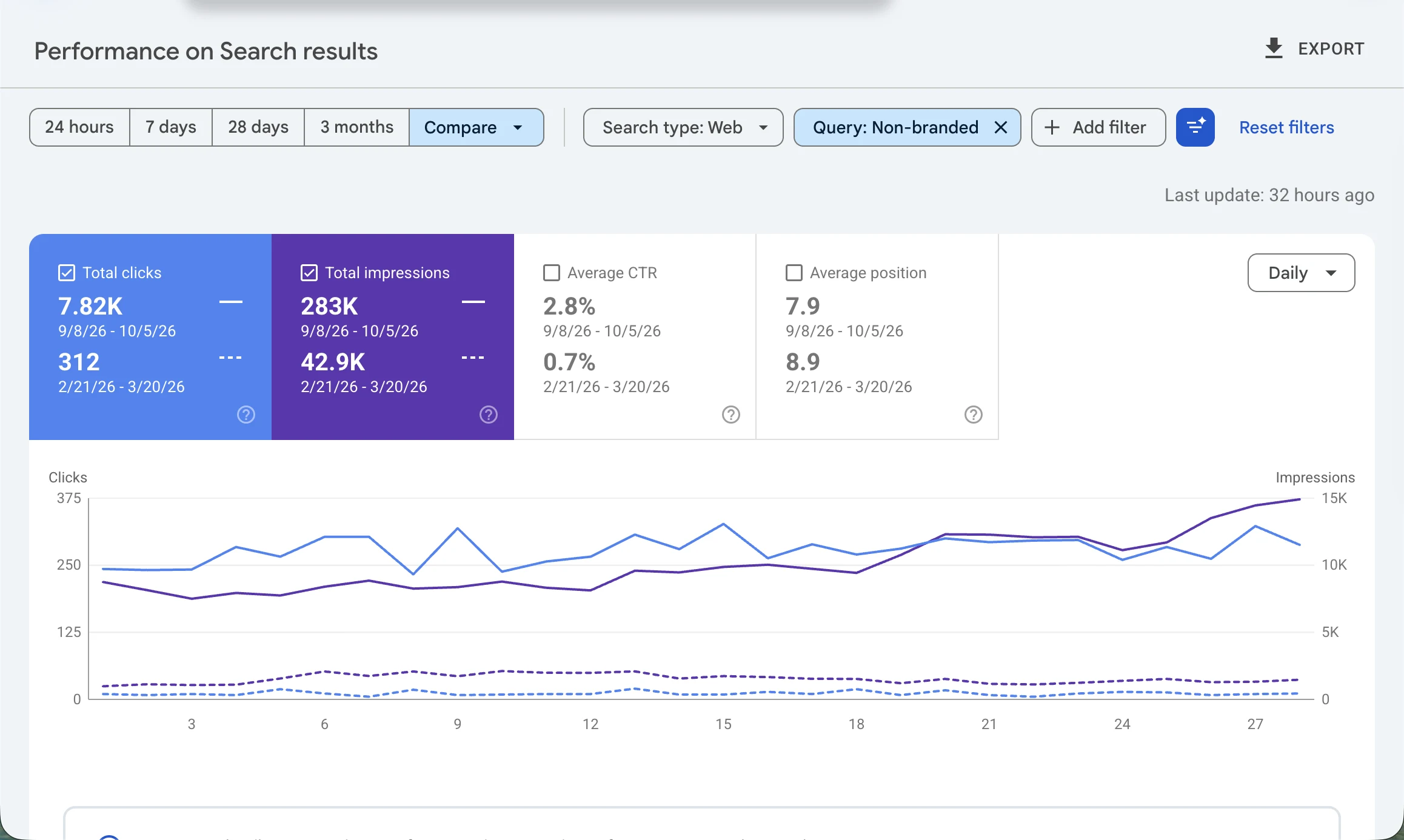
An early-stage AI startup in mental health brought me in for consulting through February and March. I built a six-month SEO and GEO strategy covering demand and content gaps, technical fixes, link acquisition and AI-citation optimization for the US, UK, Canada and Australia. The roadmap was handed off for execution in late April.

The filtered Google Search Console view shows non-branded daily impressions rising from about 225 to about 980 and daily clicks from about 3 to about 27. Growth appeared after the flat setup period, close to the timing established at the start. This is evidence of the strategy and lag pattern, not a guarantee for every startup.

See the complete startup case →
Google Search Console six-month non-branded query filter for an AI mental-health startup, showing 1.28K clicks, 76.5K impressions and a rising daily trend
GOOGLE SEARCH CONSOLE / NON-BRANDED QUERY FILTER1.28K clicks / 76.5K impressions / six months

07 / GEO + AEO

Engine optimization for AI discovery.

Potential customers, investors and partners use Google, AI Overviews, ChatGPT and Perplexity to define categories and compare products. Startup SEO and GEO should operate from the same crawlable product truth.

Unlike traditional SEO, AI discovery adds prompt tracking and citation review. AI tools can accelerate research and production, but they cannot create evidence, customer knowledge or authority.

See AI SEO services →
FACTS

Make product claims stable and extractable.

Clear definitions, capabilities, limitations, audiences, pricing logic and proof help search engines and answer systems interpret the brand.

ENTITIES

Connect company, product, people and market.

Consistent names, author identity, schema markup, About, methodology and external profiles reduce ambiguity.

CORROBORATION

Earn mentions beyond the company website.

Relevant links, directories, reviews, editorial coverage and expert contributions provide independent authority signals.

MEASUREMENT

Track prompts without pretending attribution is complete.

Monitor a focused prompt set, citations, AI referrals, branded lift and self-reported discovery alongside organic search.

08 / CHANNEL MIX

Search engine optimization or paid acquisition?

Do not force one channel to do the other's job. Use the acquisition mix that matches runway and learning speed.

DIMENSIONPAIDSEO
Signal speedImmediate after launchBuilds after release and recrawl
Best useMessage, offer and audience testingCompounding category and problem discovery
Cost behaviorTraffic stops when spend stopsAssets can continue producing discovery
ControlHigh targeting controlLower control over ranking and AI selection
Startup riskBurn without proven unit economicsWaiting without product or search fit

09 / MEASUREMENT

How to measure SEO success.

Successful SEO creates learning and qualified acquisition. Rankings and organic traffic show movement, not value by themselves; the scorecard should follow the startup funnel and keep attribution limits visible.

LAYERMEASUREDECISION
RELEASEFixes, pages, links, indexation

Did the planned work reach production?

VISIBILITYNon-brand impressions, rankings, citations

Is the startup entering relevant discovery sets?

ACQUISITIONSignups, demos, leads, activation

Does the traffic match the ICP and product?

BUSINESSPipeline, revenue, CAC, assisted influence

Should the startup invest, change or stop?

10 / AGENCY SELECTION

Choosing the right SEO agency.

Compare SEO companies by their ability to protect runway, ship work and connect search to product evidence. Data-driven SEO means changing the roadmap when customer, ranking or conversion evidence changes.

STAGE FIT

Will the agency say not yet?

The right partner should identify when product positioning, conversion or runway makes another channel more urgent. A proposal written before understanding the startup stage is not tailored SEO.

SPEED TO SHIP

What reaches production first?

Ask which fix or page can ship in the first 30 days, who owns it and what signal it should create. Startup SEO agencies should work with sprint cycles and limited development capacity.

FOUNDER VOICE

Who turns expertise into content?

Useful content should preserve product truth and founder language. The SEO partner needs a review system for subject-matter experts instead of replacing expertise with generic AI-generated copy.

ACQUISITION

Does reporting continue past traffic?

The specialist should connect search visibility to trials, demos, leads, activation or revenue where the data allows and state attribution limits instead of claiming every influenced outcome.

RED FLAGS BEFORE HIRING AN SEO AGENCY
  • Guaranteed rankings or fixed growth dates
  • A large blog plan before customer research
  • Fixed backlink quotas with no donor standard
  • Traffic reporting with no product action
  • No named specialist after the sales call
  • No implementation plan for the startup team

11 / DELIVERY + SEO PRICING

SEO consultant, in-house SEO or managed agency.

The right model depends on the missing capability and available runway. A team with developers and a content lead may need a consultant; another may need a full-service SEO firm to add production. Scope is quoted after diagnosis rather than forced into a generic package.

See SEO pricing factors →

The engagement is not white-label SEO, social media marketing or a bundled digital marketing package. It is direct work with the named specialist.

PROJECT

SEO audit + startup roadmap

For a founder or marketing team that can execute but needs a channel-fit decision, technical diagnosis, demand architecture and priorities.

EMBEDDED

Senior SEO specialist

For a startup team that needs weekly decisions, briefs, product and developer alignment, release QA and acquisition review.

MANAGED

Strategy + production

For a startup that needs coordinated technical optimization, editorial production, authority work and link building without building a permanent team yet.

12 / FAQ

Startup SEO agency questions.

Direct answers about timing, scope, cost, channel fit, hiring and AI search.

What is startup SEO?

Startup SEO is search engine optimization adapted to a young company with limited runway, a changing product and a small team. It combines demand research, technical foundations, commercial pages, expert content, authority, conversion work and analytics. The difference is prioritization: a startup should validate that search demand matches the product, ship the smallest useful page system and measure qualified acquisition before scaling content or links.

Why is SEO important for startups?

SEO can create a compounding acquisition asset when potential customers search for the problem, category, alternatives or implementation questions that the startup solves. Strong pages can keep producing discovery after publication, while the research also improves positioning and sales language. SEO is not automatically the first channel. It matters when discoverable demand exists, the offer is credible and the company has enough runway to learn before expecting predictable revenue.

When should a startup begin investing in SEO?

A startup should begin investing in SEO when it has a clear target customer, evidence of a recurring problem, a product or service people can evaluate and enough operational capacity to implement technical and content changes. Basic crawlability, analytics and branded search hygiene can start from day one. A larger SEO program should wait if the offer changes weekly, no conversion path exists or the runway cannot support a multi-month learning cycle.

Is SEO worth it for an early-stage startup?

SEO is worth testing for an early-stage startup when customers research the category online and a small set of pages can validate demand without consuming the roadmap. The first investment should answer whether the channel fits, not assume a large blog is required. Start with technical access, customer-language research and pages close to a decision. Compare the expected learning and acquisition value with paid, outbound, partnerships and product-led distribution.

What services should a startup SEO provider offer?

The scope can include an SEO audit, ICP and keyword analysis, technical implementation support, site architecture, on-page optimization, commercial landing pages, content planning, internal links, authority acquisition, conversion review, analytics and AI-search optimization. The exact mix should follow the current constraint. Every workstream should produce a decision, ticket, page, release, authority asset or measurement improvement rather than an activity report.

How is startup SEO different from SEO for established companies?

A startup has less authority, fewer pages, limited brand demand, tighter development capacity and a product or ICP that may still change. Established companies can defend known categories and optimize a large historical footprint. Startup SEO must create category clarity, prioritize faster learning, avoid premature scale and work inside runway. Local SEO also differs because it centers on geographic relevance, business profiles and reviews.

How long does SEO take for a startup?

Technical fixes and improvements to existing pages can create crawl, indexation or ranking signals within weeks after release. Competitive non-brand traffic and meaningful acquisition usually require several months because search engines must recrawl pages, authority must grow and the startup must learn which queries convert. A responsible roadmap separates leading indicators, such as shipped pages and impressions, from lagging outcomes, such as qualified leads and revenue.

How much do SEO services for startups cost?

The cost of SEO depends on competition, website condition, product complexity, target markets, content depth, authority gap, analytics maturity and who implements the work. A focused audit or strategy sprint costs differently from managed execution with writing, development and editorial outreach. The proposal should state deliverables, owners, production capacity and what can be removed or deferred when budget is limited instead of hiding scope inside a generic retainer.

Should a startup choose SEO or paid ads first?

Paid acquisition is useful when the startup needs immediate message testing and can measure unit economics; SEO is useful when discoverable demand exists and the company can invest in assets that compound over time. Many startups need both at different levels. Paid search can reveal converting terms quickly, while organic pages reduce dependence on rented clicks later. The decision should follow runway, sales cycle, margins, competition and speed of learning.

Should a startup hire an agency, consultant or in-house specialist?

Hire in-house when SEO needs daily product context and there is enough work and budget for permanent ownership. Use an SEO consultant when the team can execute but needs senior diagnosis, priorities and QA. Choose an agency when strategy and recurring production must be added together. Early-stage startups often begin with a focused consultant-led sprint, then add in-house or managed capacity after the channel proves useful.

How should a startup choose the right SEO agency?

Evaluate the provider by checking stage-specific evidence, direct access to senior specialists, technical implementation depth, customer-research methods, content review, link standards and acquisition reporting. Ask what ships in the first 30 and 90 days, which tasks the startup must own and when the agency would recommend not investing in SEO. Avoid guaranteed rankings, fixed backlink quotas and large content plans proposed before product discovery.

Does startup SEO include GEO and AI search?

Yes, when customers use AI Overviews, ChatGPT, Perplexity or other answer engines to understand a category and shortlist products. GEO extends the same search system with stable facts, entity relationships, direct answers, structured data and credible third-party mentions. It does not replace a sound technical foundation, useful product pages or genuine expertise. Startups should track a focused prompt set and citations rather than treating AI visibility as a separate content factory.

How do you measure startup SEO success?

Measure startup SEO with a layered scorecard. Leading indicators include released fixes, indexed pages, non-brand impressions, rankings and AI citations. Acquisition indicators include qualified organic sessions, signups, demos, forms and activation. Business indicators include pipeline, revenue, customer acquisition cost and assisted influence where attribution is credible. Use Google Search Console, analytics, product data, CRM stages and self-reported discovery, then document what cannot be measured reliably.
START WITH THE CHANNEL-FIT QUESTION

Get the first startup SEO priority.

Send the website, product, ICP, stage, target market and the acquisition problem search should help solve. I will identify the first likely constraint and whether an audit, consulting sprint or managed scope fits now.

  • Reply from Dima
  • No automated audit
  • No account manager
iNevidimka — Dima MochalovPrivacy · Terms · Editorial · Methodology · © 2026
Operated by Mochalov Dmitri Andrei IE (Individual Entrepreneur (Armenia)) · Reg. 20268705 · Arghishti str. 7, suite 0015, Yerevan, Kentron, Armenia · +1 (352) 665-8350 · Google Maps. All engagements are governed by our Terms of Service.