The blog grows. Trials and demos do not.
Broad informational content attracts students and researchers while comparison, alternative, integration and use-case searches go to competitors.
ORGANIC PIPELINE + AI DISCOVERY
A SaaS SEO agency for product-led and sales-led teams that need category visibility to become trials, demos and qualified pipeline, not a larger organic traffic chart with no buyer behind it.
DIRECT ANSWER
A SaaS SEO agency makes a software product visible when buyers define a problem, compare a category, evaluate tools and decide whether to start a trial or request a demo. The work combines technical SEO, buyer-intent research, product and content architecture, internal links, authority, conversion measurement and AI-search visibility.
The difference from a generic content program is commercial ownership. A SaaS SEO strategy maps each non-brand cluster to an ideal customer profile, funnel stage, landing page and measurable product or sales action. Traffic is a diagnostic. Trials, demos, qualified pipeline and recurring revenue are the business outcomes.
SaaS SEO is different from traditional SEO because the same system must help search engines, software buyers and a recurring-revenue business understand the product. Google needs crawlable pages and clear relationships. AI assistants need stable facts and external corroboration. Buyers need use cases, integrations, alternatives, comparisons, proof and an honest next step.
01 / THE CONSTRAINT
The common failure is not a lack of article ideas. It is a broken connection between product demand, page ownership, implementation and revenue measurement.
Broad informational content attracts students and researchers while comparison, alternative, integration and use-case searches go to competitors.
Competitors and publishers own the category language, so buyers discover their framing before your product enters the shortlist.
JavaScript, documentation, subdomains, international pages and release cycles create crawl, indexation and messaging gaps across the buyer journey.
Your product may rank for some queries yet remain absent when buyers ask AI assistants for comparisons, alternatives and recommendations.
02 / GROWTH MOTION
The keyword can be identical while the page, proof and conversion path are different. The operating model follows how the product is actually bought.
PLG programs prioritize use cases, templates, integrations, free tools, feature education and self-serve evaluation. The landing page must make the product understandable before a sales conversation.
Sales-led programs prioritize category education, alternatives, comparisons, implementation, security, ROI and evidence for several stakeholders. The page must reduce risk before the demo.
02B / BUYER FIT
SaaS SEO differs by product maturity, sales motion and the team already in place. The right model adds a missing capability rather than duplicating a general growth agency or an internal team.
Growth-stage SaaS companies often have some rankings, content and authority but no shared SaaS SEO framework. The work turns disconnected SEO efforts into one prioritized acquisition system.
Established SaaS teams usually need technical coordination, stronger comparison coverage, original evidence and custom SEO around several products or markets, not another generic editorial calendar.
A SaaS marketing agency, performance marketing agency or in-house team may already create content and manage campaigns. A SaaS-focused SEO partner adds demand architecture, technical QA and organic-search accountability.
03 / SERVICE SCOPE
Each workstream produces a decision, page, ticket, release, authority asset or measurement improvement. A recurring meeting is not a deliverable.
Keyword research for B2B SaaS companies is organized around the ideal customer profile, buying stage, product motion and conversion event. Each cluster is assigned to a page, content strategy and commercial job.
Rendering, indexation, canonicals, JavaScript, subdomains, documentation, internationalization, Core Web Vitals and release risk become developer-ready tickets.
Category, use-case, comparison, alternative, integration, feature and pricing-support pages turn SEO content into a useful evaluation path. Content strategies begin with the buyer decision, not a separate blog archive.
Templates, free tools, product data, directories and scalable use cases are validated against search demand, usefulness and index quality before they grow.
Original data, founder expertise, integrations, partnerships, expert commentary and relevant outreach help SaaS brands earn evidence around priority commercial pages.
Answer-ready product facts, entity consistency, third-party mentions and prompt tracking improve discovery across ChatGPT, Perplexity and Google AI Overviews.
Search Console, analytics and CRM stages connect non-brand landing pages to trials, demos, qualified pipeline and revenue where tracking permits.
Every recommendation has an owner, acceptance criteria and release check. The backlog is measured by what shipped, not by how many slides were delivered.
04 / PAGE SYSTEM
A useful SaaS content strategy gives every important buyer question a distinct destination and links those pages around the product decision.
Define the market and the costly problem in the buyer's language.
Show who the product is for, what changes and which workflow it supports.
Capture product-led demand around the tools and tasks already in use.
Answer the shortlist questions directly, fairly and with product evidence.
Reduce risk with results, implementation detail and a clear commercial next step.
One search intent gets one primary destination. Feature, use-case and blog pages should support the commercial owner rather than compete with it using slightly different wording.
05 / FIRST 90 DAYS
The first quarter moves from evidence to releases to commercial measurement. The order changes when technical access or analytics is the immediate blocker.
Audit demand, pages, product motion, competitors, technical access, content, authority, analytics and AI visibility. Build one prioritized backlog.
Fix access problems and improve the pages closest to trial or demo intent. Brief content and authority work around the same product narrative.
Review indexation, non-brand movement, trials, demos, influenced pipeline and AI visibility. Reinforce what moved and remove low-value activity.
See the complete operating model on the SEO methodology page →
06 / FIRST-HAND PROOF
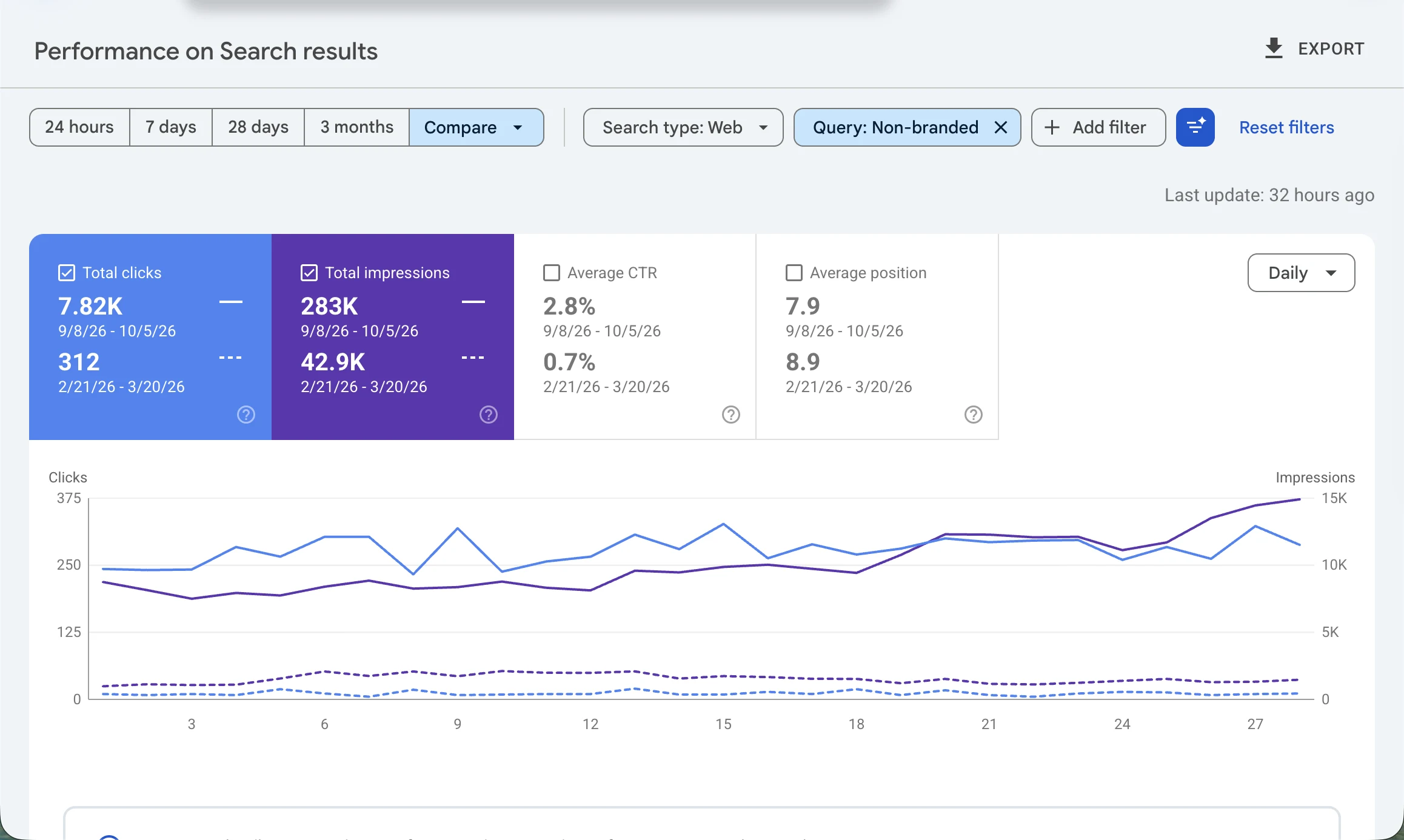
An AI startup in the mental-health space had a strong product but almost no non-brand Google traffic across the US, UK, Canada and Australia. I consulted through February and March, built a six-month SEO and GEO strategy, and handed the roadmap off for execution in late April.
The work covered keyword and content gaps, technical priorities, authority acquisition and AI-citation optimization. Strong growth appeared roughly two months after handoff, close to the lag expected at the start. The result does not prove that one isolated task caused every click. It shows the outcome of the combined system and implementation timeline.
Open the verified case →
07 / AI SEARCH
Buyers ask ChatGPT, Perplexity and Google AI Overviews to shortlist tools, explain differences and recommend products for a use case. SaaS GEO is not a separate content factory. It is an additional discovery layer built on the same crawlable facts, product evidence and external authority.
See AI SEO services →Features, use cases, integrations, limitations and evidence should not exist only behind login screens or client-side application states.
Names, categories, founders, descriptions and product facts stay aligned across owned pages and relevant third-party sources.
Reviews, partnerships, integrations, expert mentions, original research and editorial coverage support product positioning beyond self-description.
08 / MEASUREMENT
Rankings and traffic explain visibility. The business report follows the conversion model and states where attribution becomes incomplete.
Are the correct pages entering the buyer journey?
Does PLG search traffic reach product value?
Does sales-led search create qualified demand?
Is the product present when assistants build the shortlist?
Did the agreed strategy actually reach production?
09 / DELIVERY MODEL
The right model depends on the missing capability. The important question is who owns decisions, implementation and QA after the sales call.
Best when an existing product, content or engineering team needs research, priorities, briefs and senior review without another production department.
Direct access. Focused capacity.Best when the company needs writers, developers, designers, digital PR and multi-market execution running at the same time.
More capacity. More handoffs.Best when organic acquisition is a permanent core channel and the backlog needs full-time cross-functional leadership inside the company.
Deep context. Higher fixed commitment.A senior specialist owns strategy and QA while internal or trusted external teams ship. This keeps expertise close to execution without recreating every role.
Clear ownership is mandatory.10 / AGENCY SELECTION
SaaS companies do not need an agency merely because it publishes more pages. The useful difference between SaaS SEO agencies and general marketing agencies is an operating model that understands software, owns implementation quality and connects search visibility to a product or sales outcome.
The best SaaS SEO agencies can explain the product motion, target market, work shipped and measurable result. Generic SEO wins from an unrelated local or publishing site do not prove the same operating capability.
A right SaaS SEO agency names the strategist, shows who writes briefs, who reviews releases and who speaks with product and engineering. The sales team should not disappear after signature.
Strong SaaS SEO connects technical SEO, SaaS content marketing, commercial pages, digital PR and link building. Content production without product facts or authority rarely changes a competitive shortlist.
A useful SEO partner separates organic traffic from trials, activation, demos, MQLs, SQLs and influenced revenue. The report should state attribution limits instead of presenting every organic session as pipeline.
Ask each SEO agency for SaaS to diagnose one real acquisition constraint before proposing monthly SEO. A specialist should distinguish PLG from enterprise SaaS, explain the priority SaaS keyword and page owner, and show why investing in SEO now is better than creating generic content. This exposes the difference between strategic SEO and a content marketing agency selling the same marketing services to every SaaS business.
11 / SCOPE + TIMING
Cost follows competition, product complexity, authority gap, content needs, markets and implementation ownership. A focused strategy engagement is different from ongoing SaaS SEO services that include content production, digital PR and link building.
See SEO pricing factors →For a team that can execute but needs the demand map, technical diagnosis, content system, AI baseline and priorities.
For product, content and engineering teams that need monthly decisions, briefs, reviews and implementation QA.
For a company that needs pages, technical coordination, authority and measurement managed as one acquisition system.
12 / FAQ
Direct answers about strategy, pages, timing, pipeline measurement, AI search and delivery models.
A SaaS SEO agency helps a software-as-a-service company become discoverable when buyers research a category, problem, use case, integration, comparison or alternative. It combines technical SEO, product and content architecture, commercial pages, authority, internal links and measurement. The program should connect non-brand search visibility to the correct outcome, such as a free trial, product activation, demo request, qualified opportunity or influenced recurring revenue.
SaaS SEO follows a recurring-revenue product and a longer evaluation journey. Buyers compare tools, check integrations, examine alternatives, involve several stakeholders and may use both Google and AI assistants. That changes the page system and the measurement model. General SEO foundations still apply, but the priority shifts toward product-led pages, comparison ecosystems, documentation, technical coordination, trial or demo conversion and pipeline attribution.
A B2B SaaS SEO agency should map demand to the product funnel, audit the technical platform, build or improve high-intent pages, coordinate SEO and content work, and measure the commercial result. The useful difference is not the agency label. It is whether the provider understands PLG and sales-led motions, works with SaaS marketing teams and engineers, can show first-hand evidence, and stays accountable for implementation after the strategy is approved.
Usually, yes. Bottom-of-funnel pages often provide the clearest path from search to a trial or demo because the buyer is comparing categories, tools, alternatives, integrations or use cases. That does not mean informational content is useless. It means the sequence should begin with the product and evaluation gaps that can create pipeline, then expand into broader problem education once commercial destinations and measurement are ready.
The exact system depends on the product, but common SaaS SEO pages include category and solution pages, use cases, features, integrations, alternatives, comparisons, templates, industry pages, pricing support, documentation and original research. A page should exist only when it serves a distinct search intent and product decision. Publishing every keyword variation creates cannibalization and thin pages instead of useful category coverage.
Technical fixes and existing-page improvements can produce early signals within weeks after recrawling, but meaningful non-brand growth usually takes several months. Competitive category and comparison queries may take longer because authority and product recognition compound over time. In the documented AI startup engagement, strategy was developed in February and March, handed off in late April, and strong daily growth appeared roughly two months later. That timing is evidence from one project, not a universal guarantee.
Measurement starts with non-brand impressions, clicks, priority page visibility and index quality, then follows the business model. Product-led companies may track organic trial starts, activation and paid conversion. Sales-led companies may track demo requests, MQLs, SQLs, opportunities, pipeline and closed revenue. AI search adds citations, mentions and referral sessions. Attribution limits are documented so assisted discovery is not presented as guaranteed revenue.
Yes, when buyers use ChatGPT, Perplexity, Gemini or Google AI Overviews to compare software. The GEO and AEO layer improves crawlable product facts, direct answers, entity consistency, external corroboration and visibility measurement. It does not replace technical SEO, useful pages or authority. AI systems need reliable sources, so the same evidence base should support classic rankings and generated recommendations.
Yes. The operating model changes with the motion. Product-led SEO emphasizes templates, use cases, integrations, free tools, self-serve trials and activation. Sales-led SEO emphasizes category education, stakeholder objections, comparison pages, implementation evidence, demos and qualified pipeline. A hybrid product needs both, with separate conversion paths and reporting instead of one blended traffic target.
Choose the right SaaS SEO agency by checking relevant SaaS case studies, senior access, product and technical experience, the content and authority system, implementation ownership and the pipeline scorecard. The best SaaS SEO agencies should explain how their SEO framework changes for your ICP, sales motion and market. Avoid hiring an agency that promises rankings without reviewing the product, analytics, website constraints and the team that must ship the work.
B2B SaaS companies need SEO specialists when product complexity, recurring revenue, long evaluation journeys and cross-functional implementation materially change the work. SaaS SEO requires more than publishing articles: SaaS sites may include documentation, application subdomains, integrations, programmatic pages and several conversion paths. A specialist should help SaaS companies connect each SaaS keyword to the right SaaS product page, buyer stage and business outcome.
A SaaS SEO agency can work across B2B and B2C products only when its strategy changes with the buying model. B2B SaaS clients often require category education, comparison proof, demos and pipeline attribution. B2C products may prioritize high-volume problems, self-serve onboarding and paid conversion. SaaS SEO strategies should reflect those differences instead of forcing every SaaS business into the same content calendar.
Hire a consultant when you need senior diagnosis, prioritization, team guidance or a direct owner working with existing writers and developers. Hire an agency when you need parallel production across content, development, design, digital PR and several markets. A hybrid model is often practical: one senior specialist owns the strategy and QA while internal or external teams execute. Ask who does the work and how recommendations reach production.
START WITH THE ACQUISITION GAP
Send the product, target market, growth motion and the outcome organic search should create. I will identify the first likely constraint and whether an audit, consulting project or managed scope fits.
Cookies, briefly. Essential ones run the site; analytics cookies (Google) only switch on if you say yes. Details in the Privacy Policy.