Connect subject demand to the right course.
Online and offline course businesses need separate paths for topic, age, format, location, schedule and outcome intent. Parents and learners should reach a useful landing page instead of a generic catalog.
COURSES / SCHOOLS / EDTECH / HIGHER EDUCATION
Education SEO services that connect program, course and location demand to qualified inquiries, applications and enrollment across Google and AI search.
01 / DIRECT ANSWER
Education SEO is search engine optimization for organizations that need students, parents, educators or institutional buyers to discover and evaluate a learning offer. It aligns technical access, keyword research, course and program pages, content, local search, authority and conversion measurement with the real decision journey.
Unlike a generic digital marketing plan, the search strategy must distinguish audiences and outcomes. A parent looking for an offline teen course, a student comparing an online certificate, an employer evaluating training and a prospective student researching a university program should not land on the same page.
02 / WHO IT FITS
Education brands share discovery problems, but they do not share one search journey. The architecture follows the offer and target audience rather than forcing every organization into higher education language. This scope can support tertiary education, but the documented case on this page is a course provider, not a claim that I work exclusively on higher education.
Online and offline course businesses need separate paths for topic, age, format, location, schedule and outcome intent. Parents and learners should reach a useful landing page instead of a generic catalog.
School SEO combines program and admissions content with Local SEO, Google Business Profile, reviews, location signals and clear information for families comparing nearby options.
Educational technology companies may sell to students, parents, teachers, districts or employers. The architecture must separate these target audiences and connect product proof to each buying journey.
Higher education SEO focuses on degree, certificate, campus, admissions and student-decision searches. Complex governance and large websites require technical ownership, content standards and measurable inquiry paths.
03 / EDUCATION SEARCH ARCHITECTURE
Search engines rank pages, not internal content plans. Each important query cluster needs one clear owner and a conversion path appropriate to its stage. The aim is to optimize the website so a useful program page can rank higher in organic search results without sending every visitor through the home page.
Understand fit, curriculum, delivery and entry requirements.
Compare relevant programs without scanning the full catalog.
Confirm how and when learning happens.
Find local options, facilities and visit information.
Resolve the objection blocking an inquiry or application.
Help schools, districts or employers evaluate the offer.
04 / EDUCATION SEO SERVICES
The scope is selected after the audit. Every workstream must produce an implemented fix, useful landing page, evidence asset or measurement improvement. Customized SEO should integrate with marketing and enrollment operations instead of becoming a detached keyword report.
Keyword research is grouped by prospective student, parent, educator, employer and institutional buyer intent. Search volume, competition, program fit and enrollment value are assessed together.
The website audit covers crawlability, indexation, JavaScript rendering, canonicals, redirects, sitemaps, metadata, structured data, mobile performance and Core Web Vitals.
Degree, certificate, curriculum, subject, age-group, delivery-format and location landing pages are mapped to distinct decisions. Every important offering gets a clear search destination.
Guides, comparisons, outcomes, admissions answers and research content support commercial pages through a controlled hub-and-spoke system instead of an unstructured blog.
Campus, branch and offline-class discovery combines local landing pages, Google Maps signals, reviews, consistent organization data and useful information for an in-person visit.
Relevant editorial mentions, education communities, partnerships, research, expert contributions and useful resources build authority without buying arbitrary backlink packages.
Direct answers, entity consistency, expert evidence and citation-ready pages help education brands become understandable across Google AI Overviews, ChatGPT and Perplexity.
Google Search Console, analytics, CRM or admissions data connect organic search to inquiry, application, booking, trial and enrollment outcomes while attribution limits stay visible.
05 / FIRST 90 DAYS
Tailored SEO strategies should follow production capacity and enrollment goals. The first quarter establishes the system, applies defensible best practices and reads the first reliable signals. It is strategic SEO with a release cadence, not a promise that every institution shares the same SEO needs.
Map audiences, programs, locations, current rankings and competitors. Audit technical access, AI-crawler access, user experience, commercial trust and measurement before changing the content calendar.
Fix priority constraints and publish or improve course, program, admissions and location pages. Add internal links, structured data, expert review and answer-ready sections.
Review indexation, non-brand visibility, inquiries, applications, AI mentions and content gaps. Strengthen pages that attract qualified demand and revise assumptions that do not convert.
The operating model follows the complete SEO and AI search methodology.
06 / FIRST-HAND EXPERIENCE
An education client selling courses for teenagers needed predictable acquisition beyond brand demand and short paid campaigns. I rebuilt the strategy around course intent, parent-facing questions, local demand, online-program pages, technical cleanup, internal links and conversion-focused landing pages.
The tracked acquisition view moved from low daily sessions in early 2024 to a stable 150-200 sessions/day range in 2025, with repeated peaks above 200. The important evidence is the held baseline after compounding traffic growth, not a one-day spike.
This is one documented education project. It demonstrates relevant SEO expertise, strategy and execution; it is not a traffic or enrollment guarantee.
Open the complete education case →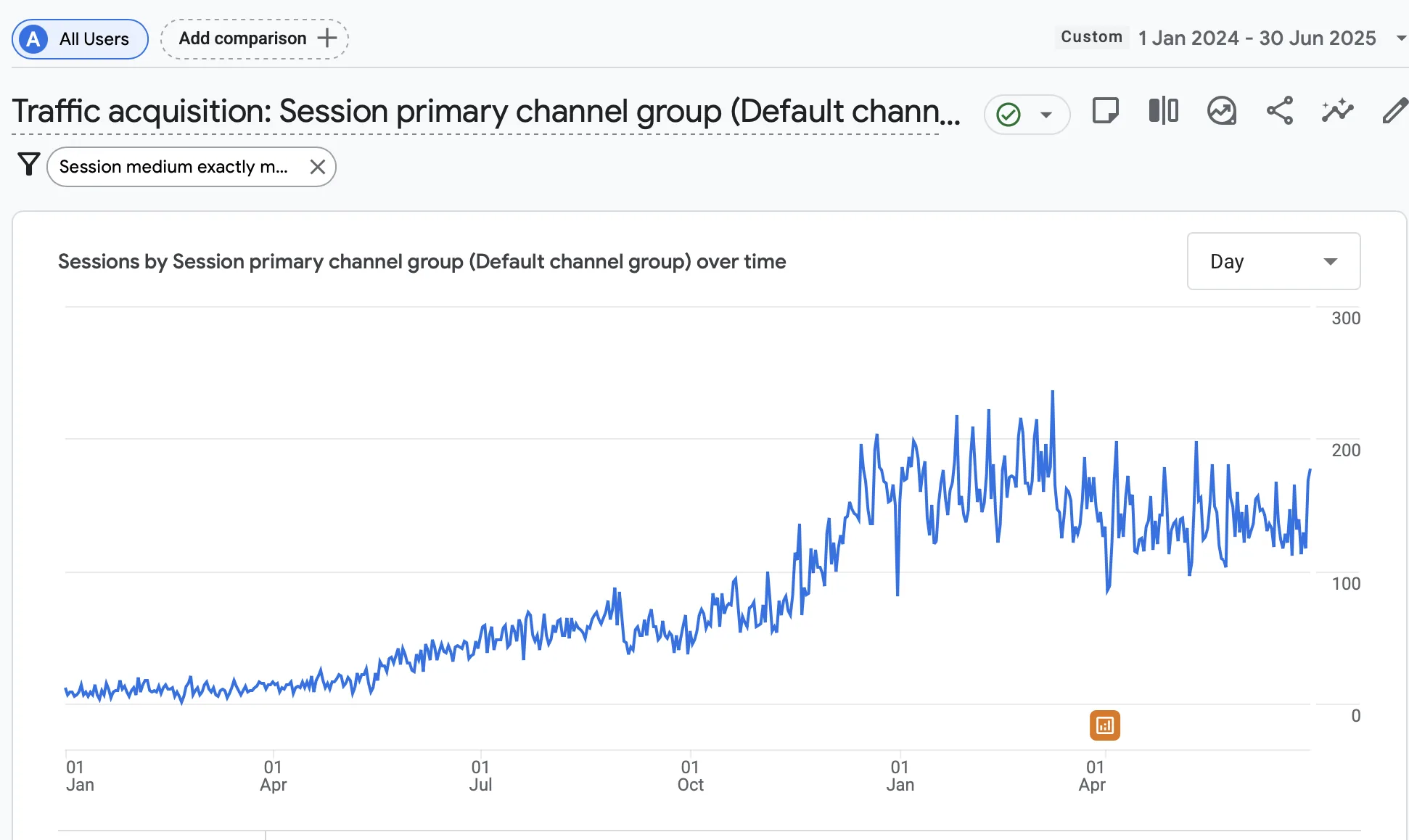
07 / GOOGLE + AI SEARCH
Artificial intelligence can synthesize program, provider and subject information before a user visits a website. GEO extends traditional SEO so the organization remains clear, retrievable and verifiable across search engines and AI platforms. The work can also cover YouTube discovery when video is part of the student research journey.
See Generative Engine Optimization →Course, program, admissions, location and expert information is not trapped inside client-only JavaScript or blocked from relevant crawlers.
Names, relationships, credentials, locations and outcomes use stable language, structured data and corroborating sources.
Self-contained sections explain requirements, formats, audiences, fees and next steps without forcing a model to infer missing knowledge.
Prompt sets, citations, referral sessions and self-reported discovery complement Google Search Console and conversion data.
08 / MEASUREMENT
A useful scorecard connects production to visibility and then to inquiry quality. It also states when CRM or admissions data cannot support a causal claim or a clean return on investment calculation.
Did the planned work reach production?
Are programs entering the right search engine results page and AI answer sets?
Does the audience match the offer?
Should the organization invest, change or stop?
09 / AGENCY SELECTION
Many SEO agencies can produce audits and content calendars. The right SEO partner can explain which education decisions the website must own, what ships first and how the work reaches production. A higher education SEO agency should also understand the unique challenges of a large university website, while an agency for education courses must not import university assumptions into a different business model.
Confirm the named SEO experts, access to senior judgment and who reviews technical, content and education claims.
Request specific releases, owners and acceptance checks instead of a list of recurring activities.
Search rankings and organic traffic should lead to an agreed conversion and enrollment scorecard.
A list of the best SEO agencies is not proof. Avoid guaranteed rankings, unsupported university claims, fixed link quotas and general articles written before demand research.
10 / DELIVERY + PRICING
The engagement model follows the missing capability. An experienced education team may need a technical and strategic consultant; a lean course provider may need strategy plus production. Pricing is scoped after the website, markets, programs, locations and implementation ownership are understood. I do not offer fixed higher education SEO services or services for universities without first confirming the fit.
See SEO pricing factors →Technical, content, architecture, authority, AI visibility and measurement diagnosis with an implementation-ready roadmap.
Weekly priorities, briefs, developer coordination, stakeholder leadership, communication, release QA and performance review.
Coordinated technical optimization, landing pages, content creation, internal linking, authority, community and reporting.
11 / FAQ
Direct answers about scope, enrollment, technical work, local search, AI, timing, pricing and agency selection.
Education SEO is search engine optimization for schools, course providers, educational institutions, EdTech companies, colleges and universities. It improves how their websites are crawled, understood and shown when students, parents, educators or buyers research a program or learning solution. The work combines technical SEO, keyword research, program and course landing pages, content marketing, local search, authority, user experience, conversion tracking and AI-search visibility.
SEO helps educational institutions appear while prospective students and parents are actively comparing programs, formats, locations, fees, outcomes and admission requirements. It can reduce dependence on paid advertising by building useful pages that continue attracting organic traffic after publication. The commercial goal is not ranking alone: the site should turn relevant visibility into inquiries, applications, visits, bookings or enrollments while preserving trust and accurate academic information.
Education SEO supports enrollment by matching high-intent searches to program, course, admissions and location pages that answer the next decision clearly. It improves discovery, removes technical barriers, strengthens trust signals and makes the inquiry or application path easier to complete. Search traffic should then be segmented by non-brand query, program, market and conversion action. SEO can influence enrollment, but the final result also depends on pricing, reputation, admissions operations and program-market fit.
The priority depends on the current constraint, but most education websites need technical auditing, search-intent research, program or course architecture, on-page optimization, internal linking, content strategy, local SEO, structured data, authority building and analytics. Large higher education websites may also need governance for departments and templates. Course businesses often need stronger category, subject, age, format and location pages before they need more blog content.
Landing pages should come first when the website lacks a clear destination for programs, courses, locations or admissions decisions. Blog content is useful when it supports those destinations with research, comparisons, practical answers and expert evidence. Publishing general education articles without a page system can grow low-intent traffic that never reaches an inquiry. The right content strategy assigns every topic a role in the student or buyer journey and a deliberate internal-link path.
Yes. Technical SEO determines whether search engines can crawl, render, index and interpret the pages that represent courses, programs and campuses. Common problems include duplicate program URLs, weak canonicals, slow templates, JavaScript-only content, broken internal links, indexable filters and inconsistent structured data. A comprehensive SEO audit should identify affected URL patterns, explain business impact and turn findings into implementation tickets with owners and acceptance checks.
Local SEO is essential when enrollment depends on campuses, schools, branches or offline classes. It aligns location pages, Google Business Profile, maps, reviews, contact details, service areas and local authority signals. A single generic city mention is not enough. Each real location needs useful information about programs, age groups, schedules, facilities, transport, admissions and how to visit, while duplicate doorway pages and unsupported locations should be avoided.
AI search expands discovery beyond traditional blue links. Students and parents may ask Google AI Overviews, ChatGPT or Perplexity to compare programs, explain requirements or recommend learning options. Education GEO improves the clarity and corroboration of the facts these systems can retrieve: stable organization and program entities, direct answers, expert authorship, structured data and credible third-party mentions. It complements traditional SEO; it does not replace crawlability, useful pages or authority.
Technical releases and improvements to existing pages can affect crawl and ranking signals within weeks, but sustained organic traffic and enrollment impact usually require several months. Timing depends on authority, competition, website condition, program demand, production speed and the admissions cycle. A responsible forecast separates early indicators such as released fixes, indexation and non-brand impressions from later outcomes such as qualified inquiries, applications and enrolled students.
Education SEO pricing depends on website size, program count, locations, markets, technical complexity, competition, content production and implementation ownership. A focused audit or strategy sprint costs differently from ongoing SEO campaigns with writing, development, digital PR and reporting. The proposal should define deliverables, owners, assumptions and measurement. Fixed packages are only useful when the included work matches the institution rather than hiding a generic monthly activity list.
Choose an education SEO agency by checking relevant evidence, the named specialists doing the work, technical implementation depth, research methods, content review, link standards and reporting beyond rankings. Ask how the agency separates student, parent and institutional intent, which pages ship first and how inquiries or enrollment are measured. Avoid guaranteed positions, invented education expertise, fixed backlink quotas and large publishing plans created before the website and audience are audited.
Education SEO performance should be measured in layers. Release metrics confirm that technical fixes and pages reached production. Visibility metrics cover indexation, non-brand impressions, rankings and AI citations. Acquisition metrics include qualified sessions, forms, calls, brochure downloads, applications and bookings. Business metrics can include enrollment, revenue, cost per inquiry and assisted influence when the data supports them. Rankings are useful diagnostics, not the final definition of measurable results.
START WITH THE REAL CONSTRAINT
Send the website, education offer, target audiences, markets, locations and the inquiry or enrollment problem search should help solve. I will identify the first likely constraint and the right engagement shape.
Cookies, briefly. Essential ones run the site; analytics cookies (Google) only switch on if you say yes. Details in the Privacy Policy.