AI answers omit the brand
Competitors are named or cited for commercial questions while your company is absent, misclassified or described with outdated facts.
AI SEARCH + ANSWER-READY CONTENT + VERIFIABLE AUTHORITY
A managed service for brands that need to be understood, cited and chosen across AI search, without abandoning the SEO foundation that makes those answers discoverable.
DIRECT ANSWER
An answer engine optimization service improves the probability that a brand is discovered, understood, verified and used when an AI system creates a direct answer. The program combines prompt research, entity mapping, technical foundations, structured content, markup, authority development and cross-platform measurement. It works across Google AI features, OpenAI search, Perplexity, Gemini, featured snippets and other answer-first experiences.
This work is not a replacement for search engine optimization. Answer engines still need accessible pages, clear internal relationships, credible sources and a trusted digital presence. The difference is the output being measured: SEO measures ranking and clicks, while the answer layer also tracks mentions, references, accuracy and visibility in AI search. The same page must serve a buyer first and remain easy for an information retrieval system to interpret.
01 / WHEN TO INVEST
The right time is when AI answers influence a real research or purchase journey. This service is not useful as a one-query stunt or a replacement for fixing an unindexable website.
Competitors are named or cited for commercial questions while your company is absent, misclassified or described with outdated facts.
Pages rank in traditional search results, but buyers can complete research inside an AI answer without visiting the usual blue links.
Important answers are buried in long introductions, inconsistent terminology, client-side rendering or pages with weak information architecture.
ChatGPT screenshots appear in Slack, but there is no fixed prompt set, competitor baseline, referral segment or conversion attribution.
02 / FULL SERVICE
The program joins research, implementation and reporting. Monitoring alone can show that the brand is absent; it cannot change the website, evidence or third-party sources causing the gap.
Benchmark priority prompts across ChatGPT, Perplexity, Gemini and Google AI features. Record references, mentions, accuracy, competitors and the source pages each system uses.
Connect buyer questions, products, people, locations, proof and related concepts to one controlled page architecture instead of publishing isolated FAQ fragments.
Rewrite priority passages with the direct answer first, explicit entity naming, evidence, useful detail and a next step that still works when the passage is read alone.
Check indexability, server-rendered text, internal links, canonical URLs, crawler access, page experience, semantic HTML and source discoverability.
Implement relevant Organization, Person, Service, Product, Article and breadcrumb markup that matches visible content. Schema clarifies facts; it does not manufacture authority.
Build credible mentions, expert contributions, first-party research and links from sources a buyer might actually use. Off-page agreement helps systems verify important claims.
Test how the same topic behaves across retrieval-based answers, Google AI features, conversational follow-ups, featured snippets and voice-search surfaces.
Track source share, named mentions, source URLs, answer accuracy, AI referrals, assisted conversions and organic performance against a fixed baseline.
03 / HOW ANSWER ENGINES WORK
Different AI models use different retrieval and generation systems, but a durable strategy controls the layers the brand can actually influence.
The page must be crawlable, indexable, linked internally and available as meaningful text. Important facts hidden behind client-side interactions or isolated URLs create an avoidable retrieval problem.
Names, services, locations, people and relationships should stay consistent across the website and credible external profiles. Machine-readable markup supports this conceptual model when it matches the visible page.
First-hand evidence, named authors, customer proof, original research and independent mentions help an AI system compare a claim with other information. Authority cannot be added with markup alone.
A strong section begins with the answer, defines the subject and adds enough context to stand alone. Structured content makes extraction easier without reducing the page to robotic keyword repetition.
04 / SEO + ANSWERS
Unlike traditional SEO reporting, AEO performance cannot be reduced to one average position. AEO focuses on answer use and attribution, but SEO and AEO should share one evidence base instead of running as competing programs.
05 / PLATFORM COVERAGE
There is no single universal AI ranking. Answer engines are tested separately, while the website, entity and authority work remains coordinated.
Indexed, snippet-eligible pages and established SEO fundamentals remain the base. Search Console and Analytics provide part of the performance picture, while prompt observation records the visible source set.
Track: supporting links, query clusters, clicksCommercial and comparison prompts are tested with consistent wording and conditions. I review named brands, cited pages, factual accuracy, follow-up behavior and whether the answer sends a useful referral path.
Track: mentions, references, referrals, assisted leadsSource selection is visible enough to diagnose page and third-party gaps. Testing separates a brand mention from a source link and checks which competitors or publishers repeatedly own the source set.
Track: source share, domains, sentimentCoverage depends on the client audience and market. The prompt set expands only when the platform is relevant, so reporting does not become a large dashboard of channels nobody uses.
Track: presence, accuracy, useful commercial actionsPRACTICAL SCOPE
AEO strategies optimize content, technical access, authority and measurement as one system. Software can expose a gap, but a leading answer engine optimization program still needs people to decide what the brand can prove and how the website should change.
AI search optimization begins with real buyer intent. Pages should directly answer the question, use explicit entities and support each important claim. This AEO optimization improves retrieval in AI-driven search without publishing thin AI-generated summaries.
Voice search optimization and featured snippet work use the same clear definitions, steps and concise facts. These surfaces are not identical to generative answers, but they reward content that answer engines can interpret and use quickly.
AI search engines cannot use a critical passage they cannot access. Rendering, indexing, canonicalization, internal links and page speed remain part of the work, just as they do in enterprise SEO and established SEO services.
Traditional SEO focuses on rankings, while content optimization makes the answer easier to use. The digital marketing agency, SEO and content marketing team, public relations specialists, product experts and analytics owners should share one entity model and one evidence standard.
06 / IMPLEMENTATION
The operating system follows the same logic as a serious SEO strategy: establish the baseline, ship priority work, then measure what changed and reinforce it.
Build the prompt set, competitor and source baseline, entity map, technical review and commercial page architecture. Verify that critical content is present in HTML and accessible to the crawlers relevant to each target surface.
Rebuild priority pages into atomic answer sections, align machine-readable facts with visible facts, strengthen author and methodology signals, and begin targeted authority work around claims worth corroborating.
Retest the controlled prompt set, compare references and sentiment, review AI referral paths and Search Console movement, then reinforce pages and sources showing early retrieval or ranking signals.
07 / FIRST-HAND EVIDENCE
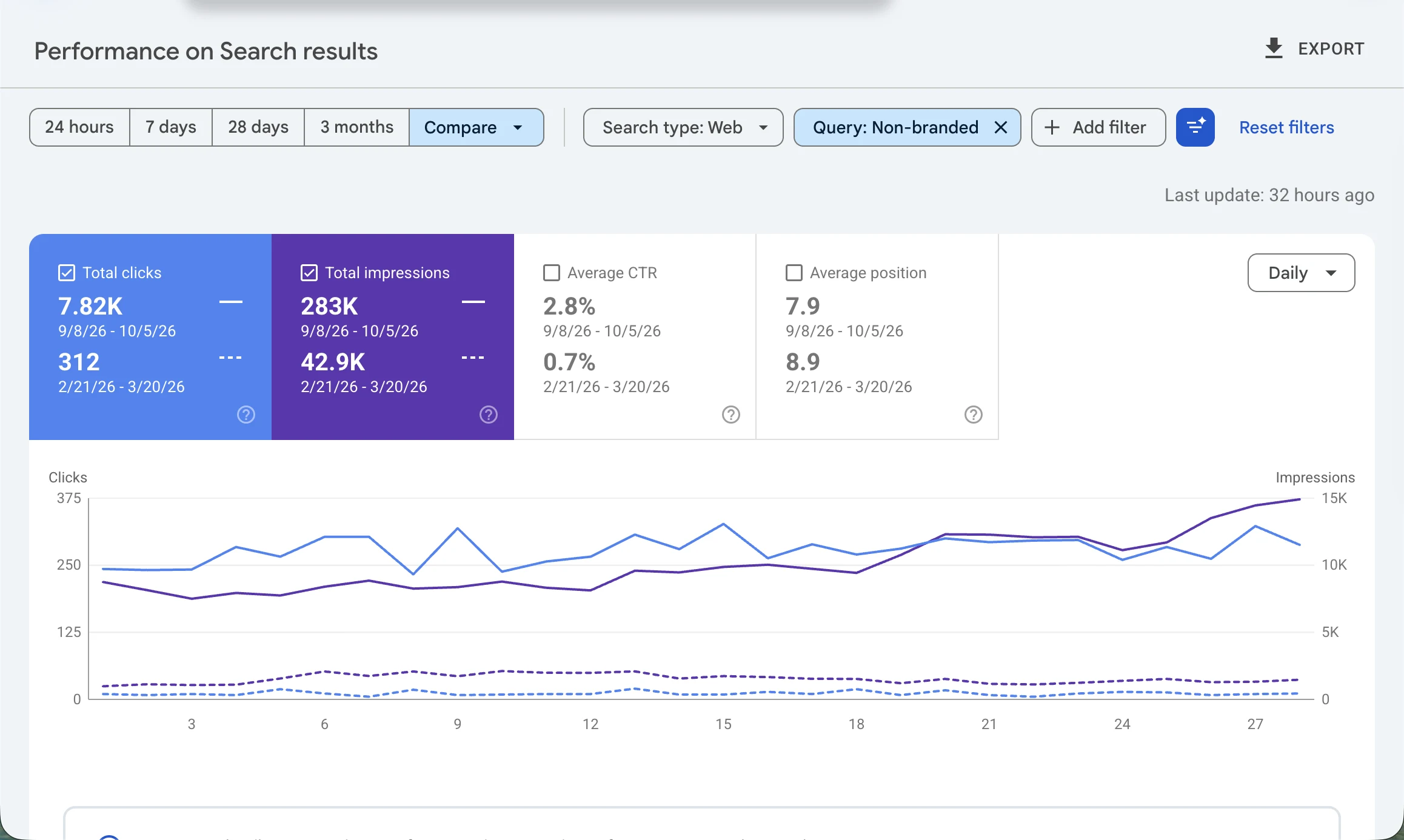
An early-stage AI startup in the mental-health space needed SEO and GEO direction across the US, UK, Canada and Australia. I built the complete strategy and worked with the client team to implement it in full from February through April 2026. Every planned page was created and published during the engagement.
AI STARTUP · YMYL HEALTH
After the completed rollout, manually corrected equal GSC windows moved from 277 to 7,767 clicks and 41,790 to 281,799 impressions.
This is observational evidence of the integrated search program, not proof that one AEO tactic caused every movement or that a model citation is guaranteed.
08 / PERFORMANCE
A useful report records the query conditions and source evidence. It does not turn a volatile answer into a permanent rank.
Named mentions, source URLs, competitor share and answer-surface coverage across the agreed AI platforms.
Accuracy, product fit, sentiment, outdated claims, missing qualifiers and whether the answer uses the intended entity.
AI referral traffic, landing paths, conversions, self-reported attribution and assisted revenue alongside organic results.
09 / ENGAGEMENT MODEL
The right format depends on the team already in place. Scope is defined after the baseline, not sold as a universal monthly package.
I provide the prompt baseline, technical and content audit, entity map, implementation priorities and measurement specification. Your content and development team owns delivery.
Best fit: mature in-house teamsI own the research, answer architecture, briefs, schema specification, authority plan, QA and reporting while coordinating publishing and engineering with your team.
Best fit: end-to-end AEO deliveryI review the organic agency or internal program, test assumptions, establish AI search visibility reporting and join the decisions where specialist experience matters.
Best fit: active SEO retainersPrice depends on prompt volume, markets, pages, competitors, platforms and who implements the work. After the initial review, the proposal states the tracked surfaces, deliverables, ownership, cadence and limitations. I do not sell a generic assistant-ranking package because no company controls the answer engine.
10 / BUYER CHECKLIST
The best answer engine optimization agencies should make their methodology and limits easy to inspect. Lists of top answer engine optimization companies can help build a shortlist, but the operating model matters more than the label. An AEO company should prove its process before you change a current organic contract.
PRIMARY-SOURCE CHECK
Google states that normal SEO fundamentals remain relevant for its AI features, that eligible pages must be indexed and snippet-ready, and that there is no special schema required for inclusion. It also requires structured data to represent visible content. Those constraints are built into this process.
Read Google’s AI features guidance · Read the markup guidelines
11 / FAQ
Visible answers and FAQ schema use the same text. Nothing is added to structured data that a reader cannot inspect here.
START WITH THE BASELINE
Send the website, target market and the questions buyers ask before choosing you. I will review the current search foundation and show whether the next move is AEO, GEO, technical SEO or better evidence.
Cookies, briefly. Essential ones run the site; analytics cookies (Google) only switch on if you say yes. Details in the Privacy Policy.